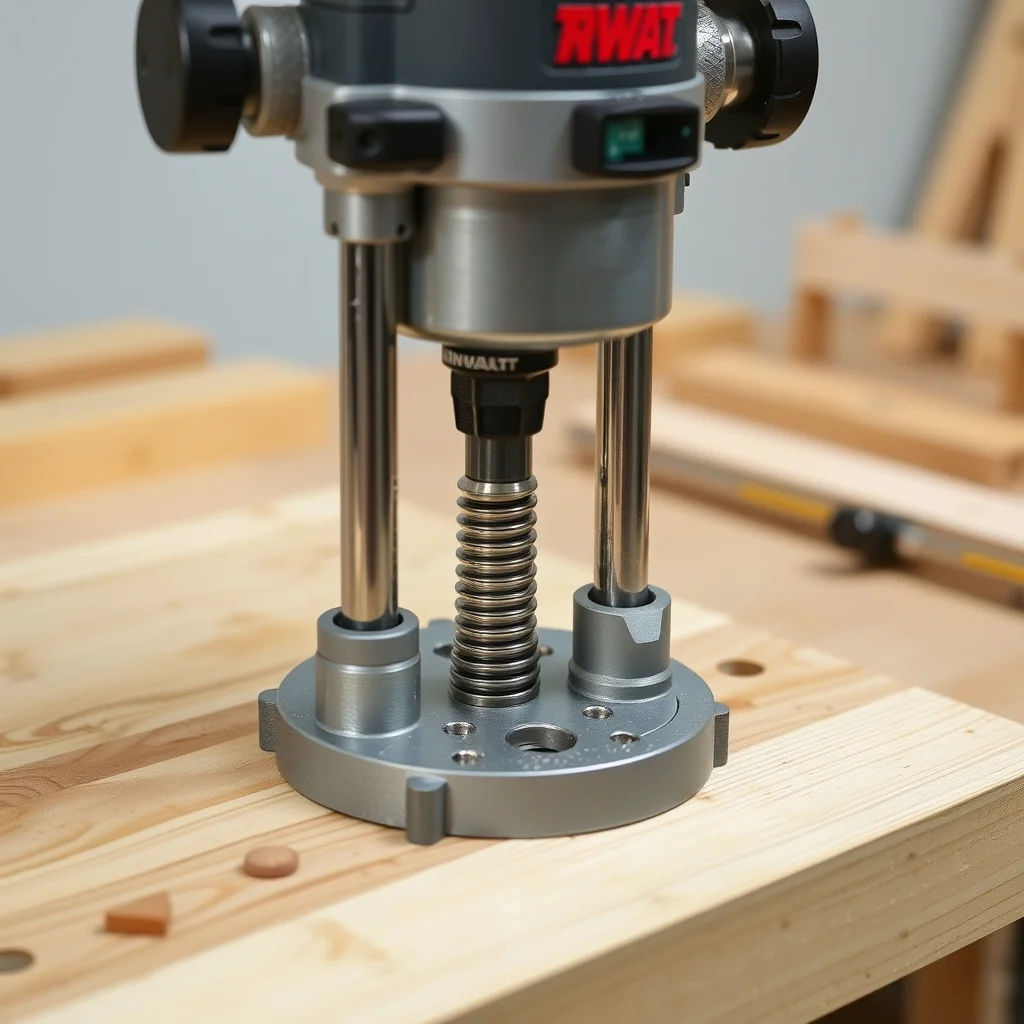
Fixed base vs plunge base: the operational difference
The base type is the most important decision when choosing a router, because it determines which cuts you can make safely.
Fixed-base routers
The motor unit locks at a set height relative to the base. You set the bit depth before starting, and the bit stays at that depth throughout the cut. Fixed bases are more stable on the workpiece, easier to control one-handed, and better suited to router table use (where the base sits in a table opening and the motor hangs below). They're the right choice for edge profiling — roundovers, chamfers, coves, ogees — and for any operation where you're running the router along an edge or guided fence.
Plunge bases
The motor unit slides on two columns and is held up by springs, so you can lower it into a spinning position at any depth during a cut. This lets you start a cut mid-panel without tilting the router in at the edge. Plunge bases are required for mortising, inlay work, and dadoes that don't run to the edge of the workpiece. The trade-off is that plunge bases are less stable than fixed bases for sustained edge-profiling passes, and they're more complex to use one-handed.
Router kits with both bases
Several manufacturers (Bosch, Dewalt, Makita, and others) offer a motor unit that accepts both fixed and plunge bases. The motor snaps into either base type. These kits cost more than a single-base router but less than buying two separate machines, and they're an efficient solution if you do both edge work and mid-panel cuts regularly. On a used market, verify that both bases are present and that the locking mechanisms function correctly.
| Base type | Best for | Table mounting | Mid-panel start |
|---|---|---|---|
| Fixed base | Edge profiling, dadoes, table routing | Yes — stable, easy to adjust | No — must tilt in or start at edge |
| Plunge base | Mortises, inlays, stopped dadoes | Less common, some models support it | Yes — springs lower cleanly |
| Compact/trim | Light edge work, chamfers, laminate | Possible with specific tables | Not typically |
Collet size: ¼ inch vs ½ inch
The collet is the sleeve that clamps the router bit's shank. Routers come with ¼-inch collets, ½-inch collets, or both (via an adapter). This is a fundamental spec that determines which bits you can run.
A ½-inch shank bit is stiffer than a ¼-inch shank bit of the same profile. Under lateral cutting force, the ¼-inch shank deflects more — which shows up as chatter marks in the cut and increased vibration. For large-diameter bits (raised panel bits, large roundover bits, panel raising profiles), a ½-inch shank is effectively required: the cutting forces are too high for a ¼-inch shank to handle cleanly.
For most hobbyists doing edge profiling with small-to-medium bits (roundovers up to ½-inch radius, chamfers, flush trims), a ¼-inch collet is sufficient and the bit selection is enormous. Full-size routers (1.75HP and above) typically include both ¼ and ½-inch collets or include the ½-inch as standard with an optional ¼-inch reducer. Compact trim routers typically have ¼-inch collets only — which limits them to small-diameter bits but is fine for the edge-profiling work they're designed to do.
Shopping for a wood router? Browse current eBay listings → (we earn a small commission; your price is unchanged).
Motor size and variable speed
Router motors are rated in horsepower (HP) or amps. Common sizes:
- Compact routers: 1–1.25HP (7–8A). Single-speed, typically 25,000–35,000 RPM. Adequate for small bits and light profiling.
- Mid-size routers: 1.5–2HP (10–12A). Often include variable speed. Handle the full range of ¼-inch bits and moderate ½-inch bits.
- Full-size routers: 2–3.25HP (12–15A). Variable speed standard at this range. Required for large-diameter bits, production routing, and router-table use with panel-raising profiles.
Variable speed matters because different bit diameters require different surface feet per minute (SFM) at the cutting edge. A large-diameter bit running at 25,000 RPM produces extremely high surface speed — the bit tip moves fast, generates heat, and can burn the wood or damage the bit. The general guideline: large-diameter bits (over 1.5 inches diameter) should run at lower RPM (8,000–16,000 RPM typically), while small-diameter bits can run at high RPM. If you plan to use bits larger than 1 inch in diameter, variable speed is not optional — it's a safety consideration as much as a quality concern.
The compact router case
A compact trim router (Makita RT0701C and its clones, Bosch Colt, and similar) is genuinely underrated for finish woodworking. At 1–1.25HP and weighing 3–4 lb, it's easy to control one-handed on an edge and produces less vibration than a full-size router for light profiling. For most hobbyists who primarily do edge roundovers, chamfers, flush trimming, and light dadoes, a compact router covers 80% of router use and is much easier to handle for hours of work than a 6-lb full-size machine.
The limitation is that compact routers typically accept only ¼-inch shanks and don't have the power or stability for large panel-raising bits or deep mortising. If your work includes furniture-scale mortise-and-tenon or raised-panel cabinet doors, you need a full-size router in addition to (or instead of) a compact.
Router tables: when they justify the space
A router table inverts the router beneath a flat tabletop and adds a fence for guided cuts. This setup changes the router from a hand-held profiling tool into something closer to a shaper — the workpiece moves through the cut rather than the router moving along the workpiece. The advantages:
- More control for long edge passes — two-handed grip on the workpiece, stable fence as a guide
- Ability to run bits too large or heavy to handle safely in a handheld router
- Repeatable setups — the fence locks and doesn't drift between cuts
- Featherboards and stops add workpiece control that's difficult to achieve hand-held
The downside is that a router table requires a full-size router, table space, and setup time. A benchtop router table (combined with a router you already own) is the most space-efficient entry point. Floor-standing tables with cast-iron or phenolic tops are more stable but require dedicated shop real estate.
Common router bit types for new buyers
You don't need a 100-piece bit set. The operations that cover most woodworking use a small set:
- Straight/spiral upcut bit: Dadoes, grooves, mortises. Spiral upcut bits clear chips better than straight bits in deep cuts.
- Roundover bit: The most-used edge profile. 1/8, ¼, and ⅜-inch radii handle most softening and furniture edge needs.
- Flush trim bit: Trims template-routed pieces flush. Bearing rides the template; bit cuts the workpiece. Essential for template routing and laminate trimming.
- Chamfer bit: 45° chamfer on edges. Clean, quick, and professional-looking.
- Rabbeting bit: Creates a stepped shoulder for cabinet backs, drawer bottoms, and joinery. Often comes with interchangeable bearings for different rabbet depths.
 Plunge Routers
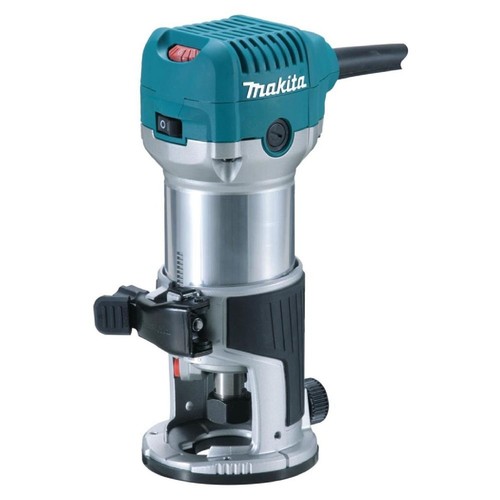 Compact Routers
 Router Tables