Two problems with two names
Hardness. The US Geological Survey (USGS) says water hardness is "generally the amount of dissolved calcium and magnesium in water". It describes the effects you notice: your hands feel slimy after washing with soap, or glasses become "less than crystal clear". It also says "When hard water is heated, such as in a home water heater, solid deposits of calcium carbonate can form." USGS adds: "Hardness is a property of water that is not a health concern, but it can be a nuisance."
Chlorine. We did not read a source on how much chlorine reaches your tap or why. What we read is what a filter maker says it targets. Frizzlife's K45-B page says its cartridge uses KDF-55 and calcium sulfite media "to help reduce free available chlorine" in shower water, and that "it does not remove hardness minerals such as calcium and magnesium, so it is not a water softener". Ask your water utility which disinfectant it uses and how hard the water is. Both are things they can tell you.
How hard is hard?
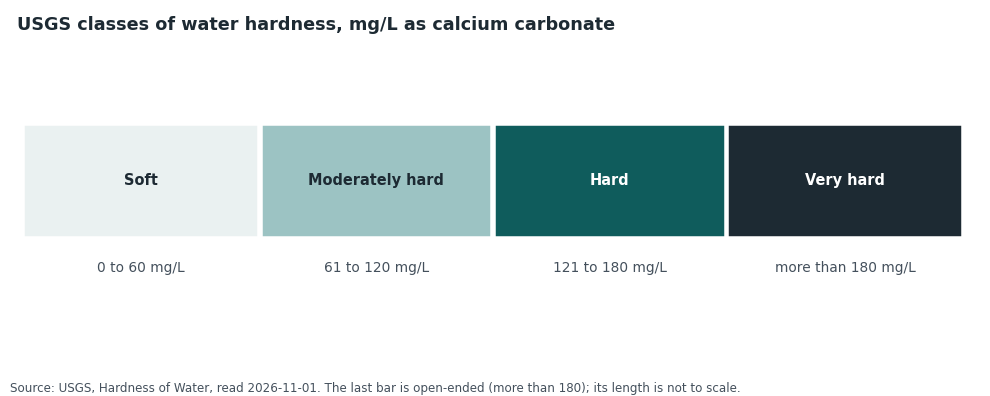
Worked example, our arithmetic from the USGS bands: a utility report that gives 150 mg/L as calcium carbonate falls in the 121 to 180 band, which USGS calls hard. A report of 45 mg/L falls in the 0 to 60 band, which USGS calls soft. If your number is in the soft band, hardness is not what you are seeing, and a softener would not address a chlorine smell.
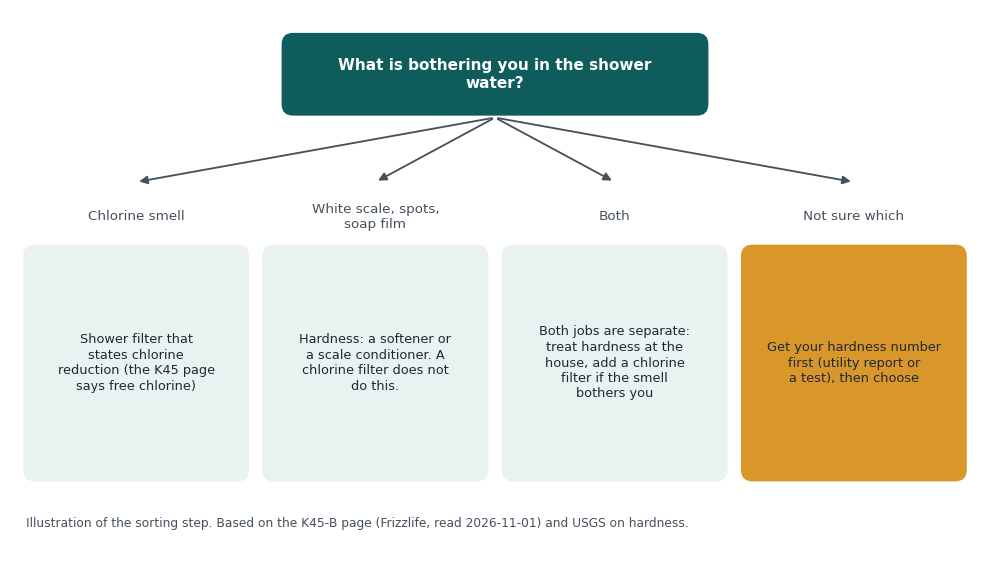
A decision tree
| What you notice | What it points to | What the sources say |
|---|---|---|
| Soap film, spotted glasses, white scale | Hardness | USGS ties these to dissolved calcium and magnesium. The K45-B page says it does not remove them. |
| Chlorine smell in a hot shower | Chlorine | The K45-B page says its cartridge helps reduce free available chlorine. It names no figures for how much. |
| Both | Two jobs | Treat hardness where the water enters or heats; add a chlorine filter if the smell bothers you. See our softener and filter guide. |
| Flaky or itchy scalp | Unknown | We found no source here that ties a shower filter to a scalp condition. Our hair guide reads the labels and the studies. A doctor or dermatologist is the person to ask about the scalp itself. |
What a filter cannot do
- A shower filter that reduces chlorine is not a softener. The K45-B page says so more than once.
- The K45-B page says it is designed for a fixed head plus a handheld hose. It does not describe a version for a single head.
- Frizzlife's pages say nothing about chloramine for the K45-B. If your utility uses chloramine, ask the seller whether the cartridge is claimed for it.
- For how a softener is sized and what it needs, see our softener buying guide. Frizzlife's menu lists no softener, so there is no Frizzlife card for that half.
What the sources do not say
- No source we read gives the chlorine level in your water or says what level a filter should cut it to.
- USGS describes hardness in general. It does not say what a softener or filter does to hair or skin.
- The K45-B page cites testing by SGS to NSF/ANSI 177 and says that is not NSF product certification. Our certification guide explains what to ask.
The cheaper or simpler option
Get the two numbers first. Your water utility can tell you the hardness and the disinfectant, usually at no cost. A test strip also works; our water test guide covers strips and lab kits. If hardness is the problem, a shower filter will not fix it, and the money belongs in a softener or conditioner. If the water is soft and you only smell chlorine, a filter is the right tool. If a new head is what you want, see our showerhead guide.
If chlorine is the problem
Our reason to click: the K45-B page states in its own text what the cartridge reduces and that it does not soften, so you can match it to the problem you measured.
We earn a small commission on qualifying sales, and 90% of it goes to charity (you can pick which); your price is unchanged. Full disclosure.
Sources
- USGS: Hardness of Water, read 2026-11-01.
- Frizzlife K45-B product page and the shower collection, read 2026-11-01. Maker claims.