Step one: know your water hardness
Water hardness is measured in grains per gallon (GPG) or milligrams per liter (mg/L). The conversion is 1 GPG = 17.1 mg/L. Your water hardness is available from two sources:
- Municipal water quality report — US water utilities are required to publish annual consumer confidence reports. Search "[your city] water quality report" to find hardness listed as GPG, mg/L, or PPM (parts per million, equivalent to mg/L for hardness).
- Test strips — Inexpensive (under $15) water hardness test strips give a reasonable field measurement. More accurate: send a sample to a certified water testing lab, especially if you're on a well.
| Hardness range (GPG) | Classification | Softener need |
|---|---|---|
| 0–1 GPG | Soft | None needed |
| 1–7 GPG | Slightly to moderately hard | Optional, depending on tolerance |
| 7–12 GPG | Hard | Softener generally worthwhile |
| 12–17 GPG | Very hard | Softener strongly recommended |
| 17+ GPG | Extremely hard | Salt-based softener likely necessary; salt-free less effective |
The grain capacity sizing formula
A water softener's "grain capacity" is the total number of grains of hardness minerals (calcium and magnesium) it can remove before it needs to regenerate. Regeneration uses salt (brine) to flush the resin bed and restore its ion-exchange capacity.
The sizing formula:
Required capacity = Water hardness (GPG) × Daily household usage (gallons) × Days between regeneration
A practical example: 4-person household in a moderately hard-water area:
- Water hardness: 12 GPG
- Daily usage estimate: 4 people × 75 gallons/person/day = 300 gallons/day (a commonly used estimate; actual usage varies significantly)
- Target regeneration interval: 7 days
- Required capacity: 12 × 300 × 7 = 25,200 grains
A 32,000 grain softener would cover this with reasonable headroom. A 48,000 grain softener would allow longer intervals or handle higher daily usage peaks.
Salt-based vs salt-free: what each actually does
Salt-based ion exchange (traditional softener)
The resin bed inside the mineral tank contains millions of tiny beads with sodium ions attached. As hard water passes through, calcium and magnesium ions displace sodium ions and attach to the resin — the water exits with sodium instead of calcium/magnesium. This is true softening: the minerals are physically removed from the water.
The regeneration cycle reverses this: a saturated brine solution (sodium chloride) washes through the resin, displacing the captured calcium/magnesium, which flushes down the drain. The resin recharges with sodium ions and is ready for the next cycle.
Salt-based systems are the only method that truly softens water (removes hardness minerals). They require a brine tank, a drain connection, and electricity for the control valve.
Salt-free template-assisted crystallization (TAC)
TAC conditioners use polymer media beads that catalyze a phase transformation of calcium and magnesium into microscopic calcite crystals. These crystals stay suspended in the water and pass through pipes without sticking to surfaces.
The distinction: salt-free systems condition water, not soften it. Hardness minerals remain in the water — they just behave differently. Soap will still lather somewhat less than with truly softened water. The benefit is reduced scale buildup on fixtures and in water heaters, without the sodium addition, salt purchase, or drain requirement of a traditional softener.
TAC systems are genuinely effective for scale prevention at moderate hardness levels (typically up to 25 GPG, with some systems rated higher). At very high hardness (17+ GPG), a salt-based softener is generally more reliable.
Shopping for water softeners? Browse current eBay listings → (we earn a small commission; your price is unchanged).
Timer vs metered regeneration
Timer-based regeneration regenerates on a fixed schedule — every 3, 5, or 7 days regardless of how much water was actually used. Simpler mechanically; lower cost. Wastes salt and water when usage is low (vacation, less-occupied house). Uses insufficient regeneration capacity when usage spikes.
Metered (demand-initiated) regeneration uses a flow meter to track actual water usage and triggers regeneration only when the resin capacity is nearly exhausted. This is more salt-efficient, uses less water for regeneration cycles, and adapts to varying household usage patterns. Metered regeneration is the better technology for most households and is standard on quality units. If you see "demand-initiated regeneration" or "DIR" in the specs, that's a metered system.
Iron and other contaminants
Standard water softeners (8% cross-linked resin) handle ferrous iron (clear-water iron, dissolved) reasonably well — typically up to 3–5 PPM iron as a rule of thumb, though manufacturer limits vary. Iron fouling of the resin bed is a concern at higher levels.
For ferric iron (rust particles, red-water iron), you need a sediment filter upstream of the softener. Fine-mesh resin (10% cross-linked) is more durable in iron-heavy water. If your iron level is above ~3 PPM, a dedicated iron filter before the softener is the right approach rather than relying on the softener alone.
Hydrogen sulfide ("rotten egg" smell) is a separate problem that softeners do not address. Manganese (black staining) requires specific treatment. Get a complete water test before investing in any treatment system — knowing exactly what's in the water avoids buying the wrong equipment.
Installation requirements
A salt-based water softener requires:
- Location near the main water entry — installed before the water heater to protect it from scale
- Drain connection — the backwash and brine rinse water must drain somewhere; typically a floor drain, utility sink, or laundry drain. The drain line should not be more than about 8 feet above the softener (creates backpressure on the drain cycle)
- Electrical outlet — control valve requires 120V AC (standard outlet near the installation location)
- Bypass valve — most softeners include one; allows water to pass unsoftened while the softener is being serviced or regenerating
- Space — a typical residential softener system (mineral tank + brine tank) occupies approximately 12" × 48" × 54" total; verify your utility room or basement dimensions
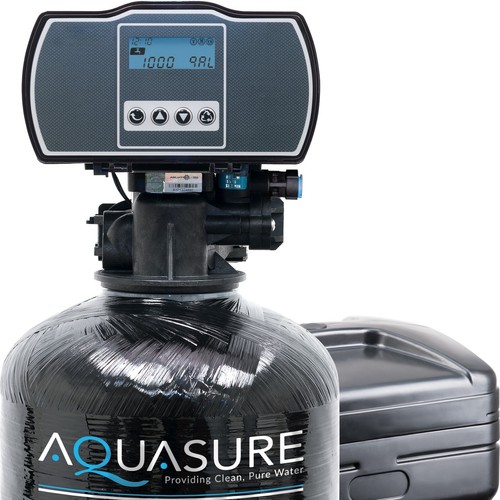 Water Softener System
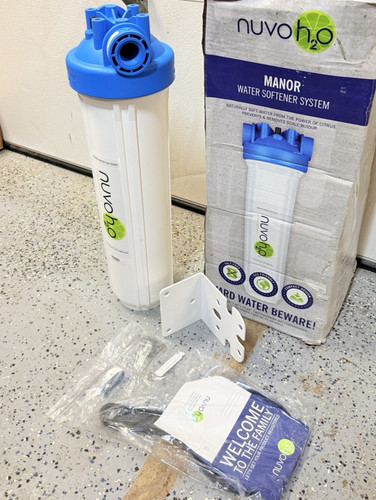 Salt-Free Conditioner
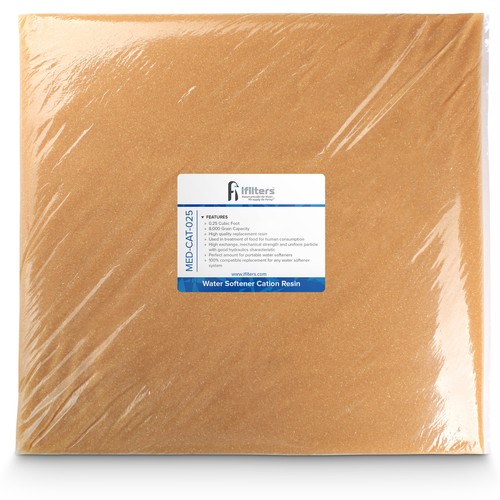 Replacement Resin