What NSF/ANSI 177 covers
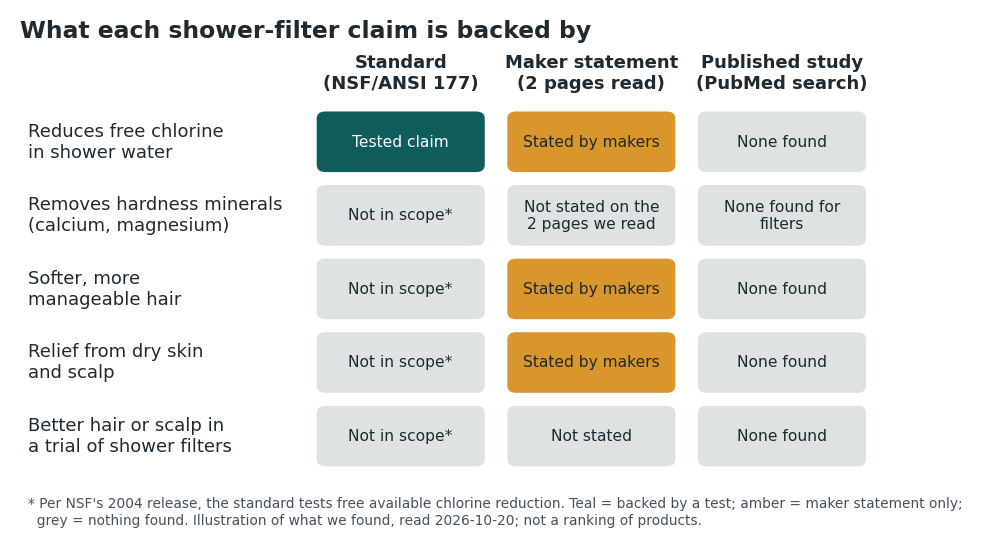
NSF International announced the standard in October 2004. In that release NSF said free available chlorine, which is used to disinfect public or private water supplies, can cause chlorine odors in shower water. The standard lets makers certify devices designed to reduce it, to improve the aesthetic quality of shower water. NSF listed four parts: a materials safety evaluation, structural integrity testing, free available chlorine reduction testing, and product literature requirements. The performance testing is done at elevated temperatures to reflect how shower filters are used.
That is one claim: chlorine reduction. Nothing in the release mentions hardness minerals or hair.
Source note. NSF's own standard pages block automated fetching, so we read NSF's 2004 release as republished by Wastewater Digest (Oct. 12, 2004). We have not read the current edition of the standard, and it may have changed since 2004. Check any filter's certificate in NSF's listings.
What makers say
| Maker page | What it says |
|---|---|
| Aquasana, shower filters page | Headline claim: "Reduce over 90% of chlorine for softer skin and healthier hair." |
| Multipure, Aquashower spec sheet | Says it is tested and certified by the Water Quality Association to NSF/ANSI Standard 177 for reduction of free available chlorine. Its benefit list includes "Softer, more manageable hair" and "Relief from dry skin & scalp", and "Removes 90% or more of free chlorine". |
Read these as the makers' statements. The chlorine number is the kind of thing the standard tests. The hair and scalp lines are the makers' words; in what we read, the standard does not certify them.
What published studies say
We searched PubMed on 2026-10-20. A search is not a systematic review, so a miss does not prove nothing exists.
| Search | Hits | Relevant? |
|---|---|---|
| "shower filter" with hair or scalp | 2 | No. One is about recovering evidence from bath water, one about UV filters in wastewater. |
| "shower head" with filter and hair or skin | 0 | Nothing to read. |
| vitamin C shower filter chlorine skin | 0 | Nothing to read. |
The closest study is on skin, not hair or a filter. Danby and colleagues (J Invest Dermatol, 2018) washed the skin of 80 people with sodium lauryl sulfate in water of different hardness and chlorine levels. Sites washed with hard water had significantly more surfactant left behind, with more water loss through the skin and more irritation, especially in people with atopic dermatitis who carried FLG mutations. The authors report that a clear effect of chlorine was not observed, and that water softening by ion exchange reduced the harm from hard water.
The lab studies on hair itself test hard against soft or distilled water, not filters. They are in our hard water guide.
What a filter cannot do, according to these sources
- The standard, as NSF described it, tests chlorine reduction. It gives no result on minerals, scalp or hair.
- The one study that separated the two found the hardness effect, not a chlorine effect, on skin. A chlorine filter is aimed at the other variable.
- No study we found tests a shower filter as the thing that makes water softer on hair.
What the sources do not say
- Whether any shower filter changes how hair or scalp looks or feels.
- Whether filters that claim to reduce scale or minerals do so, and by how much.
- Whether the current edition of NSF/ANSI 177 differs from the 2004 description.
The honest simpler option
Find your hardness number first. Your water utility may publish it; a test strip gives a rough reading. If the film on your glass and taps is minerals, a chlorine filter is not built for it, and our water softener and whole-house filter guides cover the equipment. If your water just smells of chlorine, a filter with a 177 certificate is aimed at that. If your scalp is itchy or flaky, a filter will not tell you why: see the flaky scalp guide and ask a dermatologist.
More in this hub: the No-Poo Hair Care overview.
Sources
All read on 2026-10-20. Pages and abstracts can change, so check the date shown.
- NSF International release, "New NSF American National Standard Verifies Shower Filtration Product Claims", Oct. 12, 2004, as republished by Wastewater Digest
- Aquasana, shower filters page (maker claim; page changes often)
- Multipure, Aquashower specifications (maker claim; undated)
- Danby SG et al. "The Effect of Water Hardness on Surfactant Deposition after Washing and Subsequent Skin Irritation in Atopic Dermatitis Patients and Healthy Control Subjects." J Invest Dermatol 2018 (PubMed 28927888)
- PubMed search "shower filter" AND (hair OR scalp), run 2026-10-20