Start with what your scalp is telling you
The AAD's dandruff advice says that if home tips do not relieve dandruff, "it is best to make an appointment to see a board-certified dermatologist". Its page on Black hair care says to see a board-certified dermatologist if you notice any changes in the texture or appearance of your hair, and notes that early diagnosis of hair loss leads to more effective treatment. Healthline's no-poo article says anyone with a history of skin or scalp issues should talk to a healthcare provider first.
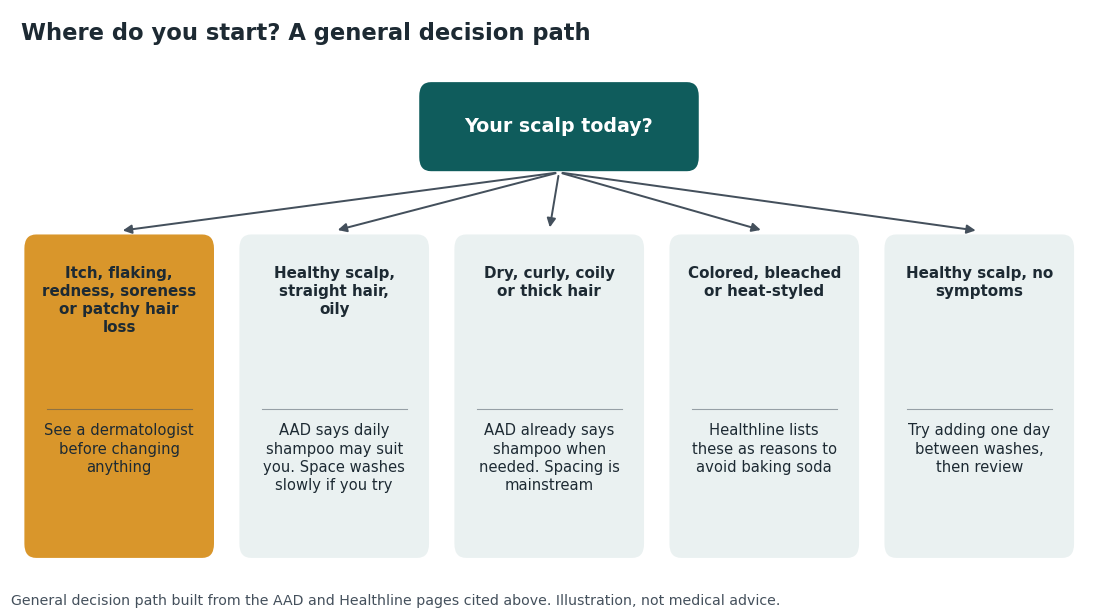
Situation by situation
| Situation | What the sources say | What follows |
|---|---|---|
| Itch, flaking, redness, soreness, patchy loss | AAD: dandruff is not caused by poor hygiene; if home care fails, see a board-certified dermatologist. Flakes can come from not shampooing often enough. | Dermatologist first. Do not use this site to decide. |
| Straight hair, oily scalp | AAD tips: you may want to shampoo every day. | Going shampoo-free runs against that advice. If you want fewer washes, stretch them slowly. |
| Dry, textured, curly or thick hair | AAD: shampoo when needed, at least once every 2 to 3 weeks. AAD curly-hair page: it "doesn't need to be washed daily or even weekly." | You may already wash this rarely. The question is how to cleanse, not whether to skip. |
| Colored, relaxed or heat-styled hair | Healthline lists chemically treated or colored hair, heat styling, dry or brittle hair and sensitive skin as reasons to avoid baking soda. The Cutis review says vinegar rinses on processed or chemically damaged hair may increase fragility. | Skip baking soda. Treat vinegar with caution. |
| You use gels, oils, creams or pomades | AAD curly-hair page: if you use these, try a clarifying shampoo first. The Cutis review says conditioning cleansers are not adequate scalp cleansers for people who wash infrequently or regularly use styling products. | Water and conditioner alone are not described as enough here. |
| You rely on dry shampoo | AAD dermatologists: it absorbs oil and does not clean; wash after one or two dry shampoos. | It is a stopgap, not a replacement. |
| Fine or thin hair | Healthline: may find no-poo harder; suggests gradually extending the time between washes. | Go slowly. |
This guide is written for adults. The AAD publishes a separate shampoo chart for children, and a child with scalp problems should see a pediatrician or dermatologist.
Who it suits, plainly
The sources do not name a group that benefits from going shampoo-free, because there is no trial to name one. What they do support: people with healthy, symptom-free scalps and dry, curly or thick hair can wash less often than daily with AAD guidance behind them. That is "washing less," not "no poo."
What the sources do not say
- None of them gives a test for whether your scalp "can" go without shampoo.
- None gives a safe number of weeks without shampoo.
- The 2018 Cutis review is a review, not a trial, and it is now several years old.
The honest simpler option
If you are curious, change one thing: add a day between washes and use a wide-tooth comb on wet hair, as the AAD advises. Then read our first-month plan. A rinse bottle is only useful if you later choose a rinse; you do not need one to start.
Sources
All read on 2026-10-20. Pages and abstracts can change, so check the date shown.
- AAD, "How to treat dandruff" (news release dated December 12, 2023)
- AAD, "Black hair: Tips for everyday care" (no update date shown)
- American Academy of Dermatology (AAD), "Tips for healthy hair" (page shows last updated 8/12/24)
- AAD, "6 curly hair care tips from dermatologists" (last updated 6/29/22)
- AAD, "Dry shampoo: Dermatologists' tips for getting your best results" (last updated 3/26/24)
- Healthline, "What Is No Poo, How Does It Work, and Should You Try It?" (updated September 18, 2018; medically reviewed September 27, 2017). A consumer health site, not a journal
- Healthline, "Is It Safe to Use Baking Soda on Your Hair?" (updated July 10, 2018). A consumer health site, not a journal
- Cline A, Uwakwe LN, McMichael AJ. "No sulfates, no parabens, and the no-poo method: a new patient perspective on common shampoo ingredients." Cutis 2018;101(1):22-26 (PubMed 29529111; Skin of Color Society collaboration). A dermatology journal review, not a trial