We read the sources below on 2026-10-20. We have not tried or tested any method or product on this site.
What the movement claims
Healthline, a consumer health site, says "no poo" in the broadest sense means no shampoo. It lists the benefits supporters give: a scalp that "produces a balanced amount of oil", more voluminous hair, less exposure to irritating chemicals, and less plastic packaging. The methods it lists are baking soda followed by apple cider vinegar, coconut oil, conditioner only, and water only.
A dermatology review in the journal Cutis (2018) describes the same set: household items such as baking soda and apple cider vinegar, conditioner-only washing, tea tree oil, or rinsing with water. It says supporters believe skipping shampoo leads to healthier hair, retained natural oils, and less exposure to "supposedly dangerous chemicals" such as parabens or sulfates.
What dermatology sources say
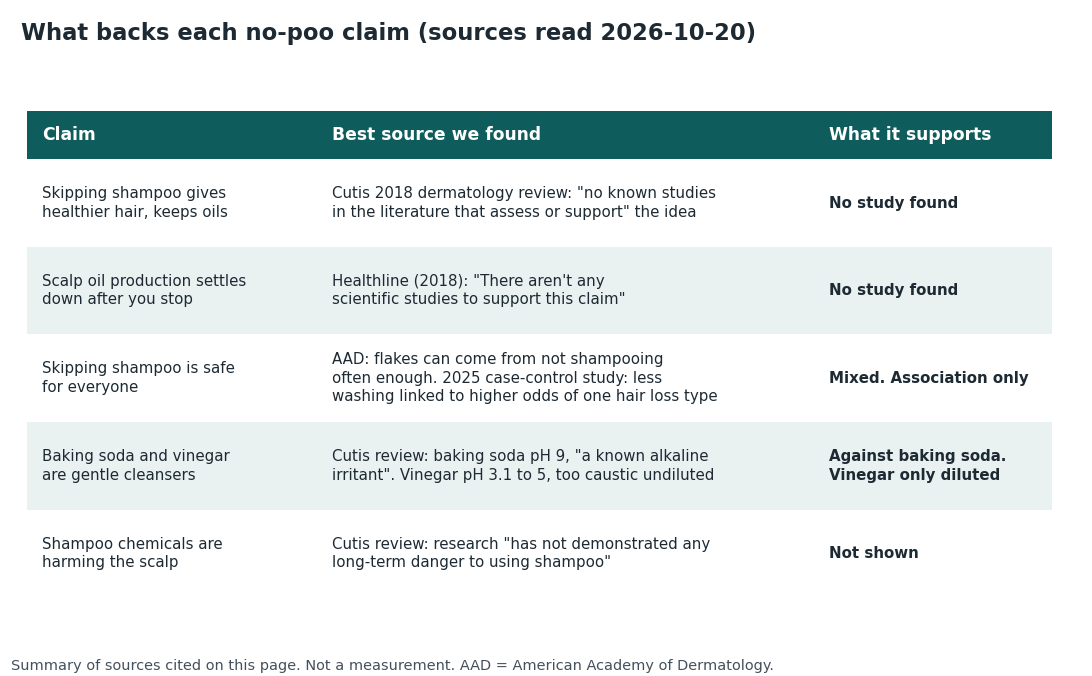
- The AAD does not say to skip shampoo. It says to shampoo to suit your hair. Its tips page says "If you have straight hair and an oily scalp, you may want to shampoo every day", and "If your hair is dry, textured, curly, or thick, shampoo when needed — at least once every 2 to 3 weeks as needed."
- AAD also warns about too little washing. The same page says that if you see flakes, a common reason could be "not shampooing frequently enough". On dry shampoo, AAD dermatologists say it does not clean hair, and that using only dry shampoo and never washing with water may lead to seborrheic dermatitis, an itchy, scaly scalp rash.
- Dandruff is not a hygiene failure. An AAD news release (December 2023) says dandruff is not caused by poor hygiene and quotes a dermatologist: causes "range from oily skin to hair care habits, along with some medical conditions."
- The Cutis review says "there are no known studies in the literature that assess or support the hypotheses of the no-poo method." It also says research has not demonstrated any long-term danger to using shampoo.
The one study that points the other way
A 2025 case-control study in Skin Appendage Disorders compared 115 people with frontal fibrosing alopecia (a form of hair loss) with 112 matched controls. Washing less often was associated with higher odds of the condition: an adjusted odds ratio of 18.7 for washing once a week or less, compared with daily washing. The authors say causality and frequency-dependent effects "remain uncertain." This is one condition, one hospital, and an association, not proof that skipping shampoo causes hair loss. We mention it because the evidence does not all run in one direction.
What the sources do not say
- We searched PubMed on 2026-10-20 for trials of going shampoo-free and for water-only or conditioner-only washing. We found the 2018 Cutis review but no controlled trial of any no-poo method. Newer work may exist that we did not find.
- Healthline says of the idea that the scalp makes less oil over time: "There aren't any scientific studies to support this claim".
- No source we read says how long any adjustment lasts. See our transition guide.
The honest simpler option
You do not need a product to test the idea. Add one day between washes with the shampoo you already own, and watch your scalp. If you have dry, curly or coily hair, you may already be washing about as rarely as the AAD suggests. Our wash-frequency guide lays that out by hair type.
If you want to check the pH of any rinse you mix, test strips give a rough reading. That is all they give.
Sources
All read on 2026-10-20. Pages and abstracts can change, so check the date shown.
- Healthline, "What Is No Poo, How Does It Work, and Should You Try It?" (updated September 18, 2018; medically reviewed September 27, 2017). A consumer health site, not a journal
- Cline A, Uwakwe LN, McMichael AJ. "No sulfates, no parabens, and the no-poo method: a new patient perspective on common shampoo ingredients." Cutis 2018;101(1):22-26 (PubMed 29529111; Skin of Color Society collaboration). A dermatology journal review, not a trial
- American Academy of Dermatology (AAD), "Tips for healthy hair" (page shows last updated 8/12/24)
- AAD, "Dry shampoo: Dermatologists' tips for getting your best results" (last updated 3/26/24)
- AAD, "How to treat dandruff" (news release dated December 12, 2023)
- Ko et al. "Hair Care Habits and Frontal Fibrosing Alopecia: A Case-Control Study." Skin Appendage Disord 2025 (PubMed 41409529)