General information, not medical advice. We are not doctors and we have not tested any product. For an itchy, flaking, sore or red scalp, or hair that is thinning or changing, see a board-certified dermatologist.
Short answer. Healthline says any no-poo method "will take you through an adjustment period where your hair may become oilier than normal" and that supporters see this as the scalp recalibrating. The same article says there are no scientific studies supporting the idea that scalp oil production decreases over time. We found none either. Itching, flaking or burning is a reason to stop and shampoo, not to push through.
What people report
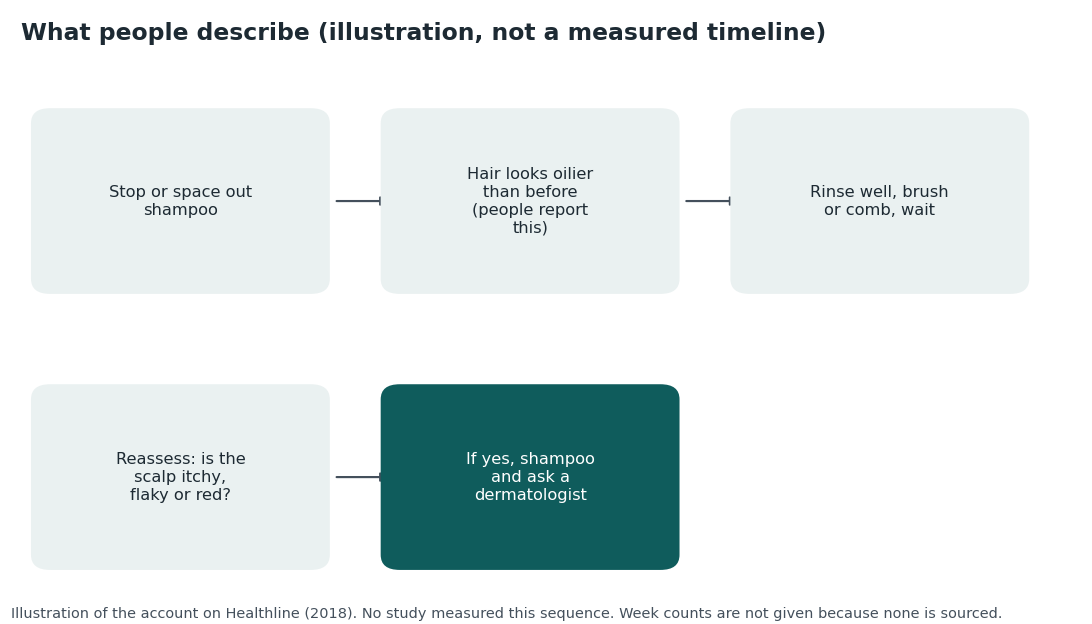
The adjustment period comes from supporters' accounts, as relayed by Healthline. It is not a measured result. Healthline does not give a number of weeks, and we do not either, because we found no source that does. The figure below is an illustration of the sequence people describe, with no dates on it.
What is known
- No study on the transition. The 2018 Cutis review says there are no known studies that assess or support the no-poo hypotheses. Healthline says the same about the idea that oil output falls over time.
- Oily scalps exist, and shampoo is the AAD's answer for them. For straight hair with an oily scalp, the AAD says you may want to shampoo every day.
- Never washing with water is linked to a rash on one AAD page. Dermatologists quoted by the AAD say that using only dry shampoo and never washing with water may lead to seborrheic dermatitis.
If you hit a rough patch
| You notice | What the sources say | What to do |
|---|---|---|
| Hair looks greasy | Healthline: expected, per supporters. AAD: dry shampoo absorbs oil but does not clean; wash after one or two. | Wash with your normal shampoo rather than stretching further. |
| Itching or burning | AAD dry shampoo page: stop using the product if your scalp itches or burns; if irritation persists after a few weeks, see a board-certified dermatologist. | Stop the product or method. Shampoo. |
| Flakes | AAD tips: common reasons include not shampooing frequently enough. AAD dandruff release: if home tips do not help, see a board-certified dermatologist. | Return to regular washing. See a dermatologist if flakes persist. |
| Tangles and frizz | AAD: use a wide-tooth comb on wet hair; do not rub hair dry with a towel; conditioner moisturizes and detangles. | Detangle gently, ends first. |
What the sources do not say
- How long an adjustment lasts, or whether there is one at all.
- Whether the oiliness people see is the scalp recalibrating or simply the absence of cleansing. That is a mechanism claim with no study behind it.
- Whether a boar bristle brush moves oil along the hair as its fans say. One dermatology review says boar bristle brushes spread scalp oils along the hair, but it describes the brush's design and gives no measurement; see our brush guide.
The honest simpler option
You can skip the whole experiment. The cheapest tool in this guide is one extra day between ordinary washes, and a wide-tooth comb is the AAD's tool for wet hair. If a stretch of oily hair bothers you, washing is always available.
Sources
All read on 2026-10-20. Pages and abstracts can change, so check the date shown.
- Healthline, "What Is No Poo, How Does It Work, and Should You Try It?" (updated September 18, 2018; medically reviewed September 27, 2017). A consumer health site, not a journal
- Cline A, Uwakwe LN, McMichael AJ. "No sulfates, no parabens, and the no-poo method: a new patient perspective on common shampoo ingredients." Cutis 2018;101(1):22-26 (PubMed 29529111; Skin of Color Society collaboration). A dermatology journal review, not a trial
- American Academy of Dermatology (AAD), "Tips for healthy hair" (page shows last updated 8/12/24)
- AAD, "Dry shampoo: Dermatologists' tips for getting your best results" (last updated 3/26/24)
- AAD, "How to treat dandruff" (news release dated December 12, 2023)
- AAD, "10 hair care habits that can damage your hair" (no update date shown)
- Williams KN, Lee J, Robles E, Tosti A. "Hairbrushes: A Guide for Dermatologists." Skin Appendage Disord 2025 (PubMed 39911979; full text PMC11793887)
The eBay links on this page are affiliate links. We earn a small commission on qualifying sales, and 90% of it goes to charity (you can pick which); your price is unchanged. Full disclosure.