Brushes: what the review says
Williams et al. wrote "Hairbrushes: A Guide for Dermatologists" in Skin Appendage Disorders (2025). Its points, as we read them:
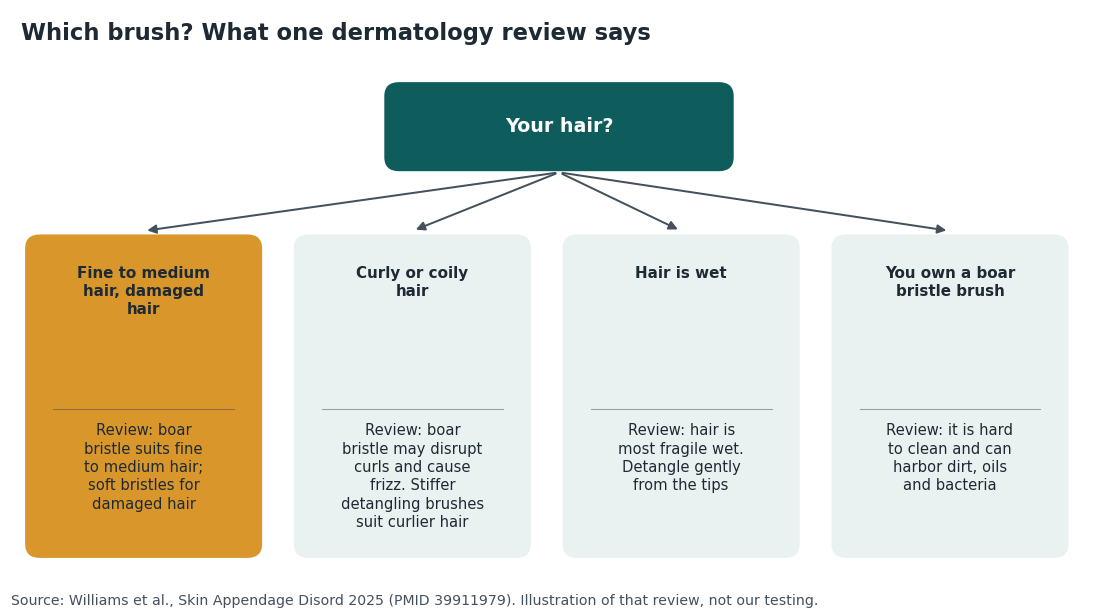
- Boar bristle. The bristles "mimic the composition of human hair". The review says they spread scalp oils along the hair, close the cuticle and may increase scalp blood flow. It says they are best for fine to medium hair and used on dry hair, from the ends toward the roots. It names curly or coily hair as unsuited, because the brush may disrupt curls and cause frizz. For damaged hair it recommends soft bristles.
- Cleaning. The review warns that boar bristle brushes are hard to clean, and that improper cleaning may harbor dirt, oils and bacteria. It gives no cleaning method.
- Detangling brushes. Flexible bristles; stiffer bristles suit curlier hair, more flexible ones suit fine hair. Use them gently.
- Risks. Improper use of hairbrushes can lead to trichomalacia, trichorrhexis nodosa and traction alopecia.
Wet hair: the sources differ a little
The review says wet hair is in its most fragile state and that a detangling brush should be used gently. The AAD goes further: it lists "Brushing your hair while it is wet" among habits that can damage hair, and advises a wide-tooth comb instead of a brush to detangle wet hair. The AAD also says "Hair never needs 100 brush strokes a day. That's a myth" and to brush and comb your hair only to style it. For curly hair the AAD says to avoid brushing dry hair, since that can cause breakage and frizz.
Scalp massage: what was studied
| Study | Design | What it found, and its limits |
|---|---|---|
| Koyama et al., 2016, Eplasty | Nine healthy men; 4 minutes a day for 24 weeks with a massage device; plus lab work on cultured cells. | Mean hair thickness rose from 0.085 to 0.092 mm. Nine people; the abstract describes no comparison group. |
| English & Barazesh, 2019, Dermatol Ther | Online survey of 1,899 people with self-assessed androgenic alopecia who had read about hand massage and watched a demonstration video. 340 (17.9%) completed the survey. | 68.9% of those who tried it reported hair loss stabilization or regrowth, by self-report, with no control group. |
We make no claim that massage grows hair. These studies do not show it. Neither tested the silicone scalp brushes sold as shower tools: the first used a specific device, the second used hand massage. The AAD's own advice is simpler: massage shampoo into your scalp with your fingers.
What the sources do not say
- Any measurement that a boar bristle brush spreads scalp oil in a way that changes hair health.
- How to clean a boar bristle brush.
- That a scalp massager does anything for hair or for a no-poo routine.
The honest simpler option
A wide-tooth comb for wet hair and your fingertips in the shower cover what the AAD advises. If you want a brush for dry hair, the review's conditions are: fine to medium hair, dry, gentle, and kept clean. A silicone massager is a comfort item here, not a proven tool. See our first-month plan for where tools fit.
Sources
All read on 2026-10-20. Pages and abstracts can change, so check the date shown.
- Williams KN, Lee J, Robles E, Tosti A. "Hairbrushes: A Guide for Dermatologists." Skin Appendage Disord 2025 (PubMed 39911979; full text PMC11793887)
- AAD, "10 hair care habits that can damage your hair" (no update date shown)
- American Academy of Dermatology (AAD), "Tips for healthy hair" (page shows last updated 8/12/24)
- AAD, "6 curly hair care tips from dermatologists" (last updated 6/29/22)
- Koyama T et al. "Standardized Scalp Massage Results in Increased Hair Thickness by Inducing Stretching Forces to Dermal Papilla Cells in the Subcutaneous Tissue." Eplasty 2016 (PubMed 26904154)
- English RS, Barazesh JM. "Self-Assessments of Standardized Scalp Massages for Androgenic Alopecia: Survey Results." Dermatol Ther (Heidelb) 2019 (PubMed 30671883)