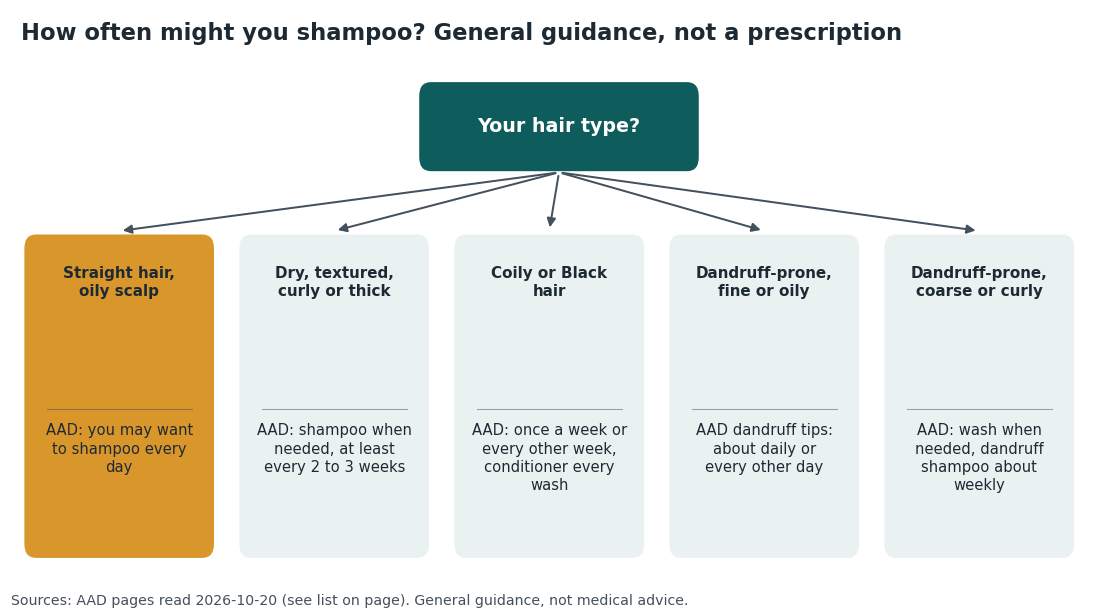
The guidance in a table
| Hair or situation | What the AAD says | Page |
|---|---|---|
| Straight hair, oily scalp | "You may want to shampoo every day." | Tips for healthy hair |
| Dry, textured, curly or thick | "Shampoo when needed — at least once every 2 to 3 weeks as needed." | Tips for healthy hair |
| Curly | "a minimum of every 2 to 3 weeks"; "doesn't need to be washed daily or even weekly." Conditioner on all of the hair. | Curly hair care |
| Black hair | "Wash your hair once a week or every other week." Conditioner "every time you wash your hair". Reason given: this helps prevent product buildup, which can dry hair. | Black hair: everyday care |
| Dandruff, fine, straight or oily | Wash often, about daily or every other day; dandruff shampoo about twice a week. | How to treat dandruff |
| Dandruff, coarse, curly or coily | Wash when needed; dandruff shampoo about once a week, on the scalp only. | How to treat dandruff |
The AAD also says to apply shampoo to the scalp, not the whole length of the hair, and to use conditioner. For fine or straight hair, conditioner goes on the ends; for dry or curly hair, on the full length.
Activity: what the sources say and do not say
The adult pages we read give no rule for sweat or sport. The AAD's page for children aged 8 to 12 does: "active" children who play outdoors, play sports or swim fall in the every-other-day or daily tier; after heavy sweating or swimming it says to rinse and condition the hair. Its children's chart also says that if hair or scalp is too oily, add one shampoo per week until the oiliness stops, and if hair is dull, shedding or dry, remove one per week until those signs stop. That is guidance for children. We use it only as a pattern: change by one step and watch.
Dry shampoo in the count
AAD dermatologists say dry shampoo absorbs oil, does not clean hair, and that you should wash after one or two dry shampoos. Use a small amount where hair is greasy, and stop if your scalp itches or burns.
What the sources do not say
- A frequency for adults who sweat heavily or swim often.
- A frequency for fine, thin or color-treated hair beyond the line that an oily scalp may want a daily shampoo.
- Anything about the effect of washing frequency on hair growth. The one study we found on that is the 2025 frontal fibrosing alopecia association described in our evidence guide.
The honest simpler option
Count how many times you shampoo in a week now, find your row, and move one step toward it. If you are already inside the AAD's range, you do not need a "no poo" method at all. A wide-tooth comb is the only tool you need. Next step: your first-month plan.
Sources
All read on 2026-10-20. Pages and abstracts can change, so check the date shown.
- American Academy of Dermatology (AAD), "Tips for healthy hair" (page shows last updated 8/12/24)
- AAD, "6 curly hair care tips from dermatologists" (last updated 6/29/22)
- AAD, "Black hair: Tips for everyday care" (no update date shown)
- AAD, "How to treat dandruff" (news release dated December 12, 2023)
- AAD, "Dry shampoo: Dermatologists' tips for getting your best results" (last updated 3/26/24)
- AAD, "How often do children need to wash their hair?" (last updated 11/14/23)
- Ko et al. "Hair Care Habits and Frontal Fibrosing Alopecia: A Case-Control Study." Skin Appendage Disord 2025 (PubMed 41409529)