The four methods
| Method | What the sources say | Main risk they name |
|---|---|---|
| Water only | Healthline: the cheapest and chemical-free, but hair may not feel as clean. Tap water is not neutral: Lambers et al. measured that European tap water, with a pH around 8.0, raised forearm skin pH for up to 6 hours before it returned to its usual value. | May not remove oil or styling product. The pH effect was measured on skin, not the scalp. |
| Co-wash (conditioner only) | The Cutis review says co-washing "is not harmful to the hair" but is "inappropriate" as a replacement for shampooing, because conditioners are made to add substances, not to remove dirt and buildup. Healthline: less likely to disrupt scalp pH, but may weigh hair down. | Buildup. The review says conditioning cleansers are not adequate for people who wash infrequently or use styling products. |
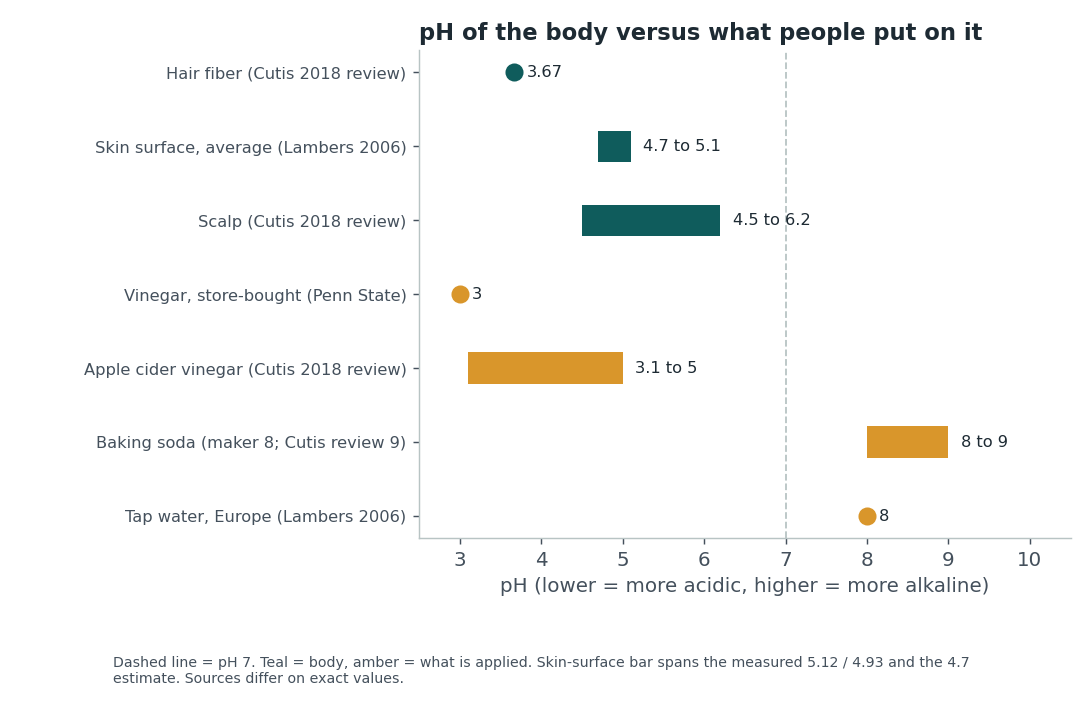
| Baking soda | Cutis review: pH 9; it causes the cuticle layer to open and is "a known alkaline irritant"; it lowers elasticity and increases friction, cuticle damage and breakage. Healthline: abrasive; repeated use causes dryness. The maker, Arm & Hammer, states baking soda has a pH of 8. | Dryness, irritation, breakage. |
| Vinegar rinse | Cutis review: apple cider vinegar has a pH from 3.1 to 5; undiluted it may be too caustic for the hair and can irritate eyes and inflamed skin; on processed or chemically damaged hair it may increase fragility. Penn State Extension: store-bought vinegar is standardized to at least 5% acetic acid, about pH 3. | Irritation if too strong. Fragility on damaged hair. |
The baking soda figure differs by source: the maker says 8, the Cutis review and Healthline say 9. Both are above neutral, and the chart shows the range.
Does a vinegar rinse irritate? One related study
Luu et al. (2019) had 22 people (11 with atopic dermatitis, 11 healthy) soak forearms for 10 minutes a day for 14 days, one arm in dilute apple cider vinegar (0.5% acetic acid) and one in water. The vinegar did not improve skin barrier measures, and 16 of 22 (72.7%) reported mild side effects that improved after stopping. This was forearm skin, not scalp, in a pilot with 22 people. It says nothing certain about a rinse on your head, but it shows that even dilute vinegar irritated most of those people.
Why pH comes up at all
Gavazzoni Dias et al. (2014) write that alkaline pH may increase the negative electrical charge of the hair fiber surface and so increase friction between fibers, which may lead to cuticle damage and breakage. They also say there is no standardized final pH for shampoo and that studies are needed to establish the best pH range for scalp and hair. The pH argument is reasonable, but nobody has shown how much any of it matters for ordinary hair.
What the sources do not say
- A safe dilution ratio for baking soda or vinegar. The Cutis review says to dilute but gives no ratio, and we will not invent one.
- Whether any method keeps hair or scalp healthier over months.
- How tap water pH affects the scalp. Lambers et al. measured European tap water on forearm skin.
The honest simpler option
The mildest option in the table costs nothing: a thorough water rinse between ordinary shampoo days. If you try a vinegar rinse anyway, the review's point is dilution, and the skin study's point is that even a weak solution irritated most people. Skip baking soda. For a first month that avoids all of this, see the first-month plan.
Sources
All read on 2026-10-20. Pages and abstracts can change, so check the date shown.
- Cline A, Uwakwe LN, McMichael AJ. "No sulfates, no parabens, and the no-poo method: a new patient perspective on common shampoo ingredients." Cutis 2018;101(1):22-26 (PubMed 29529111; Skin of Color Society collaboration). A dermatology journal review, not a trial
- Healthline, "What Is No Poo, How Does It Work, and Should You Try It?" (updated September 18, 2018; medically reviewed September 27, 2017). A consumer health site, not a journal
- Healthline, "Is It Safe to Use Baking Soda on Your Hair?" (updated July 10, 2018). A consumer health site, not a journal
- Lambers H et al. "Natural skin surface pH is on average below 5, which is beneficial for its resident flora." Int J Cosmet Sci 2006 (PubMed 18489300). Measurements on forearm skin, not scalp
- Luu LA et al. "Apple cider vinegar soaks [0.5%] as a treatment for atopic dermatitis do not improve skin barrier integrity." Pediatr Dermatol 2019 (PubMed 31328306). Pilot study, forearm skin
- Gavazzoni Dias MF et al. "The shampoo pH can affect the hair: myth or reality?" Int J Trichology 2014 (PubMed 25210332)
- Penn State Extension, "Canning and Freezing Questions and Answers" (updated April 5, 2026), for the pH of store-bought vinegar
- Arm & Hammer (Church & Dwight), pool maintenance article, for the maker's statement of baking soda pH. A maker statement