Soap or syndet?
The U.S. FDA says "Ordinary soap is made by combining fats or oils and an alkali, such as lye." Under its regulatory definition, soap must be composed mainly of the alkali salts of fatty acids. If a product contains synthetic detergents, FDA classifies it as a cosmetic, not a soap, though the label may still use the word "soap". FDA adds that most body cleansers, both liquid and solid, are synthetic detergent products. A bar sold for hair may fall on either side of that line, and the label will not always say which.
What studies measured
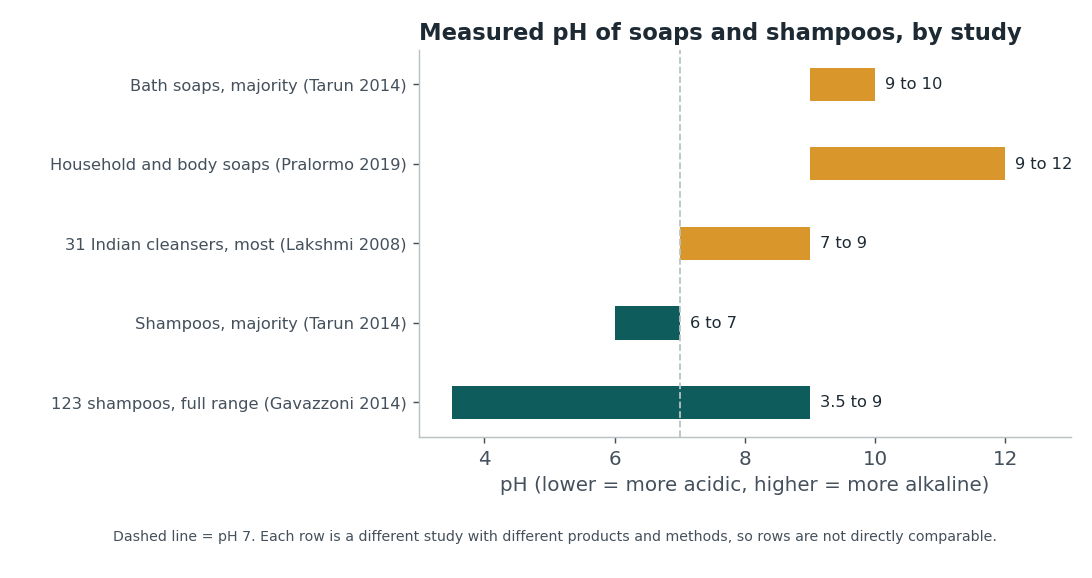
| Study | What was measured | Result |
|---|---|---|
| Tarun et al., 2014 | pH of bathing soaps and shampoos from local shops, as solutions. | Majority of soaps pH 9 to 10; majority of shampoos pH 6 to 7. The authors note most do not disclose their pH. |
| Gavazzoni Dias et al., 2014 | pH of 123 shampoos of international brands. | Range 3.5 to 9.0. 38.21% had a pH of 5.5 or below. All of the children's shampoos had a pH above 5.5. |
| Lakshmi et al., 2008 | 31 cleansers (28 bar soaps, 3 liquid) in a 24-hour patch test, with pH of each solution. | Most were pH 7 to 9. Four tested acidic (pH 5 to 6): one bar soap and three liquid or body-wash products. Irritancy varied widely between products and between volunteers. |
| De Pralormo et al., 2019 | A poison-centre study of swallowed bar soap. | The abstract states that most household and body soaps have an alkaline pH of 9 to 12 and irritate the skin. |
Why the pH matters, and how far it goes
- Lambers et al. (2006) found skin with a pH below 5.0 was in better condition on barrier, moisture and scaling measures than skin above 5.0, and that using soap, and even tap water, raised skin pH temporarily. That is forearm skin.
- Gavazzoni Dias et al. (2014) say alkaline pH may raise friction between hair fibers and may lead to cuticle damage and breakage, and that studies are needed to find the best pH for scalp and hair. They do not claim to have settled it.
- The Cutis review says shampoos should not exceed pH 5.5, and notes that one study found 82% of shampoos already have an acidic pH.
Soap in hard water forms soap scum, per USGS; we found no study of what that does to hair. See the hard water guide.
What the sources do not say
- The pH of any specific shampoo bar. We did not find a study that tested shampoo bars as a group.
- Whether a bar is better or worse for scalp or hair than a liquid. A bar can be good for another reason: Healthline lists less plastic packaging as a reason people go no-poo.
- A pH "right" for your hair. Gavazzoni Dias et al. say there is no standardized value.
The honest simpler option
The shampoo already in your shower is the cheapest test. Use it less often (see the frequency guide) before you buy a different format. If you do buy a bar, a maker that states its pH and lists ingredients is giving you something a "natural" label does not.
Sources
All read on 2026-10-20. Pages and abstracts can change, so check the date shown.
- U.S. FDA, "Frequently Asked Questions on Soap" (content current as of 08/20/2024)
- Tarun J et al. "Evaluation of pH of bathing soaps and shampoos for skin and hair care." Indian J Dermatol 2014 (PubMed 25284846)
- Gavazzoni Dias MF et al. "The shampoo pH can affect the hair: myth or reality?" Int J Trichology 2014 (PubMed 25210332)
- Lakshmi C et al. "Irritancy ranking of 31 cleansers in the Indian market in a 24-h patch test." Int J Cosmet Sci 2008 (PubMed 18713074)
- De Pralormo A et al. "Ingestion of bar soap may produce serious injury: clinical effects and risk factors." Clin Toxicol 2019 (PubMed 30307335). A poison-centre study; used here only for its soap pH statement
- Lambers H et al. "Natural skin surface pH is on average below 5, which is beneficial for its resident flora." Int J Cosmet Sci 2006 (PubMed 18489300). Measurements on forearm skin, not scalp
- Cline A, Uwakwe LN, McMichael AJ. "No sulfates, no parabens, and the no-poo method: a new patient perspective on common shampoo ingredients." Cutis 2018;101(1):22-26 (PubMed 29529111; Skin of Color Society collaboration). A dermatology journal review, not a trial
- U.S. Geological Survey, "Hardness of water" (page dated August 24, 2026)
- Healthline, "What Is No Poo, How Does It Work, and Should You Try It?" (updated September 18, 2018; medically reviewed September 27, 2017). A consumer health site, not a journal