What "hard" means
The U.S. Geological Survey classifies water hardness in mg/L as calcium carbonate: 0 to 60 is soft, 61 to 120 moderately hard, 121 to 180 hard, and more than 180 very hard. USGS also notes that in hard water, soap reacts with calcium to form "soap scum", and that more soap or detergent is needed to get things clean. Your water utility may publish a hardness figure for your area; a test strip gives a rough reading at home.
The four studies
| Study | What was done | What it found |
|---|---|---|
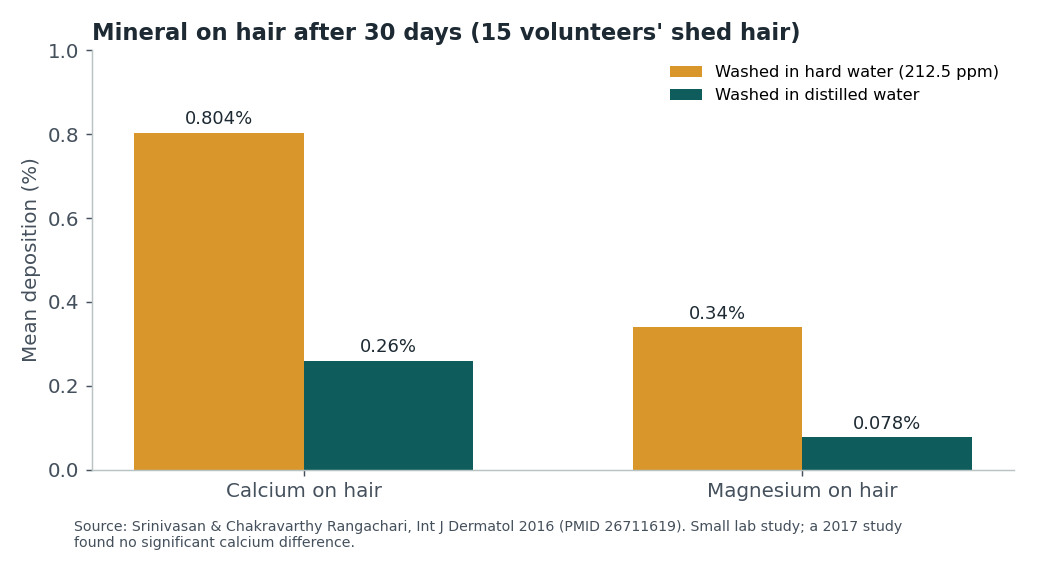
| Srinivasan & Chakravarthy Rangachari, 2016 | Shed hair from 15 healthy women, half washed in hard water (212.5 ppm CaCO3), half in distilled water, 10 minutes on alternate days for 30 days; viewed under a scanning electron microscope. | Mean calcium on hair 0.804% vs 0.26%, magnesium 0.34% vs 0.078%. Hard-water hair had a "ruffled" surface and a mean thickness of 72.78 vs 78.14 micrometres. |
| Alahmmed et al., 2017 | Hair from 20 healthy volunteers, hard water for 3 weeks vs soft water, scanning electron microscope. | No statistically significant difference in surface changes or in calcium (P = 0.28). Magnesium was higher in the hard-water group (P = 0.001). The authors say deposits do not necessarily mean visible surface changes. |
| Evans, Marsh & Wickett, 2011 (J Cosmet Sci) | Measured how much hardness metal hair takes up under different conditions. | Hair condition mattered most. Water hardness had only a small effect: hair became saturated with notable amounts of these metals even after repeated exposure to soft water. Higher pH increased uptake. |
| Evans, Marsh & Wickett, 2011 (Int J Cosmet Sci) | Tested mechanical properties of virgin and bleached hair by calcium and magnesium content. | Hardness metals stiffened fibres and reduced combing forces. Style retention of virgin hair improved; that of bleached hair was slightly reduced. |
What this means for no-poo
Hard water is a different question from shampoo, but it comes up because people who wash with water alone, or use soap-based cleansers, are exposed to the water directly. The studies do not test water-only washing. The two microscope studies are small and were done in the lab on hair samples, not on anyone's daily routine. Treat them as a reason to check your hardness, not as a diagnosis for hair that feels coated.
What the sources do not say
- Whether shower filters change mineral buildup or how hair looks or feels. Listings make their own claims; read them as the seller's claims.
- Whether hard water causes breakage in daily use. The two scanning-microscope studies disagree.
- Whether soap-based shampoo bars form scum on hair. USGS describes soap scum in general, not on hair.
The honest simpler option
Find your hardness number first, from your water utility if it publishes one, or from a home test strip. If it is soft, a filter has little to work on for minerals. If it is hard, equipment is a bigger decision than hair: our guides to water softeners and whole-house water filters cover the equipment, not hair outcomes.
Sources
All read on 2026-10-20. Pages and abstracts can change, so check the date shown.
- U.S. Geological Survey, "Hardness of water" (page dated August 24, 2026)
- Srinivasan S, Chakravarthy Rangachari. "Scanning electron microscopy of hair treated in hard water." Int J Dermatol 2016 (PubMed 26711619)
- Alahmmed A et al. "Scanning electron microscopy study of hair shaft changes related to hardness of water." Indian J Dermatol Venereol Leprol 2017 (PubMed 28799530)
- Evans R, Marsh J, Wickett R. "The uptake of water hardness metals by human hair." J Cosmet Sci 2011 (PubMed 21982353)
- Evans R, Marsh J, Wickett R. "The structural implications of water hardness metal uptake by human hair." Int J Cosmet Sci 2011 (PubMed 21923661)