What the AAD says dandruff is
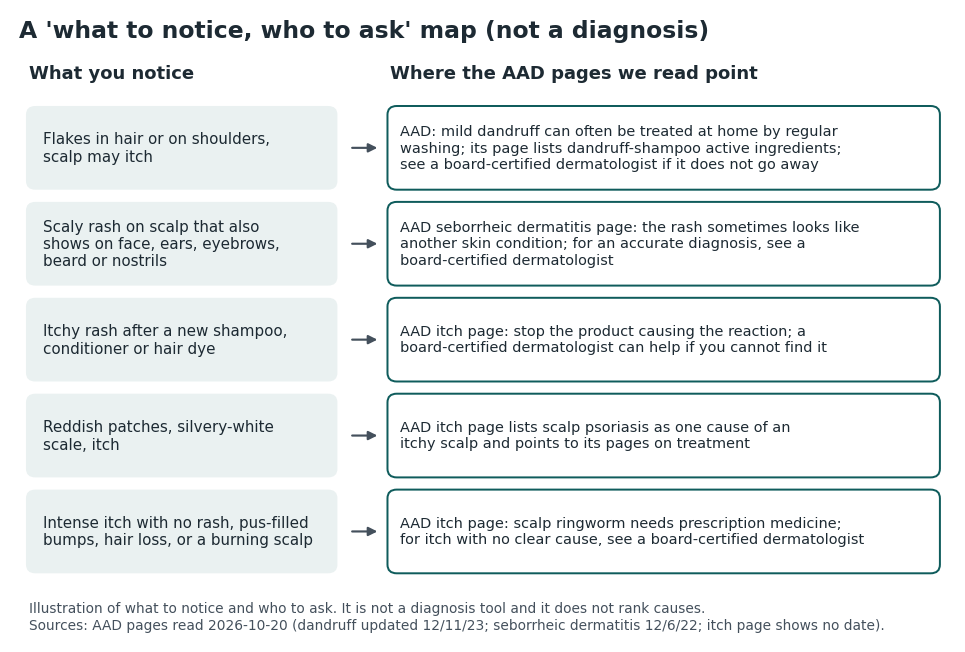
The AAD defines dandruff as "a common scalp condition in which small pieces of dry skin flake off of the scalp". It says dandruff may make the scalp itch, and that it can develop for several reasons, including some medical conditions, hair care habits, or oily skin. Mild dandruff can usually be treated at home by regular washing. If that does not help, the AAD page lists shampoo ingredients to look for: zinc pyrithione, salicylic acid, sulfur, selenium sulfide, ketoconazole and coal tar. For most people, it says, dandruff does not need medical attention; if it does not go away, or is severe, it says to partner with a board-certified dermatologist.
The AAD also says a dermatologist knows whether dandruff is a sign of a medical condition such as seborrheic dermatitis, psoriasis, fungal infections of the scalp, or eczema. That is the reason this page does not try to tell you which one you have.
What else the AAD lists for a flaky or itchy scalp
| Possible cause | What the AAD page says |
|---|---|
| Dandruff | Itchy, dry scalp with flakes on hair or clothing. Dandruff shampoo and scalp treatments can help. |
| Seborrheic dermatitis | A scaly rash on oily areas such as the scalp and face. The AAD says dandruff may be considered its mildest form. The scale can be dry or greasy and itchy. Unlike dandruff, it can appear on ears, eyebrows, beard or skin around the nostrils, and it causes inflammation. The AAD says it sometimes looks like another skin condition, so an accurate diagnosis needs a board-certified dermatologist. It may go away without treatment or flare up for life, often in winter and early spring. |
| Reaction to a hair product | The AAD says an itchy, dry, flaky scalp could mean you need to do a better job of rinsing shampoo out, because leftover shampoo can irritate. An itchy rash can be allergic contact dermatitis, common among people who dye their hair; the fix is to stop the product causing it. |
| Scalp psoriasis | About 50% of people with plaque psoriasis have a scalp flare at some point. Reddish patches, dandruff-like flaking, silvery-white scale. |
| Atopic dermatitis (eczema) | Redness and scale on the scalp; often itchy; some people say it burns. The AAD says see a board-certified dermatologist for a plan. |
| Scalp ringworm | A fungal infection with a red, intensely itchy rash. The AAD says treatment needs prescription medicine, so you need a doctor. |
Dry scalp, or product buildup?
The AAD pages we read do not treat "dry scalp" as its own condition. Its itch page says a dry, itchy scalp with flakes may be dandruff. Beyond that, the AAD gives these pointers:
- If you see flakes in your hair, its hair tips page says common reasons could be not shampooing frequently enough, or not using the right conditioner, oil or scalp moisturizer for your hair type.
- Its page on Black hair says washing once a week or every other week helps prevent build-up of hair care products, which can be drying.
- Its dry shampoo page quotes a dermatologist who says using only dry shampoo and skipping washing with water could lead to seborrheic dermatitis. See our dry shampoo guide.
- Unrinsed shampoo can irritate (above).
Hard water: we searched PubMed for dandruff or seborrheic dermatitis together with hard water on 2026-10-20 and found one hit, a 2024 study of a scalp scrub and serum, which mentions hard water only in its background. We found no study that ties hard water to dandruff. The skin study by Danby and colleagues is about skin, not scalp. See the hard water guide.
What to notice before you book
This is our list, not a clinical one. It is meant to help you describe things to a dermatologist.
- Where the flakes are: scalp only, or also ears, eyebrows, beard, nose, chest.
- Whether the scale is dry or greasy, and whether the skin under it is red.
- When it started, and whether it is worse in winter.
- What changed shortly before: a new shampoo, conditioner, dye, dry shampoo, or a switch to washing less.
- Itch, burning, pus-filled bumps, hair that is thinning or shedding in patches.
- How often you wash, how well you rinse, and whether your tap water leaves a film.
Questions to ask a dermatologist
- Is this dandruff, seborrheic dermatitis, or something else?
- Could a product I use be causing it? Should I stop any, or be patch tested?
- Which shampoo should I use, how often, and should it stay on my scalp for a set time?
- Given my hair type, should the medicated shampoo touch only my scalp? (The AAD says that for curly or coily hair, apply dandruff shampoo only to the scalp because the ingredients can dry hair.)
- How long before I should see a change, and what should make me come back?
- Does my hard water, or washing less often, matter for my scalp?
What the sources do not say
- How to tell these conditions apart by looking. The AAD says to see a dermatologist for that.
- Whether no-poo methods help or worsen dandruff. We found no study; see who no poo suits.
- Whether hard water causes flaking.
The honest simpler option
The AAD's own first step is plain: wash regularly, rinse well, and use a dandruff shampoo as its label says. Apply it to your scalp, lather it, and follow the timing on the bottle. If that does not work, book the dermatologist rather than stacking products.
More in this hub: the No-Poo Hair Care overview.
Sources
All read on 2026-10-20. Pages and abstracts can change, so check the date shown.
- AAD, "How to treat dandruff" (last updated 12/11/23)
- AAD, "10 reasons your scalp itches and how to get relief" (no update date shown)
- AAD, "Seborrheic dermatitis: Overview" (last updated 12/6/22)
- AAD, "Tips for healthy hair" (last updated 8/12/24)
- AAD, "Black hair: Tips for everyday care"
- AAD, "Dry shampoo: Dermatologists' tips for getting your best results" (last updated 3/26/24)
- Danby SG et al., J Invest Dermatol 2018 (PubMed 28927888)
- PubMed search, dandruff or seborrheic dermatitis with hard water, run 2026-10-20