What it is, according to the AAD
The AAD's page on dry shampoo (last updated 3/26/24, reviewed by dermatologists including Zoe Draelos, MD, and Paradi Mirmirani, MD) says dry shampoo contains little particles that absorb oil. It does not clean hair: you need regular shampoo and water for that. The page says the most frequent reason people use it is to make hair dye, highlights and salon styles last longer, and notes some products contain pigment that helps cover gray. Dr. Mirmirani says that if you have fine, long hair that gets frizzy after washing, you may want to use dry shampoo to reduce how often you wash your hair.
How the AAD page says to use it
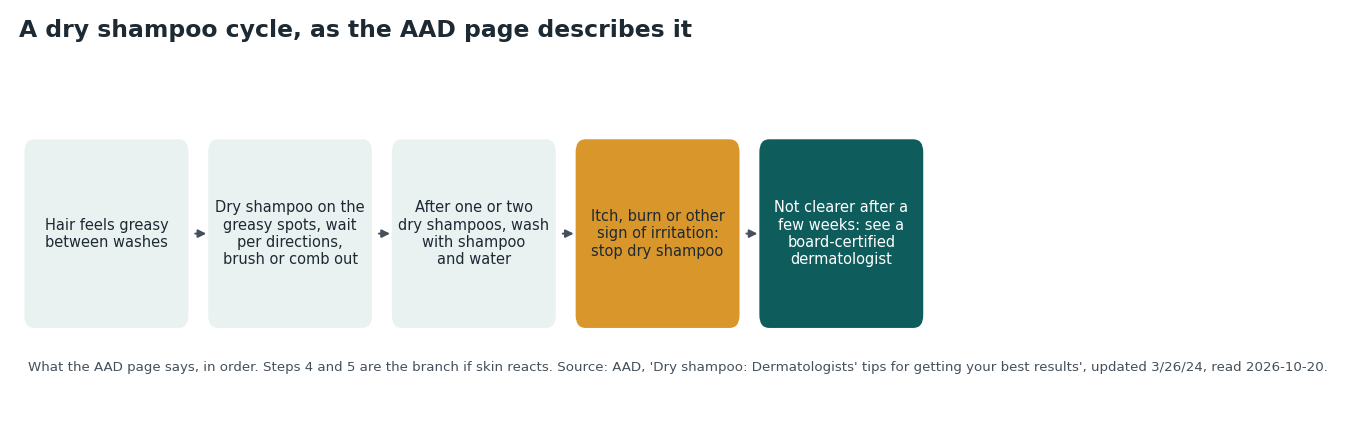
- Buy store-bought, not homemade. Homemade versions often use cornstarch, cocoa powder or baking soda. Dr. Mirmirani says homemade products can clump and clog pores in the scalp, which can itch, burn or feel tender. Dr. Draelos says bacteria can digest cornstarch, giving the scalp an unpleasant odor.
- Match it to your hair color and type. If your hair or scalp feels parched, Dr. Mirmirani suggests a fragrance-free product formulated for your hair type and color.
- Use a small amount where hair feels greasy. Too much can leave hair dry, stiff and gritty, with visible particles or an irritated scalp.
- Let it sit as directed, then brush or comb it out. Brushing out is what removes the oil.
- Keep washing with shampoo and water. The page says to wash after one or two dry shampoos; it says there is no set number.
What can go wrong
The AAD page says dry shampoo left on the hair or scalp can cause breakage and shedding, and that using only dry shampoo and skipping water washes could lead to seborrheic dermatitis, an itchy, scaly scalp rash, according to Dr. Draelos. Washing with shampoo and water also removes dead skin cells, oil and microorganisms that build up, in Dr. Mirmirani's words. Most people use it without a problem, the page adds.
When to see a dermatologist
If you develop itching, burning or another sign of irritation, the AAD says to stop using dry shampoo; after a few weeks the irritation should clear. If it stays the same or gets worse after a few weeks, it says a board-certified dermatologist can help. Our flaky scalp guide has what to notice and what to ask.
What studies say
We searched PubMed for "dry shampoo" on 2026-10-20 and found 7 hits. None we could read is a trial of dry shampoo on scalp or hair outcomes in people. They include a forensic study of cosmetic treatments and drug contamination in hair, a French study of exposure to hair cosmetics, a veterinary study in dogs, and a 2021 paper by Newell and Liszewski in Dermatitis, "Presence of Contact Allergens in Dry Shampoo Products". PubMed shows no abstract for that last paper, so we do not know its findings and do not report them. The AAD page is therefore the main source here.
What the sources do not say
- How much dry shampoo is too much, beyond the AAD's wash-after-one-or-two advice.
- Whether any particular ingredient or brand is safe or irritating.
- Whether dry shampoo changes hair growth or the scalp over months. We found no study.
- Anything specific about dry shampoo for people shifting to washing less. See the transition guide.
The honest simpler option
The AAD notes that most people use dry shampoo to extend a style or dye. If your aim is to wash less often, the simpler step is the one in our frequency guide: pick the wash frequency that suits your hair, and bring dry shampoo in only for the days between.
More in this hub: the No-Poo Hair Care overview.
Sources
All read on 2026-10-20. Pages and abstracts can change, so check the date shown.
- AAD, "Dry shampoo: Dermatologists' tips for getting your best results" (last updated 3/26/24)
- Newell P, Liszewski W. "Presence of Contact Allergens in Dry Shampoo Products." Dermatitis 2021 (PubMed 34807538; no abstract shown)
- PubMed search "dry shampoo", run 2026-10-20 (7 hits)
- AAD, "Tips for healthy hair" (last updated 8/12/24)