What the four numbers are
NSF International publishes a public database of certified drinking-water products. Its search form, read 2026-11-01, names the standards this way. NSF's main site blocked our requests (HTTP 403), so we could not read the standards or NSF's consumer pages; these titles come from the database, which did load. The right-hand column is what Frizzlife's own pages say about each one, so it is a maker's description, not NSF's.
| Standard | Title in NSF's database | What Frizzlife's pages say it covers |
|---|---|---|
| NSF/ANSI 42 | Drinking Water Treatment Units - Aesthetic Effects (NSF 42) | Chlorine taste and odor and other non-health-related factors. The PD600-TAM3 page adds that the standard "is not intended to verify reduction of health-related contaminants such as lead, arsenic, or PFAS unless those claims are certified under another applicable standard." |
| NSF/ANSI 53 | Drinking Water Treatment Units - Health Effects (NSF 53) | Specific contaminants that may have health effects, such as lead, mercury, VOCs, asbestos or microbial cysts, depending on the product's certified claims. The page also says "Certification under NSF/ANSI 53 does not mean a filter reduces every health-related contaminant." |
| NSF/ANSI 58 | Reverse Osmosis Drinking Water Treatment Systems (NSF 58) | Point-of-use RO systems. Optional contaminant claims differ from one RO system to another, so the page says to check the product's data sheet or certification listing. |
| NSF/ANSI 177 | Shower Filtration Systems - Aesthetic Effects (NSF 177) | Frizzlife's K45-B page applies it to free available chlorine reduction in a shower. Its NSF page does not describe 177. |
NSF's list also has its own standard for water softeners (NSF 44, titled Cation Exchange Water Softeners). A shower filter standard and a softener standard are separate things, which is the point of our shower filter or softener guide.
A maker's claim is not a listing
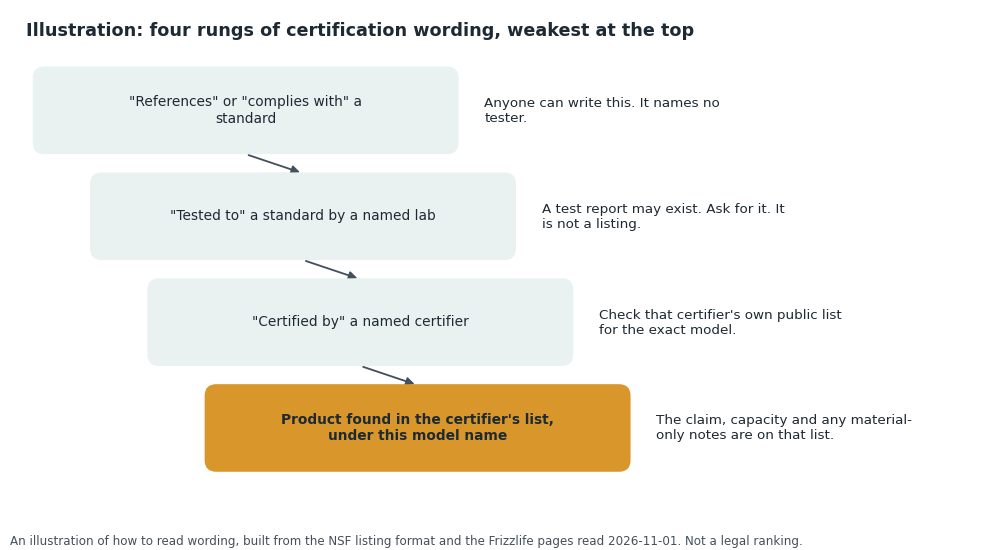
Frizzlife's pages give a live example of each rung. The MD40 page says its documentation "references filtration testing according to NSF/ANSI 42 and 53 standards" and tells users to review the documents for covered substances. The K45-B page says SGS tested it to 177 and that this is not NSF product certification. The MK99 page says IAPMO R&T tested it. The full list is in our Frizzlife guide. None of these is a claim about Frizzlife being dishonest; they are different claims, and the reader has to notice which one is being made. We did not read what an SGS test report means on SGS's own site, so we cannot say more than the Frizzlife page says.
What a real listing contains
We read NSF's listing for Brita as a format example. We are not rating that product. Each entry shows the standard, the product type (for example Plumbed-In, Pour Through), the model, a replacement element number, a service cycle in gallons, a flow rate in gpm and a Claim column such as Chlorine Reduction or Taste and Odor Reduction. Footnotes matter. One reads "Conforms to material requirements only." Another reads "Conforms to material and structural requirements only." A component can be listed for how it is built without the listing saying it reduces any contaminant. The listing for 177, read the same day, shows a claim worded "Free Available Chlorine Reduction".
Worked example: one page, two lines
The MD40 page says, as a maker claim, that it removes 99.9% of contaminants including chlorine, lead, fluoride and PFAS. The same page's explanation of 42 says that standard is not intended to verify reduction of lead, arsenic or PFAS unless certified under another standard. Frizzlife's own list of what 53 may cover names lead, mercury, VOCs, asbestos and cysts, and does not name fluoride or PFAS. Read together, those lines say: ask for the claims list, substance by substance. If the claim you care about is not on it, the badge does not cover it.
Questions to ask a seller
- Which standard, and which claim line (a named contaminant, not just a number)?
- Who tested it, and is that a test report or a certification?
- Is this exact model, and this exact replacement cartridge, in the certifier's public list? Send the link.
- Does the listing note "material requirements only" for any part?
- What flow rate and capacity was the claim tested at, and does my use match?
- When does the listing say to replace the cartridge, and what happens to the claim if I wait?
What the sources do not say
- We did not read the standards themselves. They are sold documents, and NSF's own consumer pages blocked us.
- We could not read IAPMO's certificate page for the SK99-NEW; it runs on scripts.
- We did not read EPA's home filtration fact sheet beyond its landing page; the document it points to blocked us.
- NSF's database says to contact NSF to confirm the status of any listing. Do that before you rely on a claim for a health concern, and ask your water utility or health department about any contaminant that worries you.
The cheaper or simpler option
A pitcher or faucet filter whose maker you can find in NSF's search lets you check the claim yourself, and it needs no plumbing. Our pitcher guide covers capacity and filter life. And if a free test or utility report shows nothing that bothers you, you may not need to buy a filter at all.
If you want to try the questions on a real page
Our reason to click: the MD40 page puts its testing wording and a plain-language explanation of each standard on one page, so you can check the two against each other.
We earn a small commission on qualifying sales, and 90% of it goes to charity (you can pick which); your price is unchanged. Full disclosure.
Sources
- NSF International, Certified Drinking Water Treatment Units search page and listings (info.nsf.org/Certified/DWTU/), including the Brita company listing and the NSF 177 listing, read 2026-11-01.
- Frizzlife PD600-TAM3, MD40, K45-B, MK99 and SK99-NEW product pages, frizzlife.com, read 2026-11-01.
- nsf.org consumer pages, returned HTTP 403 to our requests on 2026-11-01.