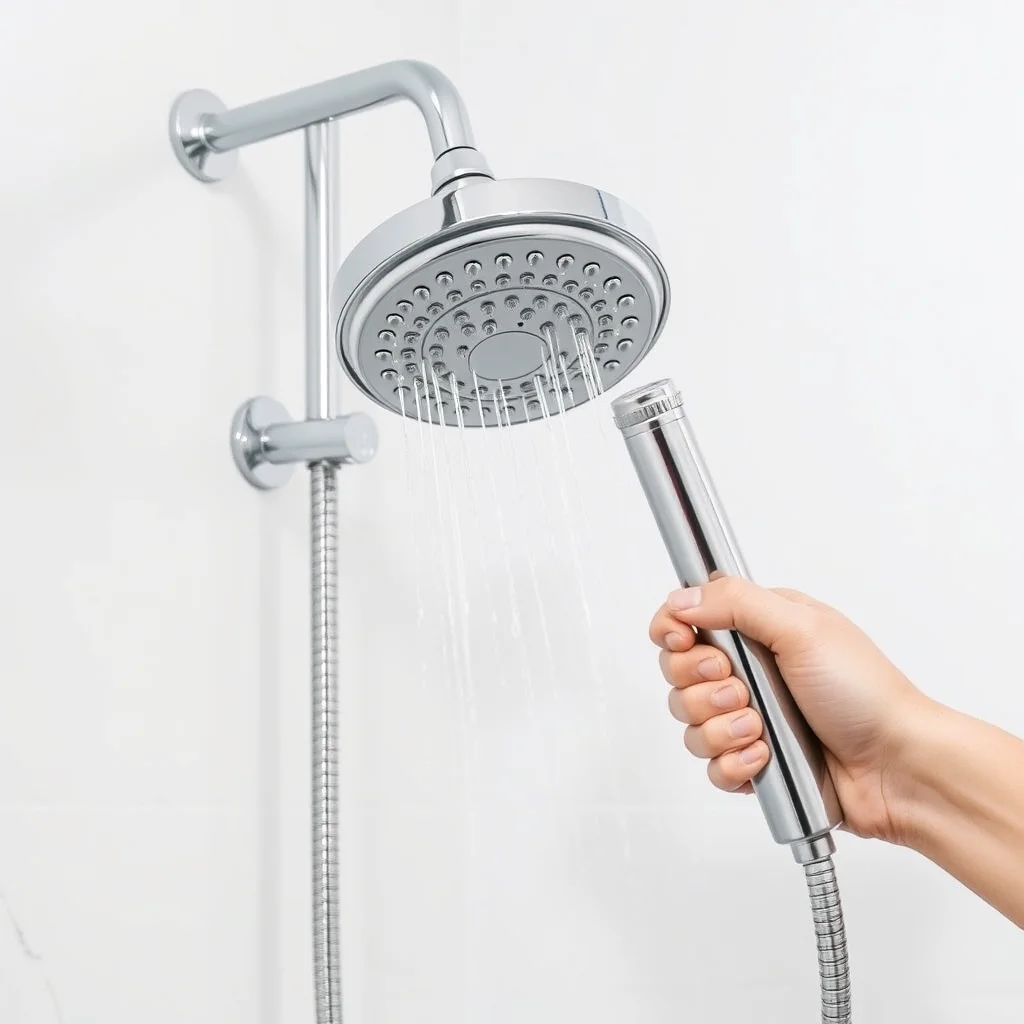
Flow rate (GPM): the number that matters most
GPM — gallons per minute — is the actual specification behind every "high pressure" or "luxurious" claim on showerhead packaging. Federal law in the US caps new showerheads at 2.5 GPM. California, Colorado, and several other states cap them lower, typically at 1.8 GPM. Some municipalities require 2.0 GPM or less.
What GPM means in practice: at 60 PSI incoming water pressure, a 2.5 GPM showerhead uses 25 gallons in a 10-minute shower. A 1.8 GPM head uses 18 gallons. The subjective feel — how "forceful" the spray is — depends on GPM in combination with nozzle design, specifically how the total flow is distributed across the spray face area.
| GPM rating | 10-min shower (gallons) | Feel / context |
|---|---|---|
| 1.5 GPM | 15 gallons | Water-efficient; concentrated nozzle pattern needed for good pressure feel |
| 1.8 GPM | 18 gallons | CA-legal standard; good balance of efficiency and spray force |
| 2.0 GPM | 20 gallons | Common mid-range; solid coverage without wasteful flow |
| 2.5 GPM | 25 gallons | Federal maximum; can feel noticeably fuller on large rain heads |
Head type: rain vs handheld vs combo
Rain (overhead) showerheads
Rain heads have a large face diameter — typically 8" to 12", sometimes larger — and deliver water at a lower velocity across a wide area. The sensation is closer to standing in rain than a conventional shower. They require adequate home water pressure to cover the full face evenly. A 12" rain head at low home pressure will produce uneven coverage with dry spots in the center or periphery.
Mounting matters significantly. A rain head on a standard wall arm at 5–6 feet elevation will spray at an angle, not truly overhead. Ceiling-mounted arms or adjustable S-arms that position the head directly above are needed for the genuine rainfall effect. This is often not apparent from the product listing.
Handheld showerheads
A handheld connects to the existing arm via a flexible hose (typically 60"–72" long) and sits in a holder bracket when not in hand. The practical uses are rinsing, bathing children or pets, cleaning the shower enclosure, and accessibility for reduced-mobility users. Hose quality varies significantly — stainless braided hoses are more durable than smooth plastic hoses, which kink and degrade.
Dual combo systems
A dual system pairs a fixed overhead head with a handheld on a diverter valve. The diverter routes water to one head, the other, or theoretically both simultaneously. Running both simultaneously at full GPM doubles your flow demand — check your home's incoming pressure and the combined rated GPM before assuming both can run at full pressure together.
Spray modes: what the settings actually do
Marketing language for spray modes varies by brand. The actual mechanics:
- Full body / rain — all nozzles open, maximum coverage area, lower velocity per nozzle.
- Massage / pulsating — nozzles cycle on and off via a rotating disc, creating an intermittent jet pattern. Useful for muscle tension; the rotation mechanism is a wear point over time.
- Mist / spray — nozzles angled to atomize water into finer droplets. Uses less water but feels less rinsing-effective; more useful in steam showers than conventional ones.
- Jet / focused stream — a narrow concentrated spray, useful for targeted rinsing or cleaning.
- Pause — reduces flow to a trickle while maintaining water temperature. Useful for water savings while soaping up, if your water heater takes time to recover temperature.
Most buyers use one or two modes regularly. The value of a multi-mode head is real for some use cases; it doesn't meaningfully justify a large price premium if you only want a full-spray rinse.
Shopping for showerheads? Browse current eBay listings → (we earn a small commission; your price is unchanged).
Pressure-boosting showerheads: what's real
Showerheads cannot increase water pressure. Pressure is determined by your home's incoming supply — the pipe diameter, water main pressure, and any pressure regulator on the main. A showerhead can only work with the pressure it receives.
What "high pressure" or "pressure-boosting" showerheads actually do: they reduce the number of nozzle openings (or use smaller-diameter nozzles) so the same volume of water exits through less total area, increasing velocity per jet. The trade-off is coverage area — a concentrated high-velocity spray covers a smaller area of your body than a wide gentler spray at the same GPM.
If you have genuinely low incoming water pressure (under 40 PSI), a showerhead with a focused nozzle pattern will help somewhat. It will not fix fundamentally inadequate line pressure. That requires a booster pump at the supply, or addressing the pressure regulator if it's set too low.
Filtered showerheads: what they remove and what they don't
Filtered showerheads typically use KDF-55 (a copper-zinc alloy media) or activated carbon as filter media, or both in combination.
KDF-55 is effective at reducing chlorine and some heavy metals (lead, mercury) through redox reaction. It is less effective at removing chloramines (chlorine + ammonia), which many municipalities now use instead of free chlorine.
Activated carbon adsorbs chlorine and chloramines reasonably well, and reduces some volatile organic compounds (VOCs). Its effectiveness in a showerhead depends on contact time — water passing through a small carbon block at 2 GPM has very little contact time compared to a full water filter system.
What filtered showerheads do not address: hard water mineral content (calcium/magnesium). Calcium and magnesium deposits (limescale) require ion exchange — a water softener — not filtration. If your primary complaint is hard water buildup on fixtures, shower doors, and hair, a filtered showerhead will not solve the problem.
Installation: what you need to know
Standard showerheads in North America use 1/2" NPT (National Pipe Thread) male connection at the arm. Nearly all residential showerheads are compatible with any standard arm. The connection process:
- Wrap the arm threads with Teflon (PTFE) tape — 2–3 wraps, clockwise when facing the thread end.
- Hand-thread the new head onto the arm until snug.
- Use an adjustable wrench for one additional quarter-turn. Do not over-tighten — the tape provides the seal; force does not improve it and can crack the head's inlet.
- Turn on water and check for leaks at the arm connection.
Handheld installations add a wall bracket mount (typically one anchor bolt or suction cup) and the hose connection at both the bracket and the head itself. Both hose connections also use Teflon tape.
Nozzle material and limescale resistance
Silicone nozzles — the small rubber dots visible on most showerhead faces — are significantly easier to clean than rigid plastic nozzle orifices. Limescale builds up inside nozzle openings and reduces flow over time. Silicone nozzles can typically be cleaned by simply rubbing the face with a thumb; the flexible material breaks up deposits. Rigid plastic nozzles require soaking in white vinegar (1–2 hours) to dissolve limescale.
In hard-water areas, nozzle material is worth checking in the product specifications. It's not always listed prominently but is often mentioned in user reviews.
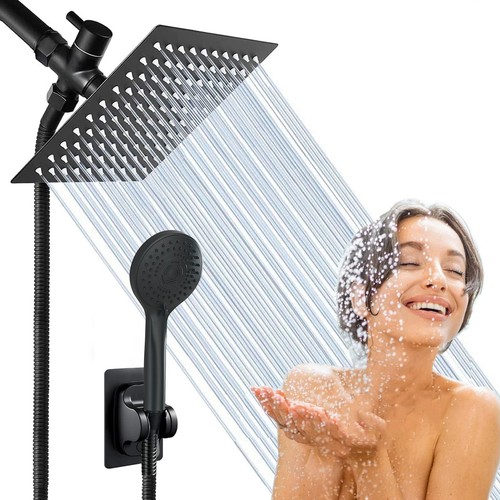 Rain Showerhead
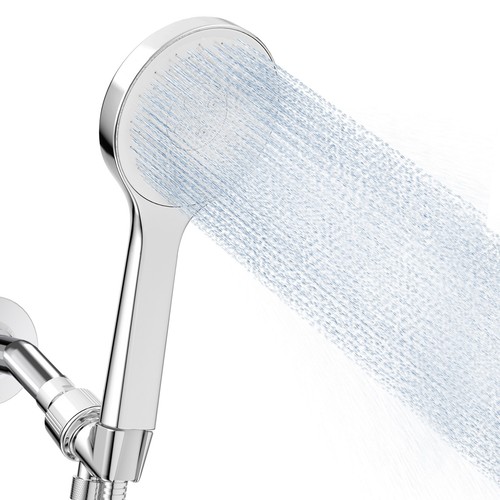 High Pressure Showerhead
 Filtered Showerhead