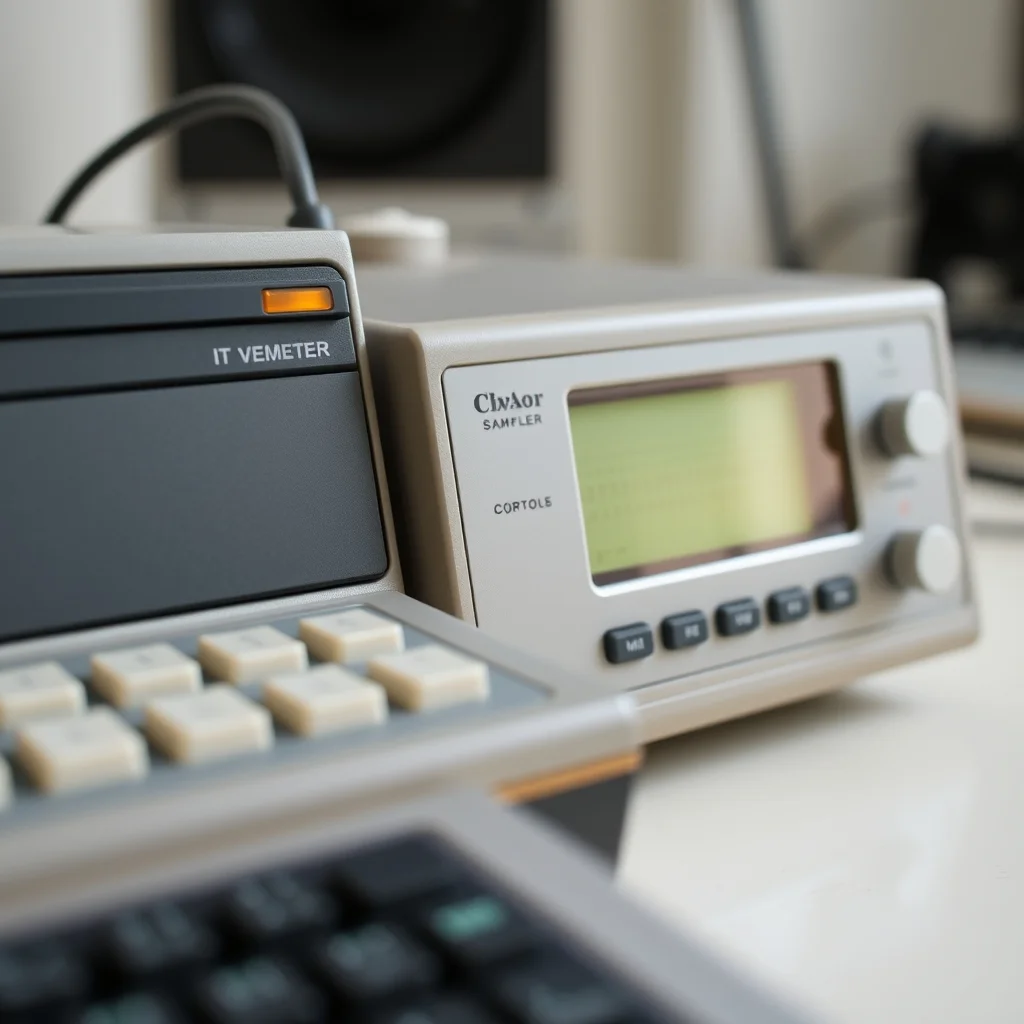
Why hardware sampling sounds different from software
The argument for hardware samplers over software is not sentimental. It is technical, and the technical case rests on a few specific properties that software emulation approximates but does not fully replicate.
The first is the analog-to-digital conversion chain. Early samplers used sigma-delta or successive-approximation ADCs operating at relatively modest sample rates by modern standards. The 12-bit word length of machines like the E-mu SP-1200 and Akai MPC60 means that quiet signals resolve to 4,096 amplitude steps rather than the 65,536 of 16-bit audio. The noise floor is higher and has a characteristic texture. When you sample a hi-hat through the SP-1200, the residual noise becomes part of the sound.
The second is the antialiasing filter design. Budget constraints in 1987 meant that the steep elliptic filters used today were not present. The rolloff characteristics of these machines' input stages color the sound in ways that are now considered desirable — particularly the high-frequency roll that gives sampled material a warmth it would not have through a flat recording chain.
The third is the playback engine. Pitch-shifting on these machines works by changing the playback clock rate — pitch up means faster playback, shorter sample; pitch down means slower playback, longer sample. This affects the sample duration in ways that modern pitch-shifting does not, creating a particular relationship between pitch and time that producers worked with and around.
E-mu SP-1200 (1987): the grit standard
The E-mu SP-1200 is the machine most associated with late-1980s hip-hop production. Its ADC runs at 26.04 kHz with 12-bit resolution, giving it approximately 10 seconds of total sample time at base configuration — roughly 1.25 seconds per pad across 8 pads. The sample time limitation forced producers to work with extremely short, looped, or transient-heavy material, which contributed to the characteristic chop-and-layer approach of the era.
The SP-1200 has an internal 3.5" floppy drive for program storage. Sample data does not persist through power cycles without saving to disk — the machine's RAM is volatile. The floppy drive is the most common maintenance issue on aged units; drives this old have rubber belts and capacitors that degrade.
SP-1200 condition priorities
- Floppy drive: Ask if it reliably reads and writes disks. Belt slippage causes read errors or complete failure. Replacement belts are available; drive replacement with a Gotek emulator is a common modern modification.
- All 8 pads: Each pad should trigger at multiple velocity levels. Test carefully — pads can develop dead zones or fixed velocity responses.
- Memory expansion: Base SP-1200 has approximately 10 seconds total; expanded units can reach roughly 20 seconds. Verify the current RAM configuration.
- OS version: The SP-1200 received OS updates via boot disk. Current OS (typically version 2.1 or higher) adds features. Ask what OS version the unit boots to.
Akai MPC60 (1988): Roger Linn's groove architecture
The MPC60 was designed by Roger Linn and manufactured by Akai. It introduced the 4×4 grid of velocity- and pressure-sensitive pads that became standard for hardware beat production, along with a sequencer that represented a significant advance in workflow integration. The MPC60 samples at up to 40 kHz with 12-bit resolution — slightly cleaner than the SP-1200, with a different character.
The MPC60 stores programs and sequences on 3.5" floppy disks. Like the SP-1200, the floppy drive is the primary mechanical failure point. The MPC60 was produced in two versions (MPC60 and MPC60 MKII) with the MKII adding a faster processor and some workflow refinements.
MPC60 condition priorities
- Floppy drive reliability: Same issue as the SP-1200. Test disk load and save cycles. Modern Gotek or SCSI2SD solutions exist for drive replacement.
- 16 pad response: Test all 16 pads across velocity range. The pressure sensitivity (aftertouch) is distinctive — verify it functions on pads that claim to have it.
- LCD display: The backlit LCD can fade with age. Dim displays are functional but affect workflow usability significantly.
- RAM expansion: The MPC60 can be expanded to 750k of sample RAM (approximately 26 seconds at maximum quality). Verify the current memory configuration — stock units have less.
- OS version: MPC60 OS updates added features including time stretch and additional sequence capabilities. OS 3.10 is generally considered the final and most capable version.
Akai MPC3000 (1994): the 16-bit upgrade
The MPC3000 moved the MPC line to 16-bit/44.1 kHz sampling, adding SCSI expansion for external drives, improved sequencer capacity, and stereo sampling (the MPC60 was mono input). It represents the professional-studio tier of the MPC line in its era, and it remains in use in working studios today.
The MPC3000 is larger than the MPC60 and heavier. Its 16 pads retain the Linn-designed layout. The SCSI port allows connection to Zip drives, hard drives, or modern SCSI2SD/BlueSCSI adapters, which effectively solve the storage problem that plagued floppy-only machines.
MPC3000 condition priorities
- Internal hard drive (if present): Original internal hard drives are 30+ years old. Many have failed or will soon. Replacement with an IDE-to-CF or similar adapter is common and advisable.
- SCSI port function: Test with a known-working SCSI device. A non-functional SCSI port significantly limits expandability.
- All 16 pads: Same pad testing as MPC60. Pressure sensitivity testing across full velocity range.
- LCD display: The MPC3000's LCD is larger than the MPC60's and equally subject to backlight degradation.
- Power supply capacitors: On 30-year-old units, the power supply electrolytic capacitors may be near end of life. A unit that has been recapped is preferable to one that has not.
Shopping for vintage samplers? Browse current eBay listings → (we earn a small commission; your price is unchanged).
Ensoniq Mirage, EPS, and ASR-10
Ensoniq produced a series of samplers that made hardware sampling accessible at lower price points. The Mirage (1985) was among the first affordable hardware samplers, using 8-bit samples at up to 29 kHz and storing programs on 3.5" floppies. Its character is dramatically lo-fi by modern standards — which is increasingly valued for exactly that reason.
The Ensoniq EPS (Ensoniq Performance Sampler, 1988) moved to 13-bit sampling with a keyboard-based form factor. It used Ensoniq's proprietary floppy format and added velocity-sensitive keys. The EPS 16+ expanded to 16-bit sampling. The ASR-10 (1992) represented Ensoniq's most capable sampler, adding SCSI, 16-bit/44.1 kHz sampling, and expanded sequencing.
Ensoniq machines are generally less expensive on the used market than Akai or E-mu equivalents, making them accessible entry points into hardware sampling. The floppy drives on all Ensoniq samplers are subject to the same belt-degradation issues as other machines of the era.
Spec comparison across key machines
| Machine | Year | Bit depth | Max sample rate | Base sample time | Storage |
|---|---|---|---|---|---|
| E-mu SP-1200 | 1987 | 12-bit | 26.04 kHz | ~10 sec | 3.5" floppy |
| Akai MPC60 | 1988 | 12-bit | 40 kHz | ~13 sec (base) | 3.5" floppy |
| Ensoniq EPS | 1988 | 13-bit | 29.3 kHz | ~10 sec | 3.5" floppy (Ensoniq format) |
| Akai MPC3000 | 1994 | 16-bit | 44.1 kHz | ~32 sec (expandable) | 3.5" floppy + SCSI |
| Ensoniq ASR-10 | 1992 | 16-bit | 44.1 kHz | ~16 sec (base) | 3.5" floppy + SCSI |
The floppy drive problem and modern solutions
Every machine in this category uses 3.5" floppy drives for program storage. Floppy drives this old have two reliable failure modes: the rubber drive belt degrades and slips (causing read errors or complete drive failure), and the electrolytic capacitors on the drive board age (causing intermittent operation or failure).
Belt replacement is a well-documented repair with parts available from multiple suppliers. The belts are specific to each drive model, so identifying the drive manufacturer before ordering is important.
Modern alternatives include the Gotek floppy emulator (replaces the physical drive with a USB-stick-based system that emulates floppy disks) and SCSI-to-SD adapters for machines with SCSI ports. Gotek installations are generally reversible and preserve original functionality with modern reliability. If a seller has already performed a Gotek or SCSI upgrade, that is a meaningful value-add — these installations take time and some skill to perform correctly.
Buying on eBay: what to verify
Before committing
- Ask for a video of the machine loading a disk (or loading via Gotek) and triggering all pads
- Ask what OS/firmware version the machine runs — relevant for MPC60, SP-1200
- Ask about RAM expansion: what is the current installed memory?
- Ask whether the floppy drive is original, replaced, or Gotek-modified
- Ask about any recap or maintenance history
Price calibration notes
SP-1200 prices have risen substantially as the machine's cultural significance has been recognized more widely. MPC60 prices track below the SP-1200 but above the MPC3000 for the same production-era cachet. The MPC3000 is often the most useful machine in the group for actual production, and typically trades at prices reflecting that practical utility rather than collector premium. Ensoniq machines remain comparatively accessible and represent good value for producers who want the hardware workflow without the top-tier price.
Search eBay for these samplers
 Akai MPC60
Ask about floppy drive health and RAM expansion before buying.
Akai MPC60
Ask about floppy drive health and RAM expansion before buying.
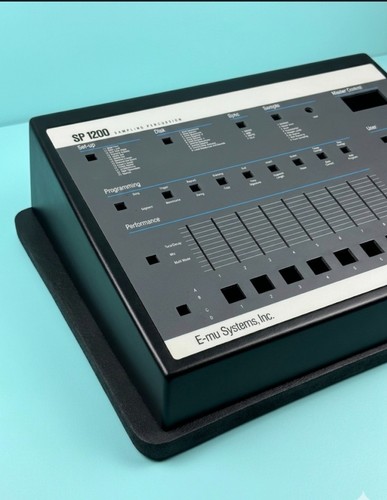 E-mu SP-1200
Verify pad response and floppy drive. OS version matters.
E-mu SP-1200
Verify pad response and floppy drive. OS version matters.
 Akai MPC3000
Check internal drive and SCSI port. Gotek/SCSI2SD upgrades are a plus.
Akai MPC3000
Check internal drive and SCSI port. Gotek/SCSI2SD upgrades are a plus.
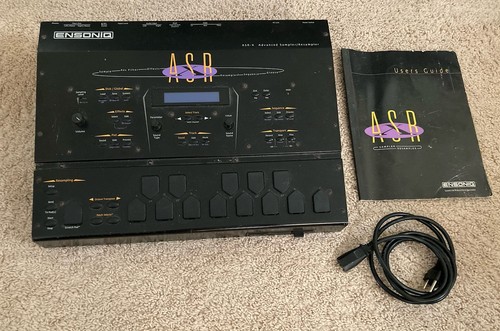 Ensoniq samplers
Mirage, EPS, ASR-10. Best value entry into hardware sampling.
Ensoniq samplers
Mirage, EPS, ASR-10. Best value entry into hardware sampling.