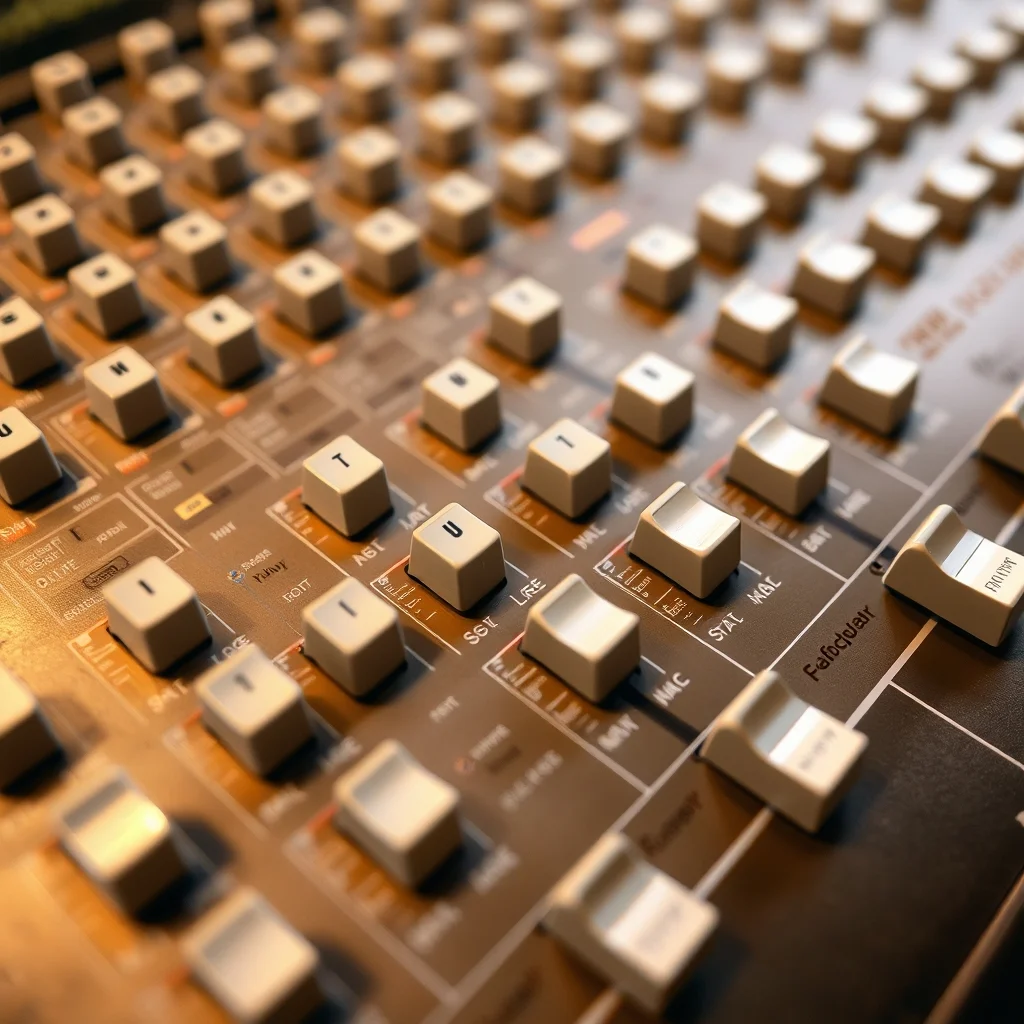
Why analog summing still matters
The argument for analog consoles has narrowed as DAW summing quality has improved, but it has not disappeared. The saturation characteristics of analog transformers, the way analog channel strips clip versus digital clipping, and the physical workflow of hands-on fader control all contribute to a production context that software mixers approximate differently.
For many users, a vintage analog console is simply the most practical and cost-effective way to achieve analog summing on a multitrack mix — by routing DAW outputs to hardware channels, mixing on the console's bus, and returning the summed stereo to the DAW. Others use consoles as channel strip front ends, passing individual sources through the mic preamp and EQ sections before entering the DAW. Both use cases have valid technical rationales that go beyond nostalgia.
What makes buying a vintage console require more diligence than buying most vintage electronics is scale: a 32-channel console has 32 copies of the same circuit, and any of them can develop problems independently. A noise problem on channel 7 does not affect channel 8, but you have to check both.
Mackie 8-Bus series: the accessible standard
The Mackie 8-Bus consoles (1604-VLZ, 2404-VLZ, 3204-VLZ and variants) defined affordable professional-caliber mixing in the 1990s. The circuit uses Mackie's XDR (Extended Dynamic Range) microphone preamp design and a clean, utilitarian channel strip with three-band EQ, direct out, and bus assignment. These consoles were workhorses in project studios and home studios across the period.
Mackie designed the VLZ series with relatively high headroom (+22 dBu typical) and clean summing. The preamps are competent but not transformerless — they use a conventional op-amp topology with good noise specs for the era. They do not have the transformer character of Neve, SSL, or API preamps, which is either a limitation or a feature depending on what you want from the console.
Mackie condition priorities
- Fader condition: Move every fader across its full travel. Scratching, dropout, or level jumps indicate worn carbon tracks or contaminated resistive elements. Fader replacement is possible but time-consuming on a large-format Mackie.
- Channel gain structure: Feed a consistent test signal into each channel and verify that all channels produce the same output level at the same fader position. Channels that differ by more than 1–2 dB may have drift in the channel amplifier components.
- Pot condition: The EQ band pots and send/return pots are subject to the same oxidation as any console. Turn every pot through its range and listen for scratching or noise.
- Bus assignment switches: The 8-bus assignment switches are used constantly in studio operation. Verify all bus assignment buttons produce clean routing on all channels.
- Power supply output voltage: The Mackie power supply outputs ±15V and +48V (phantom power). Verify phantom power functions on multiple channels — a common failure mode on aged units is degraded phantom power output voltage, which affects condenser mic performance.
Soundcraft Series consoles
Soundcraft produced several series of consoles popular in UK studios and beyond. The Series 200, 400, and Ghost are among the most commonly traded on the used market. Soundcraft designs are characterized by a slightly warm, character-forward mic preamp compared to the more transparent Mackie approach. The EQ designs on Series 400 and Ghost consoles are particularly well-regarded — the Ghost's EQ is a usable, musical sounding design that holds up in comparison to more expensive alternatives.
Soundcraft consoles tend to be heavier and more substantial than equivalent Mackie units, with more robust metalwork. The tradeoff is that they are harder to move and require more space. The channel strip density is typically lower (wider channels) which can be a feature or a limitation depending on workflow.
Soundcraft condition priorities
- EQ section function: Test each EQ band on each channel. Soundcraft EQ sections use switched inductor designs on some models — verify all switch positions engage correctly.
- Fader noise: Soundcraft faders are generally durable but subject to the same oxidation and wear as any console fader. Test all faders across full travel.
- Channel insert points: The send/return insert jacks on individual channels see significant wear from repeated patching. Test inserts on several channels with a known-good patch cable.
- Aux send consistency: Verify all auxiliary sends produce the same level on all channels at the same pot position. Aux buses with inconsistent send levels indicate component drift.
Shopping for vintage mixers? Browse current eBay listings → (we earn a small commission; your price is unchanged).
Tascam M-series: multitrack integration
Tascam's M-series consoles (M-308, M-520, M-3500 and others) were designed for integration with Tascam's multitrack tape recorder line. The M-308 is an 8-bus, 24-channel console; the M-520 is a larger format. These desks have direct outputs on each channel for multitrack routing, and their architecture reflects the tape recording workflow rather than live sound or post-production.
Tascam consoles are generally less expensive on the used market than equivalent Mackie or Soundcraft units, making them accessible entry points for multitrack recording setups. The preamps are utilitarian — functional and clean but without distinctive character. The EQ is typically simpler than Soundcraft designs.
Tascam condition priorities
- All direct outs: Verify direct out function on every channel with an appropriate cable and meter. Direct outs see heavy use in multitrack recording and are a primary signal path.
- Bus subgroup outputs: Test all 8 bus outputs for level and cleanliness. Subgroup buses see significant use and can develop channel inconsistencies.
- Meter bridge: If present, verify VU meter function on all channels. Meter bridge issues are cosmetic but affect workflow.
Fader wear: how it works and what it means
Audio faders use a resistive element — typically a carbon composition track or a conductive plastic track — over which a wiper contact slides. Over time, the contact between wiper and track oxidizes, contaminates, or physically wears the track surface. The result is electrical noise as the wiper passes over worn areas, dropout (momentary signal loss) as the contact loses continuity, or a fixed step in output level at specific fader positions.
Carbon track faders (common on earlier consoles) are more susceptible to wear than conductive plastic faders (more common on consoles from the 1980s onward). Both can be cleaned with appropriate contact cleaner, but worn tracks cannot be restored — they require fader replacement.
When testing a console, move each fader slowly across its entire range while monitoring the output. Noise that appears at specific positions and disappears at others indicates localized track wear. Noise that is consistent across the full travel may indicate oxidation on the wiper contact, which can sometimes be addressed with cleaning. Dropout (complete signal loss at a specific position) indicates significant track damage at that point.
Recapping: what it is, when it matters
Electrolytic capacitors are the component class most likely to degrade over time in analog electronics. They consist of an aluminum oxide dielectric that can dry out, changing their capacitance and equivalent series resistance (ESR) characteristics. In audio circuits, degraded electrolytic capacitors manifest as increased noise, reduced headroom, altered frequency response, or DC offset (voltage that shouldn't be there, appearing at outputs).
The standard maintenance for a vintage console is replacing all electrolytic capacitors — "recapping" — with new, correctly specified components. For a 32-channel console, this is a significant undertaking that may involve hundreds or thousands of capacitors. Professional technicians charge accordingly; an in-shop recap of a large console can run into thousands of dollars in labor alone, plus parts.
Channel consistency: the key test
The most meaningful test for any multichannel console is channel consistency: do all channels perform identically under identical conditions? On a properly functioning console, feeding the same signal into every channel at the same gain setting should produce the same output level and frequency response.
In practice, this requires a consistent source (pink noise from a generator, or a fixed tone from a DAW), a patch from the source to each channel input in turn, and a consistent way to measure the output of each channel (a calibrated meter, an oscilloscope, or a DAW's input metering). Testing 32 channels this way takes time but is the only way to know whether a console is performing uniformly.
Most used console listings do not provide this level of testing. Asking a seller to perform this test is reasonable for any significant purchase. A seller who refuses or says "it all works, I use it all the time" is providing an opinion, not a measurement — which may be accurate or not.
| Console | Channel count | Character | Key maintenance item |
|---|---|---|---|
| Mackie 1604-VLZ | 16ch, 4-bus | Clean, transparent | Faders, phantom power output |
| Mackie 2404-VLZ | 24ch, 4-bus | Clean, transparent | Faders, channel gain consistency |
| Soundcraft Ghost | 16–32ch, 8-bus | Warm, musical EQ | EQ switches, fader noise, inserts |
| Soundcraft Series 400 | 16–24ch, 8-bus | British warm character | Aux sends, fader carbon tracks |
| Tascam M-3500 | 32ch, 8-bus | Utilitarian, transparent | Direct outs, subgroup buses, meters |
Search eBay for these consoles
 Mackie 8-Bus / VLZ
Test all faders and phantom power. Ask about channel consistency.
Mackie 8-Bus / VLZ
Test all faders and phantom power. Ask about channel consistency.
 Soundcraft consoles
Verify EQ sections and aux send consistency on all channels.
Soundcraft consoles
Verify EQ sections and aux send consistency on all channels.
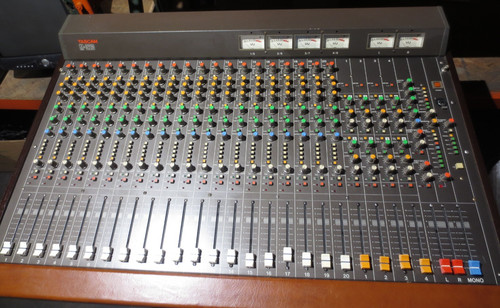 Tascam M-series
Check direct outs and bus subgroups. Good value for multitrack recording setups.
Tascam M-series
Check direct outs and bus subgroups. Good value for multitrack recording setups.
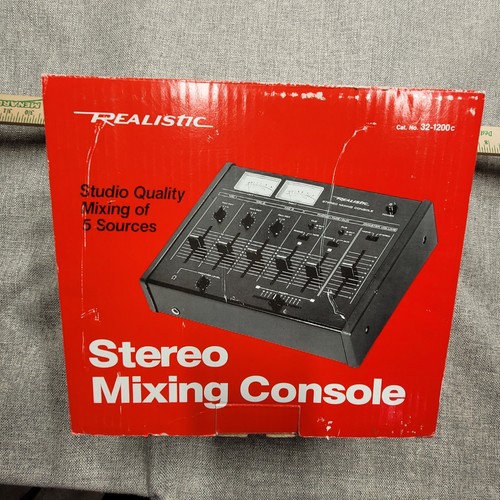 Vintage mixing consoles (broad)
For large-format consoles: require in-person inspection before buying.
Vintage mixing consoles (broad)
For large-format consoles: require in-person inspection before buying.