The worm-proof problem: why soft plastics destroy hard baits
The most important material fact in tackle storage isn't waterproofing — it's compatibility between soft plastics and hard baits. Soft plastic baits (worms, creature baits, swimbaits, Ned-rig mushroom heads) are made from polyvinyl chloride (PVC) or similar polymer compounds blended with plasticizers and dye. These plasticizers are chemically reactive with polystyrene and ABS plastics — which is exactly what most hard lures (crankbaits, jerkbaits, topwater lures) are made from.
When soft plastics contact hard lure bodies, the plasticizer migrates into the hard plastic and causes it to swell, warp, and become tacky. A soft worm stored against a crankbait for a season will stick to it and potentially deform the bait permanently. The same reaction causes soft plastics to melt the paint off crankbaits and dissolve hook points on certain hook finishes over extended contact.
Worm-proof liners and trays use polyethylene (PE) or polypropylene (PP) instead of polystyrene. These polymers are not chemically reactive with PVC plasticizers. Any tray labeled "worm-proof" uses one of these materials. Plano's worm-proof designation (used on many of their 3600/3700 series trays) means PE or PP construction. If a tray doesn't carry that designation, assume it's polystyrene and keep soft plastics out of it.
Hard tray boxes: the structured system
A classic tackle box is a hard-shell container — typically polypropylene — with a hinged lid and multiple tray compartments inside. The trays usually swing out or stack when the box is opened, providing access to multiple layers of organized gear. Styles range from simple single-level open trays to multi-level "tackle center" designs with 3–5 tray levels and a main compartment below.
Hard tray boxes excel at protecting hard baits. The rigid walls prevent crushing, and compartments keep crankbaits separated from each other so treble hooks don't tangle. For an angler who primarily fishes hard baits from a boat with deck space, a large hard tray box sitting on the floor or in a rod locker is an efficient system.
Their main disadvantage is portability. A fully loaded hard box is bulky and awkward to carry on foot. They're also not optimized for wade fishing, bank fishing, or kayak use where you need to move with your gear. A large tackle box loaded for a full day might weigh 20–30 lbs and be impossible to carry comfortably without a cart or a boat.
Utility trays: the modular backbone
Utility trays (also called "tackle trays" or "storage boxes") are flat, single-level containers with adjustable dividers inside. They stack, they fit inside tackle bags and backpacks, and they allow you to customize compartment sizes to the lures being stored. The Plano 3600 and 3700 are the closest thing to an industry standard — countless bags, backpacks, and boxes are designed to accept these trays, and they're available at nearly every fishing retailer.
A utility tray system works like this: you build a library of trays organized by technique or species. A "bass finesse" tray holds drop-shot weights, finesse jig heads, and small worms. A "bass hard bait" tray holds crankbaits and jerkbaits (in a worm-proof tray if you also carry soft plastics). A "saltwater inshore" tray holds spoons, soft plastics on jig heads, and topwater plugs. When you go out, you pull the trays relevant to that day's plan into your bag or box, leaving the rest at home.
Tackle backpacks: the mobile system
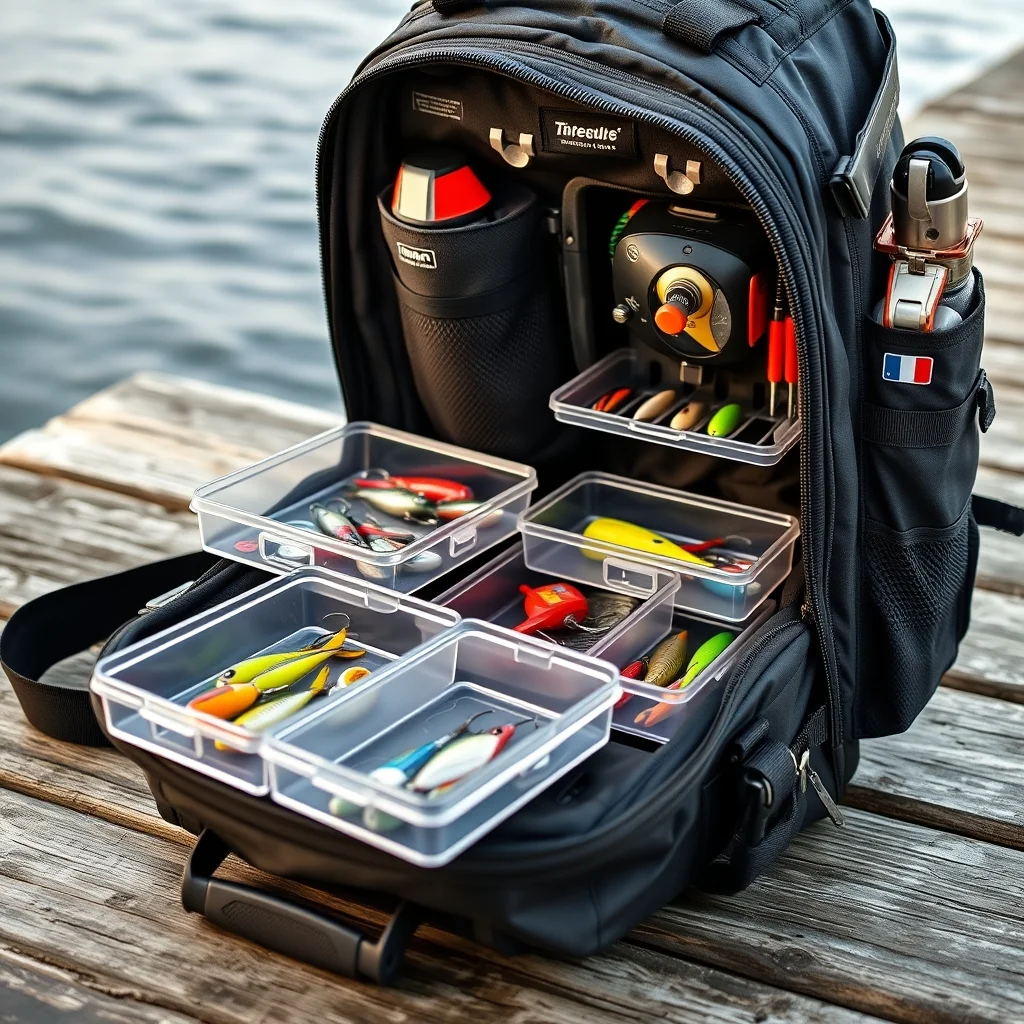
A tackle backpack combines a frame and shoulder straps with dedicated pockets sized for utility trays. A typical 3700-series tackle backpack holds 4–6 trays in the main compartment, plus exterior pockets for pliers, forceps, sunscreen, rain gear, and a lunch. Some include rod holders that clip rods alongside the pack for hands-free carrying.
Shopping for tackle storage? Browse current eBay listings → (we earn a small commission; your price is unchanged).
Backpacks are the dominant choice for wade fishermen, bank fishermen, and kayak anglers who need to carry everything on their back. The weight distribution of a backpack is significantly better than carrying a hard box by a handle when walking long distances. Look for padded, load-bearing shoulder straps and a hip belt or chest strap on larger backpacks — an unloaded 30L tackle backpack is light, but a fully loaded one can run 25+ lbs.
One tradeoff: the soft exterior of a backpack doesn't protect hard baits from impact the way a hard-shell box does. For lures you don't want damaged, the utility trays inside provide the real protection — make sure any crankbait trays are worm-proof rated and have secure latches.
Tackle bags and hip packs: the lightweight option
Smaller tackle bags — sometimes called "flip bags" or "sling bags" — hold 2–3 utility trays and open flat for fast access. Hip packs mount on a belt and hold a few trays or a dedicated soft-plastic tray for specific applications. These are the right choice for anglers who want minimal weight and quick access to a small selection of lures: a wade fisherman running 3–4 confidence baits, an ice fisherman, or a trail hiker who picks up a small stream on the way.
Waterproofing ratings: what the terms actually mean
Tackle storage products use several different terms for water resistance. Understanding the difference prevents unpleasant surprises on the water.
| Term | What it means | What it survives |
|---|---|---|
| Water resistant | Splash or light rain resistance; no rating standard | Light rain, brief spray |
| IPX4 | Protection from water splashing from any direction | Rain, spray, wave splash |
| IPX6 | Protection from powerful water jets from any direction | Heavy rain, hose-down |
| IPX7 | Immersion up to 1 meter for 30 minutes | Brief submersion (kayak roll) |
| IPX8 | Continuous immersion beyond 1 meter | Extended submersion |
| O-ring sealed | Manufacturer-specific gasket seal, not IPX rated | Varies by design |
Organizing strategy: by technique, not by lure type
A common mistake is organizing tackle alphabetically or by lure type — all crankbaits together, all soft plastics together. A more efficient approach is organizing by technique or species scenario, because that's how you actually fish. On a given trip, you're not thinking "I need all crankbaits" — you're thinking "I'm targeting deep summer bass, I need deep divers, Carolina rigs, and bottom-contact jigs."
A technique-based system looks like this:
- Finesse tray: Drop-shot weights, finesse hooks, shaky head jig heads, Ned rig mushroom heads, small Z-Man plastics. One tray, everything for light-line bass presentations.
- Power bass tray: 3/8–3/4 oz jig heads, punch sinkers, 5/0 EWG hooks, larger creature baits. Separate from the finesse setup because the hardware is different.
- Hard bait tray (worm-proof): 3–5 crankbaits at different depth ranges, jerkbaits, one or two topwater plugs. Keep this tray away from soft plastic trays in storage.
- Hardware tray: Split rings, snap swivels, barrel swivels, bobber stops, small hooks, weights. The consumables tray you always have but rarely think about until you need it.
This system means grabbing the right 2–3 trays for the day rather than carrying everything you own every trip.
 Tackle box
 Tackle backpack
 Waterproof tackle box