Guides
Practical kiln buying content — chamber sizing, cone ratings decoded, and the 120V vs 240V electrical question answered.
Troubleshooting & repair
Why your kiln won't reach temperature, under-fires, or over-fires
A kiln senses only two things — what the thermocouple reads and how fast it's climbing — so "won't reach cone," "under-fired on one side," and "over-fired" each name a cheap wear part: elements, a relay, or a drifting thermocouple. Read the symptom to the part, with the Skutt/L&L error codes decoded. Not a dead kiln.
Buying guide
How to choose a pottery kiln: size, cone rating, and power
Chamber volume in cubic feet, what cone ratings mean in real temperatures, 120V vs 240V wiring, and digital vs manual controllers. What to check before buying a used kiln.
Why this page exists
Kiln buying guides typically fail at the electrical question. A 120V kiln plugs into a standard US outlet; most serious kilns require 240V, which needs a dedicated circuit and potentially an electrician.
That single fact changes the buying decision for home potters more than almost any other spec. This page addresses electrical requirements plainly, alongside chamber sizing math and the cone system — which is not obvious to anyone coming to ceramics for the first time.
Plain note about money. Links below go to eBay searches with an affiliate tag. If you buy through one, a small commission comes to this site. Your price is identical either way. The searches are ones we'd actually run — not sponsored placements.
Pottery kilns worth searching on eBay
Electric kilns from home-studio size to full ceramic studio. We earn a small commission on qualifying sales; your price is unchanged. Full disclosure.
 Electric pottery kiln
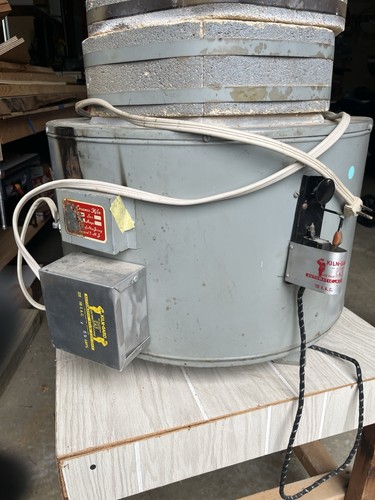
The main category. Filter by chamber size (cubic feet) and cone rating. Most home kilns are cone 6 (2232°F) or cone 10 (2381°F). Confirm 120V vs 240V requirement before purchasing.
Electric pottery kiln
The main category. Filter by chamber size (cubic feet) and cone rating. Most home kilns are cone 6 (2232°F) or cone 10 (2381°F). Confirm 120V vs 240V requirement before purchasing.
 Ceramic kiln
Broader search that surfaces studio kilns alongside pottery-specific models. Good for finding L&L, Skutt, and Paragon models — the three most common US studio brands.
Ceramic kiln
Broader search that surfaces studio kilns alongside pottery-specific models. Good for finding L&L, Skutt, and Paragon models — the three most common US studio brands.
 Small pottery kiln
Test kilns and apartment-scale models. Some fire on 120V (standard outlet), which removes the dedicated-circuit requirement. Chamber volumes typically 0.5–1.5 cubic feet.
Small pottery kiln
Test kilns and apartment-scale models. Some fire on 120V (standard outlet), which removes the dedicated-circuit requirement. Chamber volumes typically 0.5–1.5 cubic feet.
 Kiln 120V
Specifically 120V models that plug into a standard outlet. Maximum temperature is typically capped at cone 06 or cone 6 depending on the model — verify the cone rating matches your clay and glaze.
Kiln with controller
Digital kiln controllers (Skutt KilnMaster, L&L Genesis, Bartlett V6-CF) allow programmable firing schedules with ramp rates and hold times. A controller that costs $200–400 separately is worth having included.
Kiln 120V
Specifically 120V models that plug into a standard outlet. Maximum temperature is typically capped at cone 06 or cone 6 depending on the model — verify the cone rating matches your clay and glaze.
Kiln with controller
Digital kiln controllers (Skutt KilnMaster, L&L Genesis, Bartlett V6-CF) allow programmable firing schedules with ramp rates and hold times. A controller that costs $200–400 separately is worth having included.