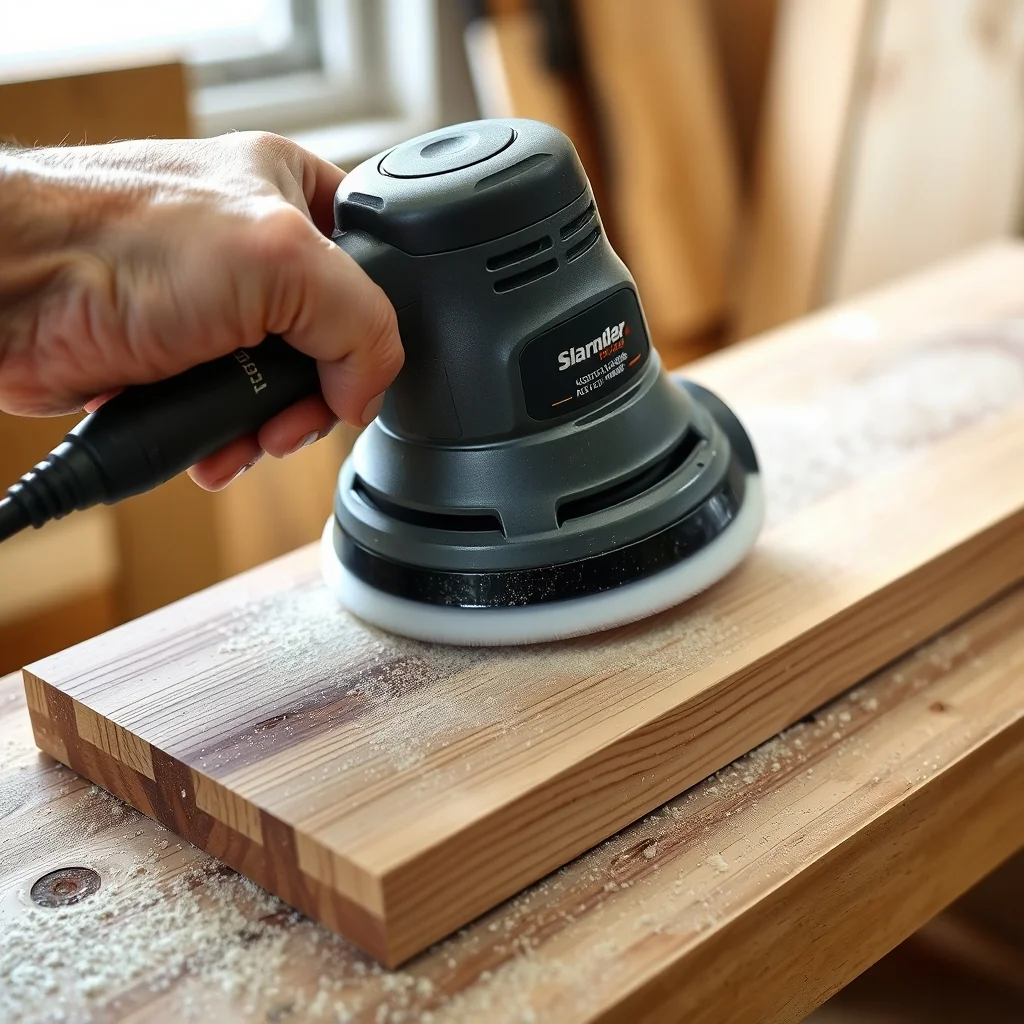
How random orbital sanders work and why orbit size matters
A random orbital sander spins its pad in a circular pattern while simultaneously oscillating the pad in an eccentric pattern. The combination means no single abrasive grain travels the same path twice — which is why random orbitals leave far fewer visible swirl marks than a standard orbital (which just moves in a fixed circular pattern).
The key spec that most buyers ignore: the orbit stroke diameter, expressed in inches or millimeters. This is the diameter of the eccentric oscillation path. Common values are 3/32 inch (2.4mm), 1/8 inch (3mm), and 3/16 inch (5mm).
- Small orbit (3/32 inch / 2.4mm): Finer finish, leaves fewer swirl marks, removes material more slowly. Preferred for final finish passes, delicate surfaces, and paint prep before spraying.
- Large orbit (3/16 inch / 5mm): Removes material faster, more aggressive, more likely to leave swirl marks visible at fine grits. Better for rapid stock removal, paint stripping, and initial preparation passes.
The trade-off is direct: larger orbit = faster removal, coarser result. If you're doing finish woodworking and want a surface that looks clean at 180–220 grit without visible swirls, a 3/32-inch orbit sander is generally the better choice for the final passes, even if it removes material more slowly.
5-inch vs 6-inch pads
The 5-inch pad is the dominant standard for random orbital sanders. It accepts an enormous range of discs from every abrasives manufacturer, the sander is compact enough to control one-handed, and the pad size is appropriate for most furniture and cabinetry work.
6-inch sanders cover more area per pass — roughly 44% more surface area than a 5-inch pad — which is meaningful for large flat surfaces like tabletops, cabinet doors, and floor sections. The downside is that the larger pad makes the sander harder to control on curved or sculpted surfaces, and the disc selection is narrower and typically more expensive than 5-inch.
For most hobbyist woodworkers, a 5-inch sander is the better choice: disc availability is better, the tool is more maneuverable, and the narrower pad is an advantage when sanding near edges or in recesses.
| Spec | 5-inch sander | 6-inch sander |
|---|---|---|
| Disc availability | Excellent — every manufacturer | Good but narrower selection |
| Coverage per pass | 19.6 sq in (nominal) | 28.3 sq in (nominal) |
| Maneuverability | Better — compact, one-hand | Larger footprint |
| Weight | 3–4 lb typical | 4–5+ lb typical |
| Best for | Furniture, cabinetry, general use | Large flat panels, floors, automotive |
Dust collection: the spec that determines usability
Orbital sanders generate fine dust in large volumes, especially in hardwood, MDF, or painted surfaces. The dust collection system — onboard bag, through-pad extraction holes, and the quality of the sealing between the pad and the body — determines whether your shop stays breathable during long sanding sessions.
Through-pad holes
Most 5-inch orbital sander discs come with 5, 8, or no holes, corresponding to different dust extraction patterns in the pad. The most common pattern is 8-hole, which aligns with the 8-hole pad. Using a 5-hole disc on an 8-hole pad (or vice versa) doesn't cause damage but reduces dust extraction efficiency — some holes are blocked. If you connect the sander to a shop vacuum, 8-hole discs typically offer the best extraction.
Onboard bag vs vacuum connection
Onboard dust bags capture roughly 50–65% of sanding dust and fill within 15–20 minutes of sustained use. A shop vacuum connected via the vacuum port dramatically improves this — the suction draws fine dust through the pad holes consistently rather than relying on centrifugal action to push dust into a bag. For any significant sanding session, a shop vacuum connection is worth using.
Shopping for an orbital sander? Browse current eBay listings → (we earn a small commission; your price is unchanged).
Variable speed: when it matters
Most entry-level orbital sanders run at a fixed speed (typically 10,000–12,000 OPM — orbits per minute). Variable speed adds a dial or trigger control that lets you adjust the speed from roughly 4,000–12,000 OPM.
Variable speed is genuinely useful in two scenarios:
- Delicate surfaces: Veneer, painted surfaces you don't want to burn, and soft woods that respond poorly to high heat from aggressive sanding all benefit from lower speeds.
- Starting on a surface: Beginning at lower speed and ramping up avoids swirl marks from stopping and starting the sander while it's at full speed against the work.
If you primarily sand solid hardwood in preparation for finishing, variable speed matters less than dust collection and orbit size. If you do painted furniture, automotive prep, or work with veneer, it's worth the cost premium.
Sanding disc selection and grit progression
The discs matter as much as the sander. A random orbital with cheap discs produces worse results than a budget sander with quality aluminum-oxide or ceramic discs from a brand like Mirka, Norton, Diablo, or 3M.
Grit progression for wood finishing
For typical furniture and cabinet work:
- Start at 80–100 grit for stock removal or removing old finish. Don't skip grits by more than one step — jumping from 80 to 180 leaves deep scratches under the fine surface.
- Progress to 120 grit to remove the 80-grit scratches.
- 150 grit for pre-finish preparation on most hardwoods.
- 180–220 grit for final prep before applying stain or clear finish. Above 220 on hardwood can close the grain and reduce stain absorption.
Pad replacement and backing pad condition
The hook-and-loop backing pad (the foam and Velcro layer that holds the disc) wears out over time. When the Velcro hooks lose their grip or the foam compresses unevenly, disc adhesion suffers and the sander may throw discs at high speed. Check the backing pad periodically — replacement pads for most orbital sanders cost $8–20 and are widely available. This is the most commonly overlooked maintenance item on orbitals.
The honest tier recommendation
For most hobbyists, a mid-tier 5-inch sander with variable speed and a vacuum port handles furniture, cabinetry, and project woodworking well. The models consistently cited in woodworking forums — Festool ETS 125, Makita BO5041, Mirka DEROS, and similar — represent the upper tier; below that, the Bosch ROS20VSC and DeWalt DWE6421K are reliable mid-market choices with good dust collection and genuine variable speed, not just an on/off switch marketed as variable.
For occasional sanding rather than regular shop use, the cost difference between budget and mid-tier is harder to justify. The biggest quality difference in that range comes from disc quality, not the sander itself — a budget sander with quality Mirka or Norton discs often outperforms a mid-tier sander with bargain discs.
Search eBay for orbital sanders
 Random Orbital Sanders
5 and 6-inch models. Check orbit stroke diameter in specs — listed in mm or inches.
Variable Speed Sanders
Confirm it's truly variable (dial) not just trigger-sensitive speed control.
Random Orbital Sanders
5 and 6-inch models. Check orbit stroke diameter in specs — listed in mm or inches.
Variable Speed Sanders
Confirm it's truly variable (dial) not just trigger-sensitive speed control.
 Sanding Discs 5-Inch
Multi-packs in 80–220 grit. Verify hole count matches your sander's backing pad.
Sanding Discs 5-Inch
Multi-packs in 80–220 grit. Verify hole count matches your sander's backing pad.