What sulfates are
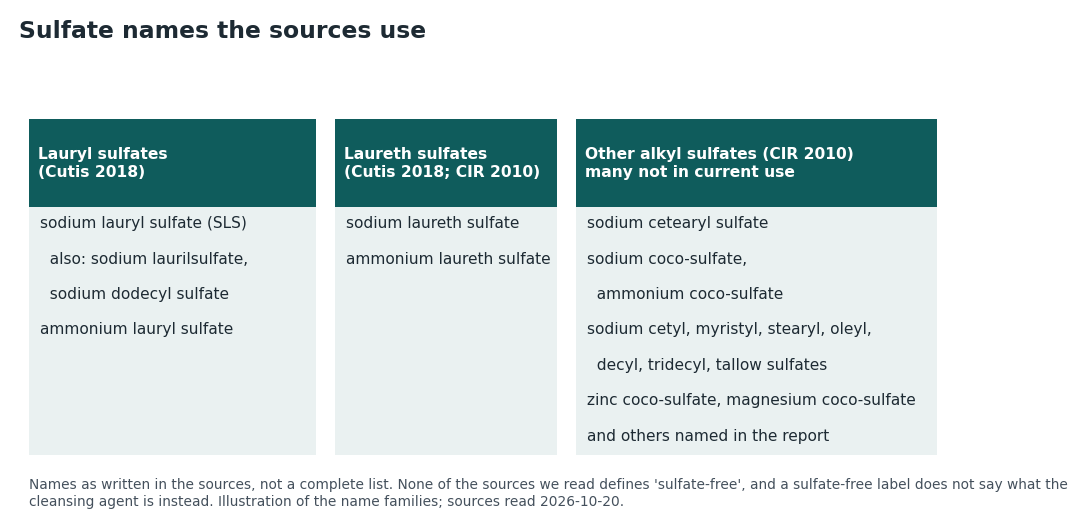
A 2018 review in Cutis by Cline, Uwakwe and McMichael describes sulfates as inexpensive detergents (anionic surfactants) responsible for lather in shampoos and many household cleaners. Sodium lauryl sulfate (SLS) is the most common in shampoo and conditioner; ammonium lauryl sulfate and sodium laureth sulfate are also common. Because they are potent surfactants, the review says, they remove dirt and debris as well as naturally produced oils, and can leave hair feeling dry. They are the main detergents in deep-cleaning shampoos made for heavy styling-product buildup, which typically are not used daily.
The review also says sulfate shampoos largely replaced traditional soap partly because soap formed a film of insoluble calcium salts on hair strands on contact with water, leaving it tangled and dull, and because soap's alkaline pH can be harsh. If your water leaves a film, that history is relevant; see our shampoo bar guide.
What the review says about the fears
The same review says sulfates have developed a negative reputation, with reports from unscientific sources calling them hazardous. It examines three claims:
- Eye damage and cataracts: it says the studies behind this used extreme conditions, such as animal eyes exposed continuously for 14 days, or a lens immersed in a highly concentrated solution, which it says do not represent how shampoo is used.
- Cancer: it says there is no known study showing SLS to be carcinogenic. It notes that 1,4-dioxane, classed by IARC as possibly carcinogenic to humans (Group 2B), is a by-product of ethoxylation, which applies to sulfates such as sodium laureth sulfate. SLS is not ethoxylated, though it says cross-contamination cannot be overlooked and that screening for 1,4-dioxane before commercial use is standard.
- Skin and scalp irritation: the review notes SLS has been described as an irritant. It does not call the fear unfounded.
What the Cosmetic Ingredient Review found
The Cosmetic Ingredient Review (CIR) is an expert panel program set up in 1976 by the cosmetics industry association with the support of FDA and the Consumer Federation of America, per a 2005 JAAD overview. Its 2010 amended report on sodium laureth sulfate and related salts says sodium and ammonium laureth sulfate "have not evoked adverse responses in any toxicological testing", and that sodium laureth sulfate was shown to be a dermal and ocular irritant but not a sensitizer. It says irritation is possible but not regularly seen in practice because of how the products are formulated, and that these ingredients should be used only when formulated to be nonirritating. A second 2010 CIR report on sodium cetearyl sulfate and related alkyl sulfates says they are surfactants used at 0.1% to 29%, primarily in soaps and shampoos, and concludes they are safe in the practices of use described. CIR was set up by the cosmetics industry association, so read these as one expert panel's view, not the last word.
What a sulfate-free label does and does not tell you
| The label says | It tells you | It does not tell you |
|---|---|---|
| Sulfate-free | A claim that the product avoids that class of detergent. None of the sources we read defines the term. | What cleans the hair instead, the pH, whether it irritates you, or whether it is better for hair. The Cutis review says reformulated products come with a "lack of proof that these formulations are an improvement over traditional approaches to hair health". |
| Contains sodium laureth sulfate | An ingredient CIR found to be an irritant that is regularly not irritating in finished products. | Whether your scalp will react. That depends on you and the formula. |
What the sources do not say
- That sulfates are safe or unsafe for your scalp. Neither source tests your situation.
- Whether sulfate-free shampoos reduce dryness, flaking or irritation in people. We found no trial.
- How "sulfate-free" is defined; our sources do not.
- Which other detergents replace sulfates, and how they compare.
The honest simpler option
If your current shampoo works and does not irritate you, nothing in these sources says to switch. If you do react, any ingredient could be the cause: the AAD says an itchy rash can come from an allergy to a shampoo, conditioner or other product, and a dermatologist can help find it (see the flaky scalp guide). Washing a little less often is another low-cost step the AAD's tips support; see the frequency guide.
More in this hub: the No-Poo Hair Care overview.
Sources
All read on 2026-10-20. Pages and abstracts can change, so check the date shown.
- Cline A, Uwakwe LN, McMichael AJ. "No Sulfates, No Parabens, and the "No-Poo" Method: A New Patient Perspective on Common Shampoo Ingredients." Cutis 2018;101(1):22-26 (PubMed 29529111)
- Robinson VC et al. "Final report of the amended safety assessment of sodium laureth sulfate and related salts of sulfated ethoxylated alcohols." Int J Toxicol 2010 (PubMed 20634505)
- Fiume M et al. "Final report on the safety assessment of sodium cetearyl sulfate and related alkyl sulfates as used in cosmetics." Int J Toxicol 2010 (PubMed 20448271)
- Bergfeld WF et al. "Safety of ingredients used in cosmetics." J Am Acad Dermatol 2005 (PubMed 15627090)
- AAD, "10 reasons your scalp itches and how to get relief" (no update date shown)