How the ingredient list is ordered
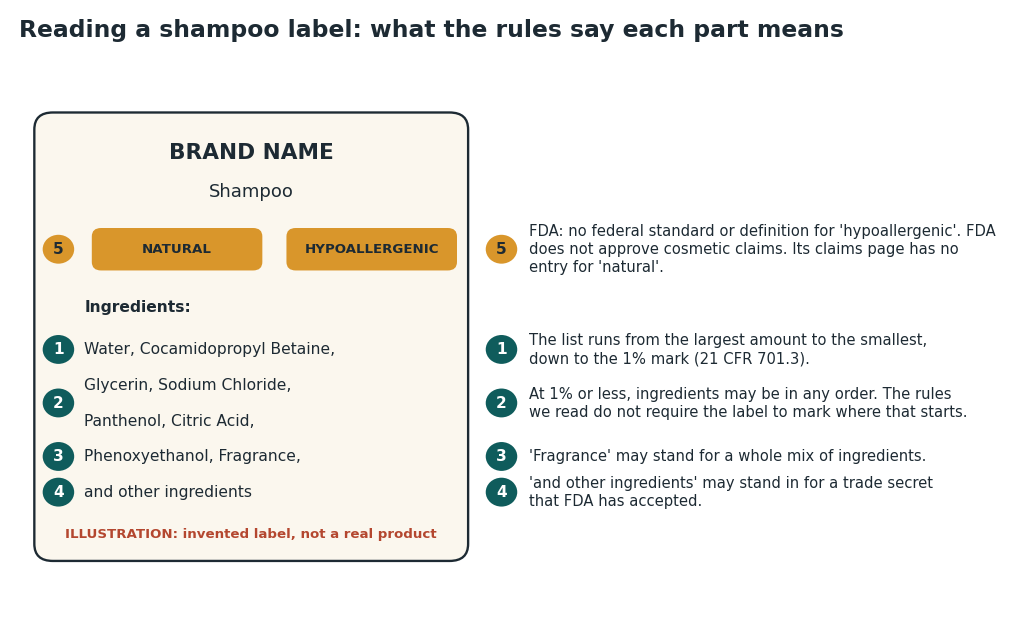
If a cosmetic is sold at retail, FDA requires the ingredients to be listed by common or usual name, generally in descending order of predominance. The regulation is 21 CFR 701.3, which we read on eCFR on 2026-10-20. FDA's Cosmetic Ingredient Names page (content current as of 02/25/2022) says this requirement comes from the Fair Packaging and Labeling Act. The rule has an alternative: a maker may list ingredients above 1 percent in descending order, then those at 1 percent or less in any order, then color additives in any order.
What that means when you read a shampoo: the first items are the largest part of the product. Further down, order may stop meaning anything. The rules we read do not require the label to mark where the 1% line falls.
What one word can cover
- Fragrance. The regulation lets a maker list a fragrance or flavor as "fragrance" or "flavor" instead of naming each component. FDA's labeling guide says the components may also be named individually.
- "and other ingredients". Where FDA has accepted an ingredient as a trade secret, the maker may write this phrase at the end of the list instead of the name.
- Incidental ingredients. FDA's guide says processing aids removed before packaging, and similar insignificant traces with no technical or functional effect, need not be declared.
If you react to a product, the list is what a dermatologist will want to see, and a single-word line like fragrance is a limit of what it can tell you.
What front-of-pack claims are worth
FDA's labeling claims page (content current as of 11/21/2022) says the law does not require FDA approval of cosmetic labeling before products are sold, and that FDA has no list of approved or accepted claims. Claims must be truthful and not misleading. FDA regulates labeling claims; the Federal Trade Commission regulates advertising claims.
| Claim | What FDA's pages say |
|---|---|
| Hypoallergenic | No federal standards or definitions govern the term. It means what a company wants it to mean, and makers do not have to submit substantiation to FDA. FDA adds that dermatologists say it has very little meaning. (FDA page; its text is dated October 18, 2000 and states it is updated only as needed.) |
| Organic | FDA does not define it for cosmetics. The USDA National Organic Program has a definition and certification. FDA says an ingredient's source does not determine its safety. |
| Natural | FDA's claims page has no entry for it. The page links an FTC article titled Are your "all natural" claims all accurate?, which we have not read. We found no FDA definition of the word for cosmetics. |
| Sulfate-free | No entry either. See our sulfate-free guide. |
What a label usually does not give you
A pH. A 2014 study of bathing soaps and shampoos in India found that most do not disclose pH (see our shampoo bar guide). Nor does a label say how your scalp will react.
What the sources do not say
- Whether the order of ingredients predicts how a shampoo feels or performs.
- How common "and other ingredients" or lone "fragrance" lines are in shampoos.
- Anything about FDA's current view of the word natural on cosmetics. We did not find a statement.
The honest simpler option
Read the ingredient list, not the front. The list is the part with legal rules behind it. If you have reacted to a product, photograph the list and take it, with the questions from our flaky scalp guide, to a dermatologist.
More in this hub: the No-Poo Hair Care overview.
Sources
All read on 2026-10-20. Pages and abstracts can change, so check the date shown.
- 21 CFR 701.3, "Designation of ingredients" (eCFR, read 2026-10-20)
- FDA, "Cosmetic Ingredient Names" (content current as of 02/25/2022)
- FDA, "Cosmetic Labeling Guide" (content current as of 02/25/2022)
- FDA, "Cosmetics Labeling Claims" (content current as of 11/21/2022)
- FDA, "Hypoallergenic" Cosmetics (content current as of 02/25/2022)
- FDA, "Organic" Cosmetics (content current as of 02/25/2022)
- Tarun J et al., Indian J Dermatol 2014 (PubMed 25284846)