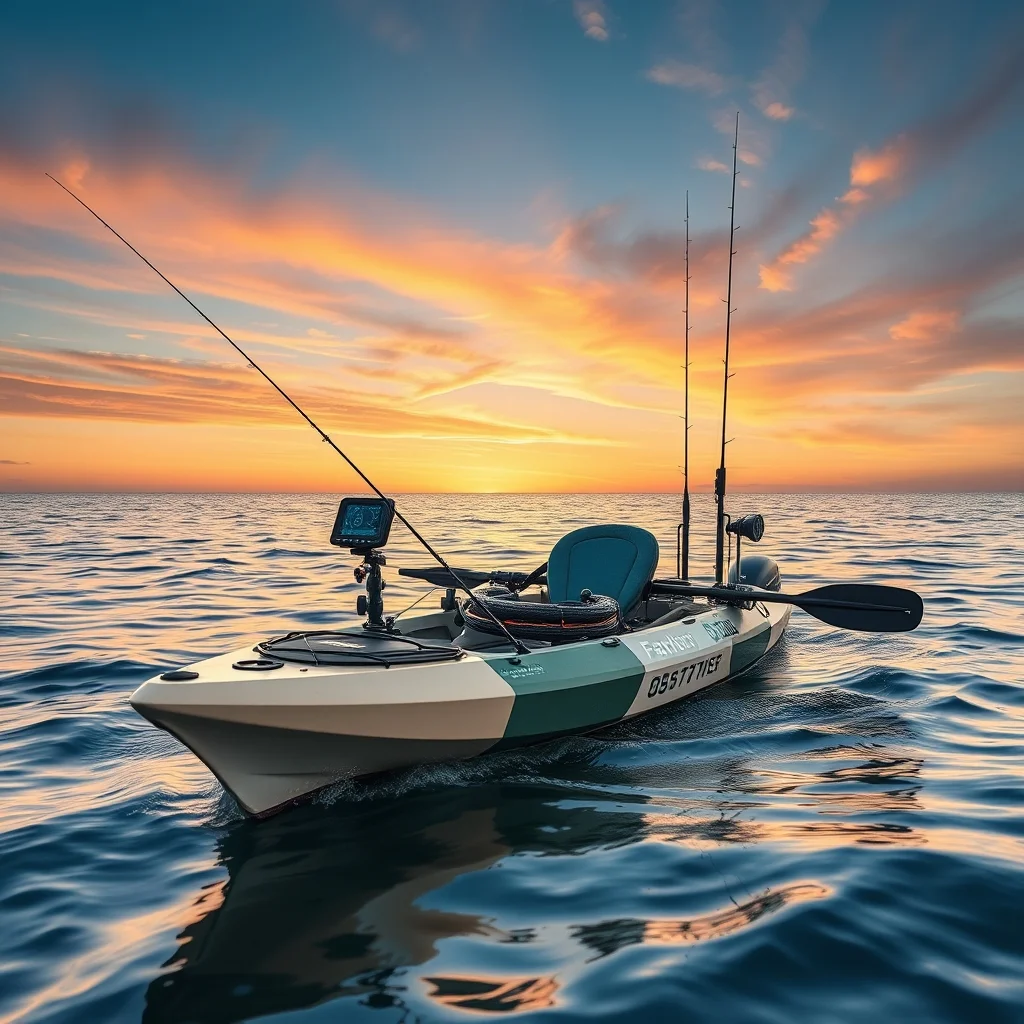
Sit-on-top vs sit-in: the platform choice
Virtually all purpose-built fishing kayaks use a sit-on-top (SOT) design rather than a traditional sit-inside cockpit. The reason is practical: SOT kayaks are dramatically easier to self-rescue (you simply climb back on if you capsize rather than executing a wet re-entry), they have an open deck that accommodates tackle crates, fish finders, and rod holders, and they drain through scupper holes in the hull rather than requiring bailing.
Sit-inside kayaks remain popular for touring, sea kayaking, and cold-water paddling where staying dry matters — the enclosed cockpit keeps the paddler's lower body protected. For fishing in temperate or warm water, the open deck of a SOT is nearly always the better platform.
A few niche exceptions: narrow, shallow streams and creeks where a shorter, more maneuverable sit-in kayak makes sense, or cold-water environments where a dry suit and sit-in design are necessary for safety. For most freshwater and inshore saltwater fishing, SOT is the default starting point.
Stability: primary vs secondary, and what hull width actually means
Kayak stability has two components that are often conflated in buyer discussions: primary stability and secondary stability. Understanding the difference explains why some hulls feel stable but capsize easily, while others feel initially "tippy" but are extremely difficult to actually flip.
Primary stability is how stable the kayak feels when you're sitting still on flat water — the initial resistance to tipping. Wide, flat-bottomed hulls have high primary stability. They feel rock-solid when you first step on. This is what most fishing kayak buyers want and what marketing emphasizes.
Secondary stability is how the kayak behaves once it's tipped past the initial flat — how well it resists actually capsizing when loaded sideways, when you lean to cast, or when a wake or wave hits. Hulls with lower initial stability (narrower, rounded bottoms) often have much higher secondary stability — they roll with the water rather than fighting it, and recover rather than flipping.
For stand-up fishing kayaks — a major marketing category — secondary stability is more important than primary. A very wide, flat hull might feel stable seated but can flip abruptly when you stand and shift weight. Purpose-built stand-up kayaks have hull designs optimized for secondary stability with enough width to make standing practical. Hull widths of 34–36 inches or more are typical for stable standing.
Hull length and speed tradeoffs
Kayak hull speed is fundamentally limited by hull length — longer hulls move through water more efficiently at speed. A 14-foot kayak will cover ground faster for the same paddling effort than a 10-foot kayak. The tradeoff is that longer kayaks are harder to maneuver in tight cover (brushy creek channels, dock skipping, working around laydowns) and are more difficult to transport and car-top.
Most fishing kayaks run 12–14 feet. Shorter kayaks (10–12 feet) are better for small rivers, tight creeks, and anglers who need easy transport. Longer kayaks (13–14 feet) are better for open lakes, reservoirs, and tidal flats where covering ground matters.
Propulsion: paddle, pedal, and motor options
Propulsion is one of the highest-leverage choices in fishing kayak selection because it directly determines whether your hands are free to fish while moving.
Paddle kayaks
The baseline option. A paddle kayak is propelled by a double-bladed paddle held in both hands. When you're paddling, you're not fishing. The advantage: lower weight, lower cost, simpler mechanics with nothing to break or service, and better performance in very shallow water (no drive system hanging below the hull). Paddle kayaks are also lighter and easier to car-top unassisted. For anglers who fish stationary or move short distances between spots, a paddle kayak is often the right choice.
Pedal kayaks
Pedal drives use your legs to propel the kayak — either through rotating fins (like a Hobie Mirage drive, which uses flipper-like fins in an elliptical stroke) or through a small underwater propeller driven by a crankshaft. Both leave your hands completely free to hold a rod, work a trolling lure, or adjust gear while moving. This is the primary advantage: you can troll a lure consistently with both hands on the rod.
Shopping for fishing kayaks? Browse current eBay listings → (we earn a small commission; your price is unchanged).
Pedal kayaks are heavier (a Hobie Pro Angler runs 130–140 lbs vs 60–80 lbs for a comparable paddle kayak), more expensive, and require minimum water depth — typically 6–8 inches for the fin-based systems, deeper for propeller systems. In very shallow flats, mangroves, or grass-choked shallows, the drive system must be retracted. But for open-water fishing, trolling, and covering ground efficiently, pedal drives are transformative.
Motor-assisted kayaks
Small electric trolling motors (30–55 lb thrust) mounted on fishing kayaks extend range and reduce fatigue on large water. Some purpose-built kayaks come motor-ready with dedicated mount points and battery storage; others require aftermarket rigging. Battery weight and capacity are the primary constraints — a 30 Ah lithium battery weighs roughly 15–20 lbs and provides several hours of low-thrust trolling. The motor and battery add 30–50 lbs to the overall system weight, which matters for transport and launch.
Weight capacity: the calculation that actually matters
A kayak's stated weight capacity is not a load rating for optimal performance — it's typically the maximum before the hull sinks dangerously low in the water. Most kayak manufacturers recommend loading to 70–80% of the stated maximum for best performance and a safe freeboard margin.
The calculation you should actually make: your body weight + gear weight + kayak accessories (fish finder, battery, crate, tackle, water, food, anchor). A 175-lb angler with 40 lbs of gear needs a kayak with a practical working load of 215 lbs — meaning a stated capacity of at least 270–300 lbs to stay at 70–80% of max. Many entry-level kayaks rated for "up to 300 lbs" are already at their working limit for a fully equipped 200-lb angler.
| Angler weight | Typical gear load | Recommended minimum capacity |
|---|---|---|
| Under 150 lbs | 30–40 lbs | 250 lbs minimum |
| 150–200 lbs | 40–60 lbs | 300–350 lbs minimum |
| 200–250 lbs | 50–70 lbs | 380–450 lbs minimum |
| Over 250 lbs | 60–80 lbs | 475+ lbs — verify specific model |
Rigging essentials: rod holders, crates, and electronics mounting
A bare fishing kayak requires rigging to become a functional fishing platform. The core components:
Rod holders: Most fishing kayaks include 2–4 flush-mount rod holders molded into the deck. These hold rods while you paddle or pedal. Aftermarket RAM rod holders on adjustable arms allow angling rods forward or outward for trolling. For serious kayak anglers, 4–6 total rod positions (flush and RAM) is a common setup.
Tackle crate system: A Milk Crate or purpose-built kayak crate fits in the rear tank well and holds utility trays, a tackle bag, tools, and a small cooler. The crate system keeps gear organized and accessible without loose items sliding around the deck.
Fish finder mount: Most fishing kayaks include a standard transducer scupper — a scupper hole sized to accept a transducer mounting arm. The head unit mounts on a RAM mount or adjustable arm on the dash area. A 5–7" unit is the standard for kayak use; larger screens require secure mounting to handle vibration.
Anchor system: A 1.5–3 lb folding grapnel anchor on a 30–50 foot line and a cleat or anchor trolley lets you hold position on current or wind. An anchor trolley — a rope-and-ring system running along the side of the kayak — allows repositioning the anchor point from bow to stern without moving the anchor itself, allowing the kayak to weathervane with wind and current rather than being pushed sideways.
Inflatable vs hard-shell: the transport question
Inflatable kayaks have advanced significantly — drop-stitch floor construction in quality inflatables creates rigid bottoms comparable to hard shells at fishing speeds. For anglers without a truck, roof rack, or trailer, an inflatable that packs into a large duffle bag solves the transport problem entirely. The tradeoffs: inflation/deflation time (typically 10–20 minutes each way), slightly slower tracking performance, and more susceptibility to wind drift due to higher freeboard.
Hard-shell kayaks (polyethylene, thermoform, or composite) are more durable long-term, track better, and are typically more stable for standing. They require a vehicle with roof rack capacity or a small trailer, and unloading a 90–130 lb kayak solo demands technique or a partner.
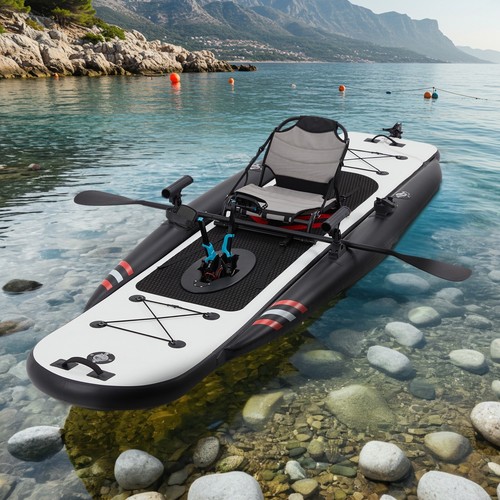 Fishing kayak
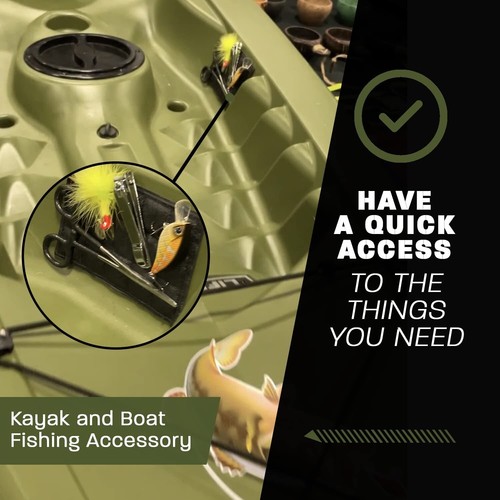 Kayak fishing accessories