Power: how much force it takes to bend the rod
Power — sometimes called "weight" — is the most fundamental rod spec. It describes the rod's resistance to bending under load. Manufacturers use a scale that typically runs: ultralight (UL), light (L), medium-light (ML), medium (M), medium-heavy (MH), heavy (H), and extra-heavy (XH). Some brands add intermediate steps like medium-medium-heavy (MMH), but the core scale above covers most rods sold.
Power governs two things directly: the recommended line weight and the recommended lure weight. Every rod has these ranges printed on the blank near the handle, and they are the most actionable specs on any rod. A medium-light rod might call for 6–12 lb test and 1/8–3/8 oz lures. An extra-heavy rod might call for 17–65 lb braid and 1–4 oz lures. Fishing outside those ranges — too heavy a lure on a light rod, or too light a lure on a heavy one — produces either broken rods or casts that go nowhere.
| Power | Typical line range | Typical lure range | Common uses |
|---|---|---|---|
| Ultralight | 2–6 lb | 1/32–1/4 oz | Trout, panfish, creek bass |
| Light | 4–8 lb | 1/16–3/8 oz | Trout, small bass, walleye |
| Medium-Light | 6–10 lb | 1/8–3/8 oz | Bass finesse, walleye, crappie |
| Medium | 8–14 lb | 1/4–5/8 oz | All-around bass, pike, redfish |
| Medium-Heavy | 10–20 lb | 3/8–1 oz | Bass, muskie, big redfish |
| Heavy | 15–30 lb | 1/2–1.5 oz | Catfish, muskie, inshore saltwater |
| Extra-Heavy | 20–65 lb (braid) | 1–4 oz | Offshore, big catfish, surf |
Action: where the rod bends
Action describes where along the blank the rod begins to flex when loaded. It runs from extra-fast through fast, moderate-fast, moderate, and slow. A fast-action rod bends primarily in the top third — the tip deflects significantly while the lower two-thirds remain relatively stiff. A slow-action rod bends in a deep parabolic curve from butt to tip.
Action affects three things: sensitivity, hook-setting power, and the type of lures the rod handles well.
Fast action is the dominant choice for most modern bass fishing techniques — jigs, Texas-rigged plastics, swimbaits, and drop-shots. The stiff lower section transmits bottom vibration as tactile feedback up through the cork or EVA grip. When you set the hook, that stiffness translates energy directly into the fish's jaw. Fast action rods are less forgiving, though: they don't absorb surges during a fight the way softer rods do, which matters on light line.
Moderate action bends through the middle and upper half of the blank. This gives it a built-in shock-absorber quality that works well for treble-hook lures — crankbaits, topwater plugs, and jerkbaits. When a bass hits a crankbait and shakes, a moderate rod "loads" against the fish and keeps the hooks pinned. A fast rod on the same lure can lever hooks out of a soft mouth. Many experienced bass anglers own both a fast rod for plastics and a moderate rod for crankbaits specifically for this reason.
Slow action rods (full-parabolic) are relatively rare in freshwater but common in fly-fishing and some ultralight trout applications where casting lightweight lures or absorbing the fight of small fish on thin tippet is the priority.
Length: casting distance versus leverage and feel
Rod length primarily affects casting distance and leverage. A longer rod generates more arc on the cast — the tip travels a longer path, which translates to more line velocity and distance. A 7'6" rod will typically outcast a 6'6" rod with the same lure and same casting stroke. This matters on open water or when you need to reach structure across a flat.
Shorter rods offer more precision and better feel in tight quarters. A 6'0" to 6'6" rod is easier to handle in heavy brush, under low-hanging trees, or when skipping docks. The reduced arc makes accuracy easier to manage at close range. Many bass finesse anglers prefer 6'6"–6'10" spinning rods for drop-shot and shaky head work: long enough for a solid cast, short enough for sensitivity.
For surf and beach fishing, length is the dominant spec. Rods running 9–14 feet allow casts that clear the wave zone and reach the outer bar where feeding fish hold. The trade-off is pure bulk — a 12-foot surf rod is unwieldy in any other context.
Spinning vs casting: reel seat, guide orientation, and grip style
Spinning rods have a reel seat that holds the reel below the blank, guides that face downward toward the ground when held naturally, and are designed to work with open-face spinning reels. The spool is fixed and line uncoils in loops off the front — which means line twist is the main mechanical issue to manage. Spinning setups handle lighter lines and lures better than casting gear, and the learning curve is much more forgiving.
Shopping for fishing rods? Browse current eBay listings → (we earn a small commission; your price is unchanged).
Casting rods have a trigger grip below the reel seat, guides that face upward, and are designed to pair with baitcasting or spincast reels. The trigger grip provides a reference point for the thumb, which controls spool speed on a baitcaster and determines casting accuracy. Casting setups handle heavier lines and lures more efficiently than spinning gear, and the mechanical advantage when working big jigs or heavy swimbaits is noticeable. The trade-off is a steeper skill curve: baitcasters backlash if not properly thumbed on the cast.
Neither style is universally superior. Most serious bass anglers use both — spinning for finesse presentations (drop-shot, shaky head, small swimbaits) and casting for power techniques (jigs, Texas rigs, big swimbaits, topwater).
Graphite vs fiberglass: material tradeoffs
Modern fishing rods are made from one of three materials: graphite (carbon fiber), fiberglass, or a composite of both. Each has genuine strengths.
Graphite dominates the market because it is lighter, stiffer, and more sensitive than fiberglass at comparable diameters. High-modulus graphite (IM6, IM7, IM8, or proprietary designations like "HM86") refers to how stiff and lightweight the carbon fiber is — higher modulus means lighter blanks with less material needed to achieve the same stiffness. The tradeoff: higher-modulus graphite is more brittle. An IM8 blank snapped in a car door or nicked against a concrete dock piling is more likely to crack than a fiberglass blank taking the same hit. For anglers who are careful with gear, graphite's sensitivity advantage is real and worth it.
Fiberglass is heavier and less sensitive but nearly indestructible and more forgiving under load. It flexes without the brittleness risk. Moderate-action fiberglass crankbait rods — popularized by the original Shakespeare Ugly Stik and later by St. Croix and Shimano's glass crankbait rods — are a deliberate choice for treble-hook applications because the parabolic bend under load keeps fish pinned through a fight better than a stiff graphite blank. Fiberglass is also the right choice for beginning anglers who are harder on gear.
Composite (glass-graphite blend) attempts to deliver the sensitivity of graphite with the durability and flex of fiberglass. Quality varies by manufacturer. A well-designed composite blank can be genuinely excellent for crankbait or topwater work. A cheap composite blank often ends up with the drawbacks of both materials rather than the strengths.
Guide quality: what actually matters
Guides are the rings the line passes through from the reel to the tip. The material of the guide insert — the ring itself — matters more than most beginners expect. Three common insert materials:
- Aluminum oxide — the entry-level standard. Durable enough for monofilament and fluorocarbon. Braid can groove cheaper aluminum oxide over time.
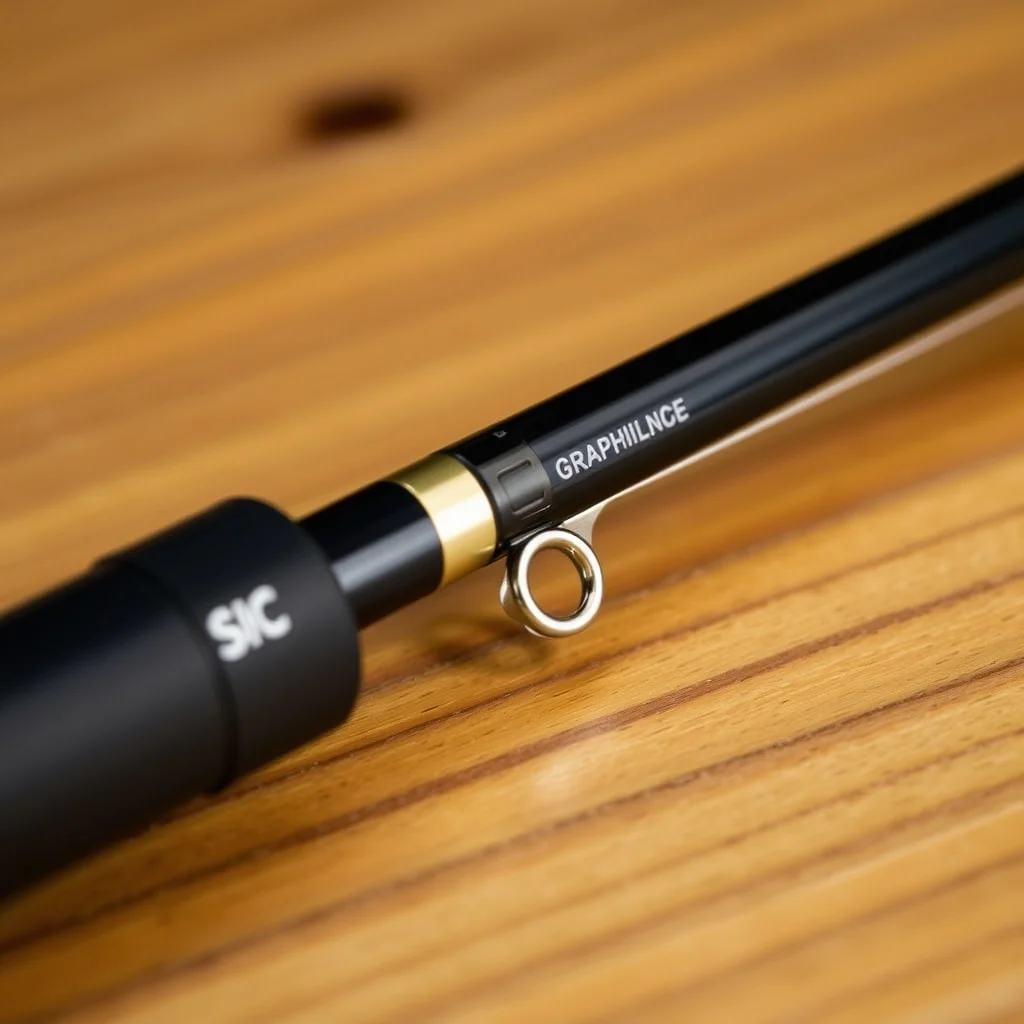
- Silicon carbide (SiC) — the premium standard. Extremely hard, perfectly smooth, handles braid without wear, and dissipates heat from high-speed casting better than aluminum oxide. Most rods above $100 retail use SiC or a proprietary equivalent.
- Titanium frames — the frame that holds the insert can be stainless steel or titanium. Titanium frames are significantly lighter and flex slightly on impact rather than cracking. A titanium-framed SiC guide is the combination found on high-end bass rods.
For braid lines specifically, SiC inserts are worth paying for. Running 30 lb braid through aluminum oxide guides for a full season will groove the guides, which then frays the braid and degrades casting distance.
The practical matching guide: rod spec to technique
Connecting specs to techniques is the actual goal. A few direct mappings:
- Drop-shot or shaky head (finesse bass): 6'8"–7'0" ML or M spinning, fast action, graphite. Sensitivity is everything here — you need to feel the jig on bottom and detect light bites.
- Jig or Texas-rig (power bass): 7'0"–7'4" MH casting, fast to extra-fast action, graphite. The stiff tip detects strikes, the powerful lower section drives the hook home.
- Crankbait (bass/pike): 7'0"–7'6" M casting, moderate action, fiberglass or composite. The soft tip loads against the fish's head shake and keeps treble hooks pinned.
- Topwater walking bait: 6'6"–7'0" M or MH casting, moderate-fast action. Moderate-fast gives some tip cushion without going fully soft.
- Surf fishing: 9'0"–12'0" H or XH spinning, moderate-fast action. Length for distance, power for sinker weight and big fish.
- Trout / panfish: 5'6"–6'6" UL or L spinning, moderate to fast action, graphite. Light and sensitive — you're detecting subtle takes, not setting a jig hook into hard bone.
 Spinning rod
 Ultralight fishing rod