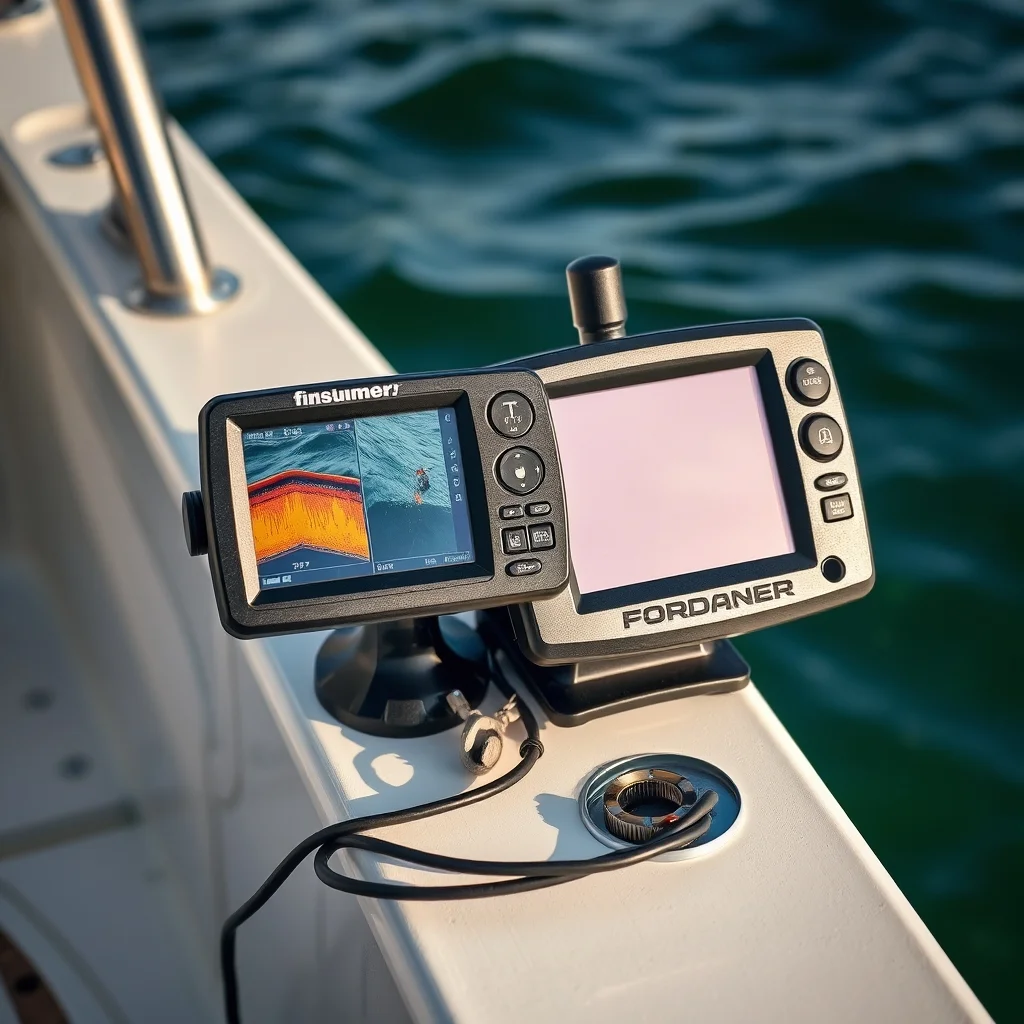
How sonar works: the basics behind every fish finder
A fish finder consists of two components: the head unit (the display and processor) and the transducer (the underwater sender/receiver). The transducer converts electrical energy into sound pulses, transmits them into the water, listens for the return echo, and sends that signal to the head unit for processing and display.
The key variables are transmit frequency (measured in kHz), pulse width, and power (measured in watts of peak-to-peak power, or RMS — note that most manufacturers quote peak-to-peak, which is about 8× higher than RMS). Higher frequency produces more detail at shallower depths; lower frequency penetrates deeper but with less resolution. This tradeoff is the central tension in fish finder design.
Traditional 2D sonar uses a single frequency to draw a scrolling view of what's below the boat. CHIRP sonar sweeps a continuous range of frequencies in each pulse, producing dramatically better target separation and detail. Imaging sonar (down imaging, side imaging) uses a different transducer element that produces a thin, high-frequency "knife blade" beam aimed to produce near-photographic images of the bottom.
Traditional 2D sonar: the baseline
Traditional fish finders operate at fixed frequencies — typically 83 kHz (wide, shallow penetration for structure and vegetation) and 200 kHz (narrow, deeper penetration for fish arches and bottom detail). Most entry-level and mid-range fish finders offer dual-frequency capability, allowing you to display both simultaneously or split-screen.
Traditional 2D is excellent for reading depth, identifying bottom composition (hard vs soft), tracking depth changes quickly, and finding general fish presence. It's not ideal for distinguishing individual fish in schools, reading complex structure, or understanding bottom features in detail. For ice fishing, basic freshwater lake fishing, and beginners, it's fully capable.
CHIRP: what it changes and why it matters
CHIRP — Compressed High Intensity Radar Pulse — transmits a sweep of frequencies in a single pulse rather than a single frequency. Where traditional 200 kHz transmits one frequency, a CHIRP transducer might sweep from 150–220 kHz in each pulse. The processor correlates the returned signal across all those frequencies, separating targets that overlap in traditional sonar.
The practical result is dramatically better target separation — fish near the bottom, fish near each other in a school, and structure near fish all appear as distinct, clearly separated targets rather than merging blobs. CHIRP also produces consistently better deep-water performance than traditional single-frequency sonar at comparable power ratings.
CHIRP requires a CHIRP-capable transducer — upgrading a head unit to a CHIRP-compatible model while keeping an old single-frequency transducer gains you nothing. The transducer upgrade is often what makes CHIRP worthwhile.
Down imaging: what it shows and when it matters
Down imaging (also called DownScan or DownVü depending on manufacturer) uses a thin, high-frequency sonar beam — typically 455 kHz and 800 kHz — that fans out in a wide swath directly below the boat. The result is a nearly photographic image of the bottom structure directly beneath you: rocks, timber, brush piles, ledges, and fish appear with a level of detail that traditional 2D cannot match.
Down imaging is particularly valuable for understanding bottom composition and structure — distinguishing a brush pile from a rock pile, seeing individual limbs on a submerged tree, or identifying the lip of a ledge. It's less useful for real-time fish detection because the thin beam has a very narrow width; fish must pass directly through the slice to appear on screen.
Pairing traditional 2D or CHIRP (for fish detection) with down imaging (for structure detail) on a split screen is the standard setup for bass and walleye anglers on structure-rich water.
Side imaging: mapping structure laterally
Side imaging sends thin sonar beams out to both sides of the boat — typically to 75 or 150 feet per side at 455/800 kHz — building a continuous mosaic of bottom structure as you move. It reveals what's beside the boat, not just below it: points, humps, submerged roads, timber, and grass beds visible from a distance in the sonar image.
Shopping for fish finders? Browse current eBay listings → (we earn a small commission; your price is unchanged).
Side imaging is most valuable on large bodies of water where you need to cover ground efficiently to find productive structure. On small ponds or narrow rivers, its advantage shrinks. It requires a dedicated side-imaging transducer element (most combo transducers on higher-end units include this). Side imaging at 800 kHz provides more detail at shorter range; 455 kHz reaches farther but with less resolution.
GPS chart plotting: features that matter
GPS functionality in a fish finder allows you to mark waypoints (productive spots, hazards, your launch ramp), track your route, and navigate between points. Chart plotting overlays your position on a nautical or lake map, allowing you to see depth contours, boat lanes, and underwater features relative to your position.
Built-in base maps on most fish finders are rudimentary — they show general lake shape and approximate depths. Premium mapping upgrades (Navionics+, LakeMaster, C-MAP) loaded via SD card provide highly detailed contour data, often showing 1-foot contour lines where the base map shows 10-foot lines. For structure fishing on unfamiliar lakes, this level of detail is genuinely valuable.
Some newer units offer the ability to create your own custom maps from GPS and sonar data as you fish — building a detailed contour map of your home lake over multiple seasons. Garmin's Quickdraw and Humminbird AutoChart are the two primary proprietary versions of this capability.
Screen size and resolution: the practical limits
Screen size is partly a practical matter (sunlight readability, mounting space) and partly about how much information you can display simultaneously. A 7" screen can run 4-way split (CHIRP, down imaging, GPS map, depth numbers) without each panel becoming too small to read. A 5" screen running the same split becomes difficult to interpret at speed.
For kayak and small boat mounting, 5–7" units are the standard choice — they're compact, low-power, and purpose-built for narrow mounting tracks. For bass boats and pontoons with dedicated console mounting, 9–12" units allow full-featured display layouts and better sunlight visibility. Sunlight readability (measured in nits — 1500+ nits is excellent in full sun) matters significantly on open water where you can't shade the screen.
Transducer mounting: options and tradeoffs
The transducer must contact the water (or be in the water) to function. Four mounting approaches cover most fishing platforms:
- Transom mount: The standard for aluminum and fiberglass bass boats. A bracket clamps to the transom and holds the transducer below the waterline. Works well at low-to-moderate speeds; turbulence at high speed can cause signal loss with low-quality brackets.
- Through-hull mount: The transducer is installed through a hole in the hull, either as a "shoot-through" (glued to the inside of the hull with no hole) or a true through-hull. Most reliable signal, but permanent installation. Shoot-through works only on fiberglass hulls — not aluminum or wood.
- Trolling motor mount: Attaches to the trolling motor head, positioning the transducer at the bow. Excellent for fishing while moving at slow trolling speeds — the bow-mounted unit sees undisturbed water ahead of the propeller wash.
- Kayak scupper or track mount: Most fishing kayaks have scupper holes (drainage holes through the hull) or built-in tracks that accept compatible transducer mounting arms. Purpose-built kayak transducer mounts hold the transducer at the correct depth without cutting the hull.
Matching unit to fishing scenario
| Scenario | Recommended features | Screen size |
|---|---|---|
| Small pond / creek bass | Traditional 2D or basic CHIRP, GPS optional | 5–7" |
| Lake bass / structure fishing | CHIRP + down imaging + GPS with premium map | 7–9" |
| Large reservoir / walleye | CHIRP + side imaging + GPS (custom mapping) | 9–12" |
| Kayak fishing | Basic CHIRP or 2D, GPS, low power draw | 5–7" |
| Shore / castable | Castable Bluetooth unit, phone display | Phone screen |
| Ice fishing | Flasher or dedicated ice unit, portable | Varies |
 Fish finder with GPS
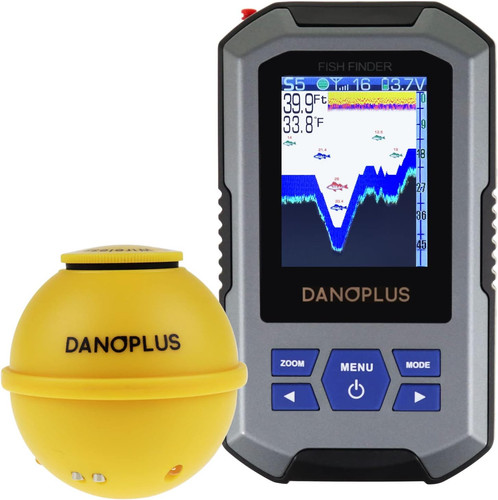 Portable fish finder
 Kayak fish finder