
The Eurorack format: what it specifies and what it doesn't
The Eurorack standard was established by Dieter Doepfer with the introduction of the A-100 modular system in 1995. It specifies the following physical and electrical parameters:
- Height: 3U (rack units), where 1U = 1.75 inches. Modules are 128.5 mm tall.
- Width: Measured in HP (horizontal pitch), where 1HP = 5.08 mm. A typical module might be 4HP, 8HP, 12HP, or wider.
- Power supply voltages: ±12V DC (required) and +5V DC (optional, not all modules use it).
- Power connector: 16-pin IDC connector (10-pin also exists on some older modules).
- Signal levels: Not strictly specified, but audio signals typically run at ±5V peak, CV signals at various ranges depending on manufacturer convention.
What Eurorack does not specify: panel layout, jack assignments, CV/gate signal ranges (manufacturers use both 0–5V and 0–10V CV, and ±5V audio), or any aspect of what the module actually does. This is both the format's strength (enormous variety of modules possible) and the buyer's challenge (no standardization on how modules interface with each other).
Power: the variable that hides in listings
Every Eurorack module draws current from the power bus on the +12V, -12V, and optionally +5V rails. The case's power supply has a maximum current rating on each rail. If the total current draw of installed modules exceeds the power supply's rating, the system will malfunction — typically with noise, CV instability, or module failures that can be difficult to diagnose because they are load-dependent rather than constant.
Module power draw is specified in milliamps (mA) per rail. A typical VCO might draw 50mA on +12V and 40mA on -12V. A complex DSP module might draw 200mA on +12V and 10mA on -12V. The asymmetry between rails matters — a supply rated at 3A/3A (+12V/-12V) can still be overloaded on the -12V rail if the module selection is heavily negative-rail-intensive.
Bus board quality matters
The bus board distributes power from the supply to the individual modules. A poor-quality bus board with inadequate decoupling capacitors allows voltage noise from one module's power supply rejection to bleed into adjacent modules. This manifests as audio noise that moves with specific module activity. Quality bus boards (from Tiptop Audio, Doepfer, TPS series, and others) use decoupling capacitors on each power connector position to reduce this crosstalk.
Make Noise: complex patches, distinctive architecture
Make Noise (Tony Rolando, Asheville, NC) produces modules in the complex/experimental end of the Eurorack spectrum. The brand's defining modules include Maths (a function generator/CV processor that does not fit neatly into any single category), René (a Cartesian sequencer), Morphagene (a granular sampler/splicer), QPAS (four-channel state variable filter), and 0-CTRL (a touch controller/sequencer).
Make Noise modules are hardware-software hybrids in the sense that many contain microcontrollers running firmware that can be updated. Firmware updates on Maths, René (v2), and other modules add new features and address bugs. Verifying the firmware version on a used Make Noise module is straightforward — the module typically displays firmware version on startup or via a hidden menu.
Make Noise condition priorities
- Firmware version: Check the manufacturer's update page for the module and compare against the installed version. Outdated firmware may lack features or contain known bugs.
- All jacks functional: 3.5mm TS (mono) jacks on Eurorack modules can develop intermittent contact with age. Test all jacks with a patch cable and verify signal is clean in both directions.
- Knob smooth travel: Potentiometers on heavily used modules develop scratching or dead spots. Test all knobs across their full range while monitoring the parameter they control.
- Panel condition: Make Noise panels are screen-printed; heavy use can wear the printed graphics. This is cosmetic but can affect readability of the panel layout.
Mutable Instruments: discontinued and open-source
Mutable Instruments, founded by Émilie Gillet in France, produced some of the most widely used and celebrated Eurorack modules before the company was closed in 2022. Key modules include Clouds (a granular processor, discontinued before the company closure), Braids (a macro-oscillator), Rings (a resonator/physical modeling module), Plaits (Braids successor), Elements (a physical modeling voice), Stages, Marbles, and others.
Gillet open-sourced the hardware and firmware designs for all Mutable Instruments modules. This created two important dynamics for used buyers:
First, genuine MI production modules coexist on the used market with DIY builds and commercial clones. DIY builds are not inherently inferior, but the quality varies significantly by builder, and a DIY module should be priced accordingly. Commercial clones (Antumbra, Tall Dog, Momo) are often smaller (1U or fewer HP) and have cosmetic differences; they are NOT genuine MI modules and should not be priced as such.
Second, many Mutable firmware modules run alternative firmware developed by the community. Clouds in particular has several well-known alternative firmware versions (Parasites, Kammerl Beat Repeat) that change the module's behavior significantly. A Clouds running alternative firmware sounds different from factory Clouds — verify which firmware is installed.
Shopping for Eurorack modules? Browse current eBay listings → (we earn a small commission; your price is unchanged).
Mutable condition priorities
- Genuine vs clone/DIY: Genuine MI modules have distinctive panel artwork and build quality. Ask for a photo of the back of the module; genuine MI boards have consistent silkscreen and component placement.
- Firmware version and type: Ask what firmware is installed. Factory firmware vs community alternatives (Parasites, etc.) affects functionality significantly.
- All modes functional: Mutable modules typically have multiple modes accessed via button combinations. Test all documented modes before buying.
Doepfer A-100: the format's foundation
Doepfer's A-100 system modules represent the Eurorack format's reference implementations. The A-110 VCO, A-108 filter (Moog ladder topology), A-124 Wasp filter, A-140 ADSR, A-150 voltage-controlled switch, and many others form the foundation of a large proportion of European and global Eurorack systems.
Doepfer modules are generally utilitarian in design — functional, robust, and straightforwardly documented. They are also typically among the more affordable used modules in their categories. The A-100 series has been in continuous production since 1995 with incremental revisions; some earlier versions have minor differences from current production but are not typically considered separately collectible.
Doepfer condition priorities
- All jacks: Doepfer uses standard 3.5mm jacks. Test all jacks with cable and signal. Worn jacks are the most common issue on heavily used modules.
- CV tracking on VCOs: The A-110 and other VCO modules should track 1V/octave accurately. Test tracking across multiple octaves — a module that tracks correctly at low octaves but drifts at high octaves may need recalibration.
- Power connector: Doepfer modules use both 10-pin and 16-pin IDC connectors depending on the module and production year. Verify the connector is compatible with your bus board before buying.
Cases: what to look for
The case holds the modules and the power supply. Case quality affects both the practical experience of using the system and, more importantly, the power quality delivered to the modules.
| Case factor | What it affects | What to look for |
|---|---|---|
| Power supply rating | Maximum module load before instability | Rated current in mA per rail, separately for +12V/-12V/+5V |
| Bus board design | Noise crosstalk between modules | Per-connector decoupling caps; quality brands: Tiptop, Doepfer |
| Rail voltage regulation | CV stability under load variation | Switching vs linear regulation; ask manufacturer or check spec sheet |
| Case material/construction | Module security, portability | Threaded mounting rails vs plastic; rack compatibility |
| Depth | Deep module compatibility | Some modules exceed 50mm depth; verify case depth before buying deep modules |
Module condition: what actually wears
Eurorack modules are solid-state electronics with no moving parts beyond the panel controls (potentiometers, encoders, buttons). Wear and failure modes concentrate in a few areas:
3.5mm jacks
The most heavily used component on any active Eurorack module is its 3.5mm TS jacks. In systems where patching and repatching happens constantly, a busy jack can receive dozens of connection cycles per session. The most common failure is the jack's internal ground contact becoming intermittent, which causes signal dropout when the cable is slightly jostled. This is repairable by resoldering the jack or replacing it, but it indicates heavy use.
Potentiometers and encoders
Potentiometers that control parameters (frequency, resonance, depth, etc.) develop a scratching sound when the resistive element oxidizes or wears. Encoders on digital modules can develop loose detents or missed steps. Both are repairable with cleaning or replacement, but the presence of these issues on a used module indicates it was heavily used.
Panel cosmetics
Eurorack panels are typically aluminum with printed graphics. The graphics can scratch or wear, particularly around frequently used controls. A worn panel is cosmetically degraded but functionally fine — factor this into price expectations. Replacement panels are available for popular modules from several aftermarket suppliers.
Buying on eBay: key questions to ask
- What firmware version is installed, and is it factory or alternative?
- Are all jacks functional? (Ask for a demo video if possible)
- Is this a genuine production module or a DIY build / clone?
- What case was it powered in, and what is the power supply rating?
- Has the module ever been repaired or modified?
- What is the HP width and power draw? (Cross-reference against published specs)
Used Eurorack module prices tend to track close to the original retail price for modules that are still in production, and above retail for discontinued modules with strong reputations (Clouds, Braids, certain Make Noise modules). The secondary market is efficient enough that significant discounts on popular modules often indicate a condition issue — price the risk accordingly.
Search eBay for these modules
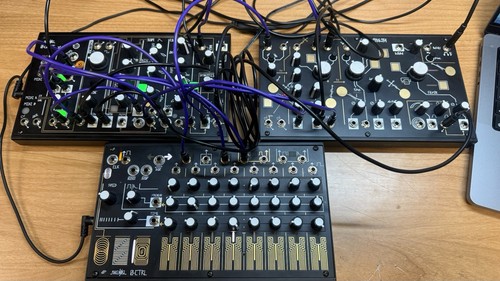 Make Noise modules
Verify firmware version and test all jacks and knobs.
Make Noise modules
Verify firmware version and test all jacks and knobs.
 Mutable Instruments
Confirm genuine MI production vs clone. Ask about firmware type.
Mutable Instruments
Confirm genuine MI production vs clone. Ask about firmware type.
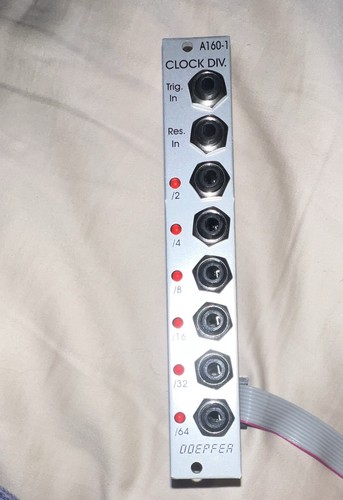 Doepfer A-100
Test all jacks and CV tracking on VCOs. Good value reference implementations.
Doepfer A-100
Test all jacks and CV tracking on VCOs. Good value reference implementations.
 Eurorack modules (all)
Broad search for less common manufacturers and bundle deals.
Eurorack modules (all)
Broad search for less common manufacturers and bundle deals.