Motor horsepower: what it actually means for your clay
Pottery wheel motors are rated in horsepower (HP), and the numbers get misread constantly. A ¼ HP motor can typically center 10–15 lbs of clay before it starts to bog under load. A ½ HP motor handles roughly 25 lbs comfortably. A 1 HP motor — the standard for dedicated studio wheels like the Brent C and Shimpo RK-3D — can center 100 lbs or more, though in practice most throwers work well under that limit.
Why does HP matter beyond centering? It affects how smoothly the wheel maintains speed under the resistance of your hands. A motor with marginal HP will surge and lag as you apply pressure, which makes consistent wall thickness harder to achieve. A well-spec'd motor holds RPM steady even when you're pulling an aggressively thick cylinder.
| Motor HP | Typical centering capacity | Best for |
|---|---|---|
| ¼ HP | Up to ~15 lbs | Beginner, small mugs and bowls |
| ½ HP | Up to ~25 lbs | Intermediate, medium vessels and plates |
| 1 HP | 50–100+ lbs | Serious studio work, large forms |
One practical note: manufacturers often list "maximum centering capacity" rather than a comfortable working capacity. Working comfortably typically means operating at 60–70% of the rated max. If the spec sheet says 25 lbs, assume comfortable daily use is 15–18 lbs.
Tabletop vs standing: the portability trade-off
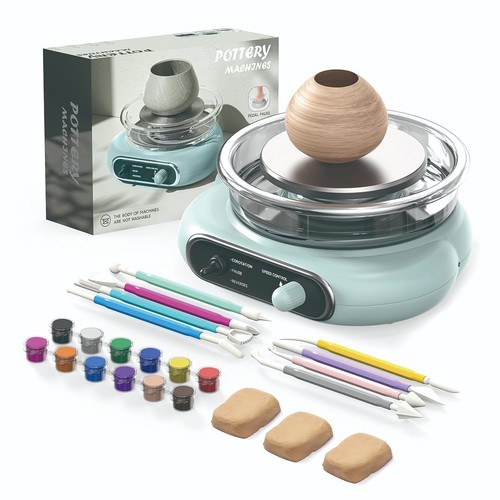
Tabletop pottery wheels (also called portable wheels or mini wheels) sit on a table or countertop. They typically run ¼ HP or less and weigh 15–30 lbs — easily moved, easy to store. The trade-off is that most tabletop models have smaller wheel heads (typically 8–10" vs 12" on a floor model) and reduced centering capacity.
For apartments, shared studios, or beginners testing the hobby, a tabletop wheel is a legitimate choice. You lose ergonomic posture flexibility — adjusting table height isn't the same as adjusting a stand-mounted wheel — and you may be missing a true foot pedal, instead controlling speed with a hand-operated dial. Both matter for technique.
Standing (floor-mounted) wheels have the proper ergonomics for sustained throwing: foot pedal for hands-free RPM control, sitting height adjusted by stool, and generally larger splash pans. If you're serious about continuing with pottery, a floor model is the long-term answer.
Reversible direction: why it matters
Most wheels default to counterclockwise rotation (viewed from above), which matches the dominant right-handed throwing convention. Reversible-direction motors let the wheel spin clockwise, which is standard for left-handed throwers and occasionally useful when trimming. Not all budget models include reversible direction — check the spec sheet explicitly if it matters for your setup.
On higher-end wheels, direction is a switch or button. On some economy models, reversing direction requires a tool or is not supported at all. If you're left-handed, this feature is non-negotiable.
Noise level: the apartment concern
Pottery wheels are generally not loud in the way power tools are, but motor hum and wheel head vibration vary significantly between models. Shimpo wheels are well-regarded for quiet operation. Generic budget wheels from less-known brands can produce motor whine that becomes fatiguing over a two-hour session.
If noise matters (apartment, shared space, late-night throwing), look for wheels marketed explicitly as quiet or low-noise. Some manufacturers publish decibel ratings; when they don't, user reviews on noise tend to be reliable.
Shopping for pottery wheels? Browse current eBay listings → (we earn a small commission; your price is unchanged).
Splash pan: more important than it looks
The splash pan is the tray that surrounds the wheel head and catches water and clay slurry. Size matters practically: a pan that's too shallow or too small means constant cleanup on your floor and your clothes. On tabletop models, the pan is often integrated and just adequate. On floor models, splash pans are typically removable for cleaning — check that the removal mechanism is genuinely tool-free.
Some studio wheels use a removable pan that slips into a groove; others bolt in. Cleaning a splash pan after a session is non-negotiable, so how easily it comes off and back on affects daily workflow more than most buyers anticipate.
Wheel head diameter and bat systems
Standard studio wheel heads are typically 11–14" in diameter. Larger heads give you room for wide platters; smaller heads suit mugs and cylinders. More practically, check whether the wheel head accepts bat pins — a standardized hole pattern that lets you attach removable bats (discs that hold your clay while it stays attached to the bat, allowing wet pots to be moved off the wheel without distortion). Bat pins at 10" spacing are a common standard, but verify compatibility before buying third-party bats.
RPM range and foot pedal response
Most pottery wheels top out at 200–300 RPM. The low end matters as much as the high end: trimming typically happens at slow RPM (often 20–40 RPM), and a wheel that can't hold a consistent low speed makes trimming frustrating. Foot pedal quality (smoothness of RPM graduation, not just on/off) separates good studio wheels from economy models more than any other single factor.
Used wheels: a realistic option
Pottery wheels are built to last decades. A well-maintained Brent or Shimpo from the 1990s will outperform a brand-new budget wheel by a wide margin. The main things to check on a used wheel are: motor noise (any grinding or surge), foot pedal response (should be smooth, not sticky or erratic), wheel head wobble (mount it and test — any vertical play is a bearing issue), and splash pan condition (easily replaced if cracked). The eBay used-wheel market is active and worth exploring for intermediate throwers who want studio-grade performance without studio-grade new prices.
Common buying mistakes
- Buying on HP alone — the more relevant number is listed centering capacity, and even that requires the 60–70% working-capacity discount.
- Skipping the foot pedal check — a dial-only speed control makes technique harder; always confirm the model includes a foot pedal.
- Ignoring reversibility — left-handed throwers who discover their new wheel only spins one direction have a real problem.
- Underestimating portability costs — tabletop wheels are convenient to move but limit your ergonomics; factor in the stool-height compromise.
- Confusing centering capacity with throwing capacity — centering 25 lbs and throwing a 25-lb pot are different skills; most beginners start with 2–5 lb clay bodies.