What polymer clay is and isn't
Polymer clay is a PVC-based modeling compound that hardens when baked in a regular household oven — typically at temperatures between 215°F and 275°F (100–135°C) for 15–30 minutes, depending on brand and piece thickness. It does not require a kiln, does not air-dry (it stays workable indefinitely at room temperature), and does not behave like earthen clay. You cannot throw it on a pottery wheel.
It's used for: jewelry and charms, miniatures, figurines, faux finishes (faux stone, faux wood), millefiori caning, and sculptural work. It's not used for functional pottery like plates and mugs — polymer clay pieces are decorative and not food-safe for contact surfaces after baking.
Brand firmness: the most important buying variable
Firmness determines how hard you have to work to make the clay pliable. Brands market firmness inconsistently, but here is how the major lines compare in practice:
| Brand / Line | Firmness | Best for | Bake temp (typical) |
|---|---|---|---|
| Sculpey III | Very soft | Beginners, children, large pieces | 275°F / 135°C |
| Premo (Sculpey brand) | Medium-firm | Jewelry, caning, general detail | 275°F / 135°C |
| Fimo Soft | Firm | Intermediate sculptors, charms | 230°F / 110°C |
| Fimo Professional | Very firm | Miniatures, fine caning, advanced work | 230°F / 110°C |
| Kato Polyclay | Very firm | Precision caning, fine detail | 300°F / 150°C |
Sculpey III's very soft formula is friendly to beginners — it requires minimal conditioning and responds quickly to warm hands. The downside is that it's brittle after baking compared to firmer formulas, and very thin sections (earring posts, thin arms on figurines) may break. Premo is a better choice for jewelry precisely because baked Premo is more flexible and durable.
Fimo and Kato are firmer and require more effort to condition, but they hold fine detail better before and after baking. For miniature work — where you're forming features 2–3mm across — the firmness is an advantage because it doesn't slump or finger-print as easily.
Conditioning: what it means and why it's not optional
Conditioning is the process of working polymer clay until the plasticizers are evenly distributed and the clay is smooth, warm, and pliable throughout. Unconditioned polymer clay can crack after baking — the plasticizer distribution is uneven, producing weak spots.
For soft clays (Sculpey III), conditioning by hand is straightforward: press, roll, fold, repeat for a few minutes until the clay is uniform and smooth. For firmer clays (Fimo Professional, Kato), hand conditioning can be laborious — the clay resists deformation until it warms up, and if you rush it, it crumbles. The practical solutions:
- A dedicated clay-only pasta machine — run the clay through progressively thinner settings, fold, and repeat. The most efficient conditioning tool for firm clays. Must be dedicated to clay only (not food use after).
- A food processor (clay-dedicated) — pulse firm clay blocks into crumbles, then collect and hand-knead. Speeds up the initial break-in significantly.
- Warming — firm clay conditions more easily when slightly warm. A clay heating pad, brief time in a sealed bag in warm water (not boiling), or simply holding in warm hands helps.
Shopping for polymer clay? Browse current eBay listings → (we earn a small commission; your price is unchanged).
Color packs vs individual blocks: how to think about it
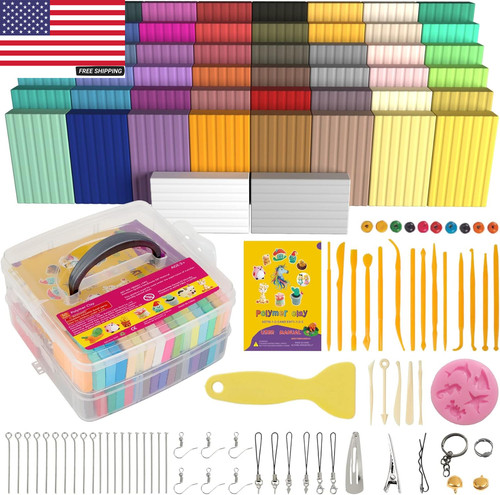
Color packs of 12–48 individual 2 oz blocks give you a range to start with. The advantage of larger packs is color mixing — polymer clay colors blend like paint, so more colors means more mixing range. The disadvantage is that small blocks (especially 2 oz) get used up fast in sculpture work; if you're building volume, buy larger blocks of your base colors (white, black, tan/beige) separately.
Translucent polymer clay is a separate purchase worth knowing about early. Translucent clay, after baking, allows light to pass through thin sections — essential for faux stone effects, realistic skin tones in miniature figures (mixed with opaque flesh tones), and certain caning techniques. It's not in most starter packs.
Baking: temperature precision matters
Polymer clay requires precise oven temperature. Most brands specify 230–275°F; Kato is higher at 300°F. Consumer ovens often run 25–50°F hot or cold. An oven thermometer is a worthwhile addition — the difference between 275°F and 325°F is the difference between a correctly cured piece and a scorched, darkened surface that produces small amounts of irritating fumes.
Baking time is thickness-dependent: 15–30 minutes for pieces under ¼" (6mm) thick, longer for thicker work. Pieces can be baked multiple times without harm — in fact, baking in stages (building armatures, baking, then adding detail layers and baking again) is a common technique for complex sculpture.
Never microwave polymer clay — it does not cure in microwave radiation, and the localized heat causes burning and uneven results.
Essential tools beyond the clay
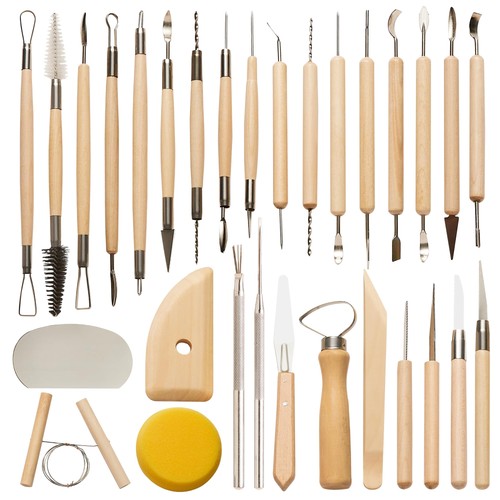
A minimal useful toolset for polymer clay includes:
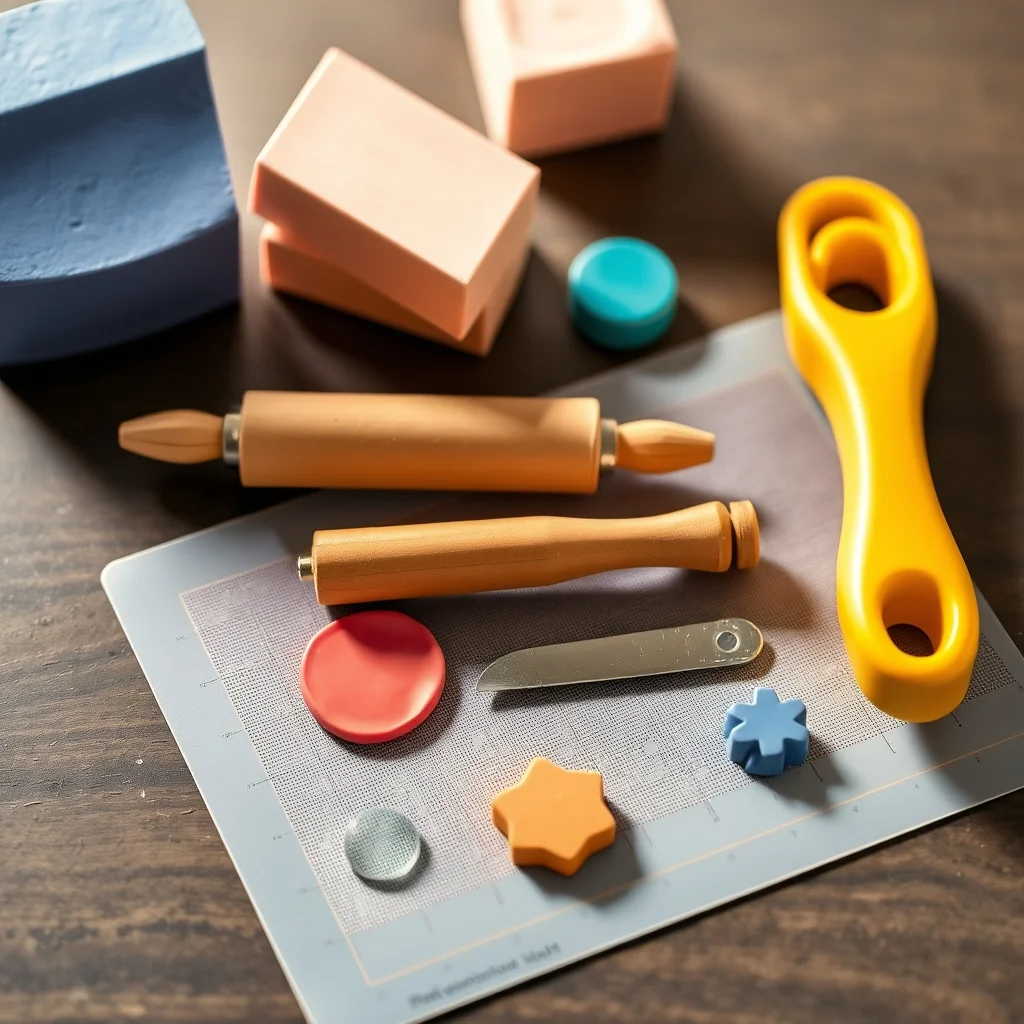
- Acrylic roller or brayer — for rolling even thickness sheets. Glass or acrylic only; wood absorbs plasticizer over time and sticks.
- Tissue blade (long, thin, flexible) — for clean straight cuts and shaving thin slices from canes.
- Ball-tip stylus — for forming rounded recesses, eyes, and indentations in figurines.
- Clay-dedicated pasta machine — if working with firm clays or doing cane work, effectively non-optional.
- Silicone work mat — non-stick surface that doesn't react with the clay. Avoid wax paper (sticks) and paper (fibers transfer).
Storing polymer clay
Polymer clay does not air-dry at room temperature, but it does pick up dust, pet hair, and lint (it's slightly tacky). Store unused clay in plastic wrap or sealed bags, away from heat sources and direct sunlight. Heat above roughly 90°F (32°C) can begin to partially cure clay — avoid leaving it in a hot car.
Old clay that has gotten stiff and crumbly can sometimes be revived by mixing in a small amount of liquid polymer clay (like Fimo Mix Quick or Sculpey Clay Softener) or translucent clay to re-introduce plasticizers. Work in small amounts — too much softener makes the clay sticky and unusable.
Common buying mistakes
- Buying Fimo Professional as a beginner — the firmness will be frustrating without a pasta machine; start with Sculpey III or Fimo Soft.
- Using a food pasta machine for clay and then for food — clay plasticizers contaminate food equipment; keep a dedicated clay machine.
- Overbaking in an uncalibrated oven — scorched polymer clay is not just ugly; it releases fumes. Use an oven thermometer.
- Mixing brands in a project without testing compatibility — most brands mix fine, but bake temperatures differ; use the lower temperature for mixed-brand pieces.
- Using polymer clay for food-contact surfaces — baked polymer clay is not food-safe for surfaces that contact food or drink.