What the three pages say
Cleveland Clinic (dermatologist Taylor Bullock, MD, published Aug. 12, 2026) says chlorine strips the natural oils that protect hair. In its words, hair "may become dry, rough, dull and more susceptible to breakage the more it comes into contact with chlorine". It adds that most people will not notice significant damage after an occasional swim, and that frequent swimmers are more likely to.
UAB Medicine (dermatologist Rachel Falkner, MD, published Jul. 14, 2026) says chlorine and salt water can make hair dry and more porous, leading to frizz and breakage. It says people with healthy hair typically will not damage their hair while swimming unless they often swim with it down, which can create tangles, and that already damaged hair can be affected after only a few swims.
The AAD's wash-frequency chart for children aged 8 to 12 (updated 11/14/23) says to rinse and condition the hair after heavy sweating or swimming. It is the only AAD page we read that mentions swimming, and it covers children only.
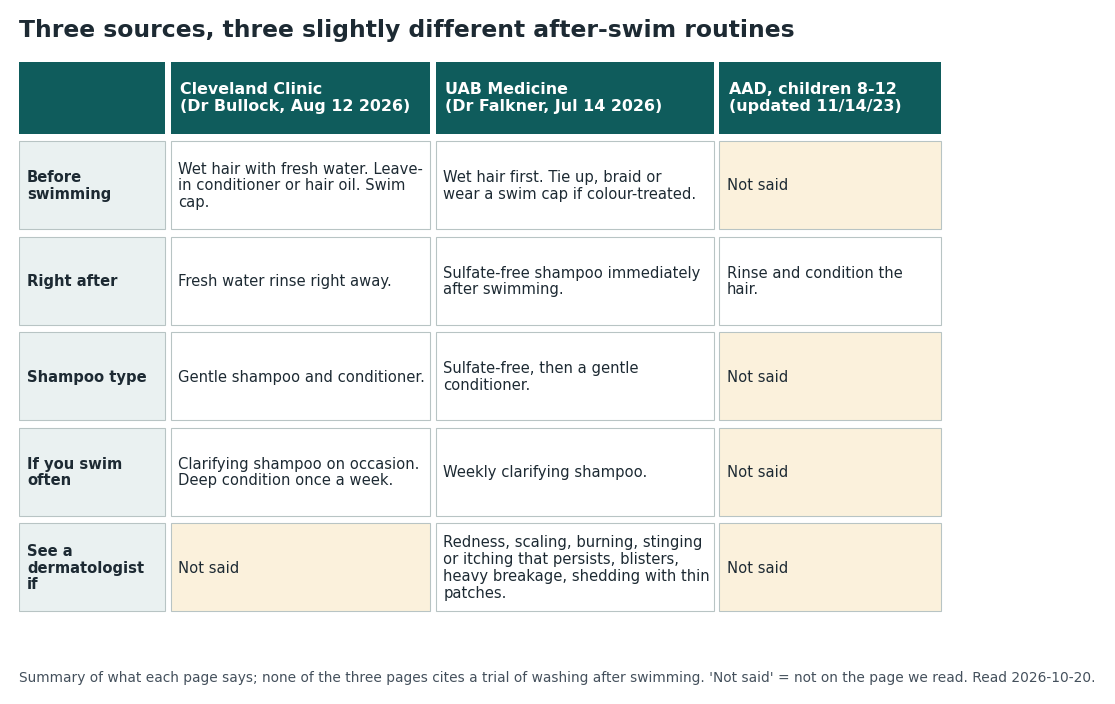
The sources agree on a short list: wet hair with fresh water before you swim and rinse with fresh water after. They differ on shampoo. Cleveland Clinic says a gentle shampoo and conditioner; UAB says a sulfate-free shampoo. Neither cites a trial for that choice. Our sulfate-free guide covers what that label does and does not tell you.
What studies found
We searched PubMed on 2026-10-20 for chlorine, hair and swimmers. Three hits came back; two matter.
- Nanko et al., J Dermatol 2000: 67 elite members of the Japan National Swimming Team and 54 age-matched controls. Hair discoloration appeared in 61% of the swimmers and 0% of controls. Under the electron microscope, the discolored hair showed complete loss of cuticle. The authors suggest the cause was mainly cuticle damage from friction with water, with hypochlorous acid from the pool reaching the cortex. These were elite athletes with heavy exposure, so the result may not describe an occasional swim.
- Cureus 2024 case report: one 19-year-old professional volleyball player who also swam recreationally, with fragile, fractured hair shafts. The authors say years of chlorine exposure and training may have contributed. One person cannot show cause.
Cleveland Clinic also says the green tint some swimmers see comes from minerals in pool water rather than chlorine. If your tap water already leaves a mineral film, that is one more reason to rinse well. Our hard water guide covers the lab studies on minerals and hair.
When the sources say to see a dermatologist
UAB lists these signs for swim-related irritation or damage: redness, scaling, burning, persistent stinging or itching, blistering or painful skin, excessive hair breakage, or shedding with thin areas on the scalp. Cleveland Clinic says chlorine can also cause a red, itchy rash on skin. Either is a reason to ask a board-certified dermatologist, not to try another product.
What is not known
- Whether washing right after swimming, rather than later, changes hair outcomes. We found no trial.
- Whether a sulfate-free shampoo, a gentle shampoo or a clarifying shampoo is better after swimming. The two pages disagree, and neither cites evidence.
- How much a swim cap, leave-in conditioner or oil protects. Cleveland Clinic says no method completely blocks chlorine exposure; no study of the effect size turned up.
- Whether the elite-swimmer finding applies to people who swim a few times a week.
The honest simpler option
Nothing on this page requires buying anything. Wet your hair with fresh water first, rinse with fresh water right after, then wash and condition as your own hair needs (see the frequency guide). A swim cap is the one item both Cleveland Clinic and UAB mention, for frequent swimmers or colour-treated hair.
More in this hub: the No-Poo Hair Care overview.
Sources
All read on 2026-10-20. Pages and abstracts can change, so check the date shown.
- Cleveland Clinic, "Protect Your Hair From Chlorine the Next Time You Go Swimming" (Aug. 12, 2026; dermatologist Taylor Bullock, MD). A health-system consumer page
- UAB Medicine, "Summer skincare: Protect your skin and hair from chlorine and salt water" (Jul. 14, 2026; Rachel Falkner, MD). A health-system news page
- AAD, "How often do children need to wash their hair?" (updated 11/14/23)
- Nanko H et al. "Hair-discoloration of Japanese elite swimmers." J Dermatol 2000 (PubMed 11092265)
- "Hair Shaft Fracture in a Young Athlete: A Rare Case Report of Acquired Trichorrhexis Nodosa." Cureus 2024 (PubMed 39310559)