Guides
Practical French press guidance — material differences, size selection, and filter quality. No lifestyle photography required.
Why this page exists
French press is often presented as the "simple" method that requires no gear knowledge. In practice, a poorly chosen French press produces bitter, over-extracted, or gritty coffee — and most of the common problems trace directly to equipment choices.
Glass breaks. Cheap filter screens let through excessive sediment. Undersized presses produce concentrations that don't match your recipe. An insulated stainless press holds temperature for a second cup; glass loses heat in 10–15 minutes. These are real differences that affect daily use.
French press options worth searching on eBay
Glass, stainless, and insulated French presses across sizes. We earn a small commission on qualifying sales; your price is unchanged. Full disclosure.
 French press coffee maker
Glass body with chrome or plastic frame. Classic borosilicate glass is heat-resistant; verify the carafe is borosilicate, not soda-lime, for durability.
French press coffee maker
Glass body with chrome or plastic frame. Classic borosilicate glass is heat-resistant; verify the carafe is borosilicate, not soda-lime, for durability.
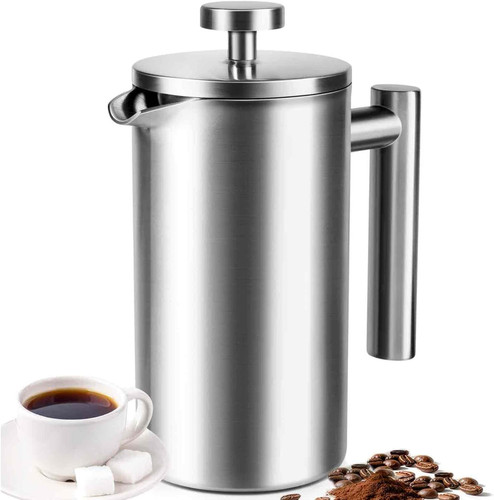 Stainless French press
Single-wall stainless conducts heat — the body gets hot but the coffee cools similar to glass. More durable than glass. Check filter mesh quality in reviews before buying.
Double wall French press
Double-wall stainless or glass retains heat significantly longer than single-wall. Exterior stays cool; interior holds brew temperature. Best for slow morning sessions.
Stainless French press
Single-wall stainless conducts heat — the body gets hot but the coffee cools similar to glass. More durable than glass. Check filter mesh quality in reviews before buying.
Double wall French press
Double-wall stainless or glass retains heat significantly longer than single-wall. Exterior stays cool; interior holds brew temperature. Best for slow morning sessions.
 Large French press
8-cup (1000ml) or 12-cup presses for households brewing multiple servings. Verify the filter assembly scales to the larger size without becoming floppy or leaky at the sides.
Large French press
8-cup (1000ml) or 12-cup presses for households brewing multiple servings. Verify the filter assembly scales to the larger size without becoming floppy or leaky at the sides.
 Insulated French press
Vacuum-insulated double-wall maintains brew temperature for 1–2 hours. Key for decanting immediately after brewing to stop extraction — you pour into the insulated vessel, not leave it in the press.
Insulated French press
Vacuum-insulated double-wall maintains brew temperature for 1–2 hours. Key for decanting immediately after brewing to stop extraction — you pour into the insulated vessel, not leave it in the press.