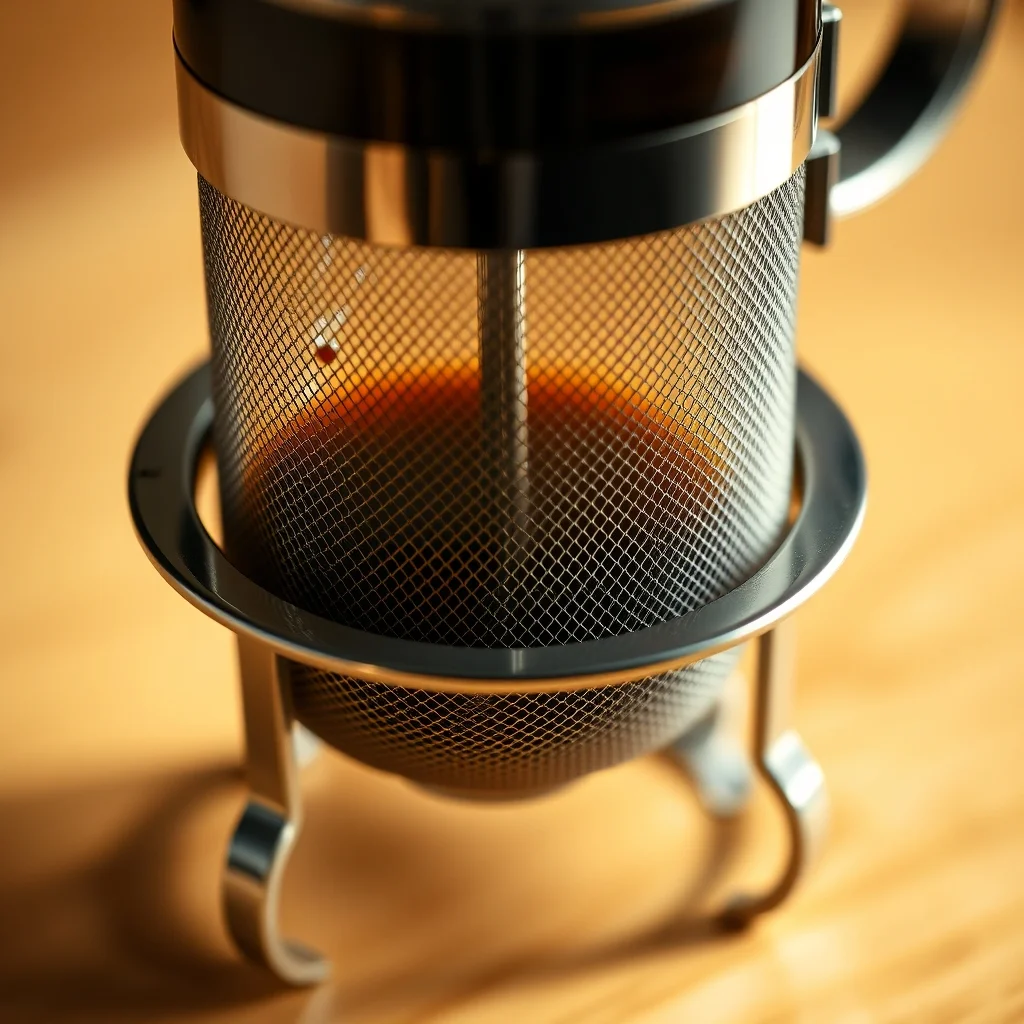
How French press brewing works
French press is an immersion method: coffee grounds and hot water combine in the carafe and steep together for 4–8 minutes (depending on recipe and grind). The plunger assembly — a rod with a filter screen attached — is pushed down through the liquid, holding the grounds at the bottom while you pour. Unlike pour-over or drip, there is no paper filter: coffee oils, very fine particles, and some sediment pass into the cup.
This is why French press coffee has a heavier body and more texture than filtered methods. The oils contribute flavor complexity; the fine sediment settles to the bottom of the cup and is best not drunk. French press rewards a coarse grind specifically because the mesh filter cannot catch fine particles — a medium or fine grind produces a gritty cup and often contributes to over-extraction.
Size: matching the press to your volume
French press sizes are labeled in cups, but the "cup" measurement is typically 4 oz (120ml) — significantly smaller than a standard mug. Common sizes:
| Labeled size | Actual capacity | Practical serving |
|---|---|---|
| 3-cup | ~350ml (12 oz) | 1 large mug or 2 small cups |
| 4-cup | ~500ml (17 oz) | 1–2 large mugs |
| 8-cup | ~1000ml (34 oz) | 3–4 large mugs |
| 12-cup | ~1500ml (51 oz) | 5–6 large mugs |
The most practical sizing advice: buy for your typical brew, not your maximum. A French press works best when filled close to capacity — under-filling means the plunger assembly doesn't reach the grounds properly. If you typically make one large mug of coffee, a 3-cup or 4-cup press is more appropriate than an 8-cup.
Material: glass vs stainless vs insulated
Glass
The classic French press is glass — typically borosilicate glass in a metal frame. Advantages: you can see the brew, the material is chemically neutral (no metal taste risk), and glass cleans easily. Disadvantages: glass breaks (the most common French press failure mode), and glass loses heat quickly. A glass press brews at temperature but the second cup poured 15–20 minutes later will be noticeably cooler.
If you buy a glass press, verify that the carafe is borosilicate, not soda-lime glass. Borosilicate handles thermal shock (pouring boiling water into a room-temperature vessel) significantly better. Many cheap glass presses use soda-lime glass and crack.
Single-wall stainless steel
Single-wall stainless is more durable than glass and won't shatter if dropped. Heat retention is similar to glass — single-wall metal conducts heat to the exterior and the coffee cools at a comparable rate. Some stainless presses have very tight tolerances between the plunger and walls, which can create suction making the press hard to lift after plunging. Check user reviews for "hard to pull up" complaints on specific models.
Double-wall insulated (vacuum-insulated)
Double-wall or vacuum-insulated stainless presses maintain coffee temperature for 1–2 hours and keep the exterior cool to the touch. This is the premium option and resolves the heat-loss problem with glass. The tradeoff is cost (typically 2–3x a comparable glass press) and the inability to see the brew. Some double-wall designs have the filter assembly integrated in a way that's harder to clean thoroughly — check that the components fully disassemble.
Filter screen quality: the overlooked variable
The filter assembly in a French press typically consists of a metal mesh screen, cross plate, and spiral plate sandwiched together. The mesh catches coffee grounds while liquid passes through. Cheap mesh screens have larger, irregular openings that let significant fine particles through — gritty coffee is almost always a filter quality problem, not just a grind problem.
Signs of a quality filter assembly:
- Fine, uniform mesh (finer mesh = less sediment)
- Tight fit between the plunger disk and carafe walls (prevents grounds from bypassing the filter at the edges)
- Multi-layer filtration (some presses include a secondary screen or paper filter option)
- Stainless construction that won't rust or degrade
The filter is often the weakest component in budget French presses. A press with a poor filter produces gritty coffee regardless of how coarsely you grind. Some users add a secondary layer of filtration — a small paper filter placed in the carafe after plunging and before pouring — to catch fine particles that pass through the mesh.
Shopping for a French press? Browse current eBay listings → (we earn a small commission; your price is unchanged).
Grind size: the non-negotiable
French press requires a coarse grind — roughly the texture of coarse sea salt or raw sugar. This is non-negotiable for two reasons:
- Filter bypass: Fine particles pass through the mesh filter and settle in the cup as grit. The finer the grind, the more sediment in the cup.
- Extraction rate: French press steeps for 4 minutes at full immersion. Finer grinds extract much faster than coarse — a medium grind left to steep for 4 minutes will be significantly over-extracted (bitter, harsh). A coarse grind extracts at the right rate for the 4-minute steep time.
If you're transitioning to French press from a drip machine, you need to adjust your grind. Most drip machines use medium grind. Using the same grind in a French press produces over-extracted, gritty coffee. This is the most common cause of bad French press results and is grinder-setting simple to fix.
Brew time and ratio
Standard French press recipe: 1:15 ratio (coffee to water by weight), 4-minute steep, water at 93–96°C (200–205°F).
- For a 350ml press: ~23g of coffee, 350ml water
- For a 500ml press: ~33g of coffee, 500ml water
- For a 1000ml press: ~65g of coffee, 1000ml water
Adjust ratio to taste: stronger means a lower ratio (1:13 or 1:14); weaker means higher (1:17 or 1:18). Adjust steep time to taste but with caution — extending beyond 5–6 minutes increases sediment and can push into over-extraction territory. If the coffee is weak at 4 minutes, adjust ratio or grind rather than steep time.
Cleaning: what to check before buying
French press cleaning is the most common complaint about the format. Grounds accumulate in the carafe, the mesh filter traps fines, and the plunger assembly can be difficult to disassemble for thorough cleaning.
Before buying, verify:
- The plunger assembly fully disassembles (at minimum: mesh screen, cross plate, spiral plate should separate for individual cleaning)
- The carafe is dishwasher-safe (most glass ones are; double-wall stainless varies)
- Replacement filter assemblies are available (filters wear and deform over time)
Daily cleaning: rinse the carafe with water, swirl, and dispose of grounds. Don't pour grounds down the drain — they accumulate and cause clogs. A rubber spatula removes grounds cleanly. Once weekly, disassemble the filter and clean the mesh screen with a brush.
The honest bottom line
For a single brewer: a 3-cup or 4-cup glass press from a reputable brand with a quality filter assembly is the right starting point. Plan on $25–$50. Bodum is the benchmark in this range and has been for decades — their filter assembly quality is consistently better than budget alternatives.
For two or more people, or if you want heat retention: an 8-cup insulated stainless double-wall press. Plan on $50–$100. The heat retention makes the difference for anyone who doesn't drink the entire pot immediately.
The most common mistake: buying a cheap press with a poor filter, then blaming the method when the coffee is gritty. French press produces a clean-enough cup when the filter is good quality and the grind is coarse. If your current press produces excessive sediment, try a replacement filter assembly before blaming your grind.
Search eBay for French press options
 French press coffee maker
Glass with metal frame. Verify borosilicate glass — check the listing description or brand.
French press coffee maker
Glass with metal frame. Verify borosilicate glass — check the listing description or brand.
 Insulated French press
Double-wall vacuum stainless. Maintains temperature 1–2 hours. Check filter disassembles.
Insulated French press
Double-wall vacuum stainless. Maintains temperature 1–2 hours. Check filter disassembles.
 Large French press
8-cup (1000ml) for households. Check plunger fits tightly at full fill height.
Large French press
8-cup (1000ml) for households. Check plunger fits tightly at full fill height.