The five essential pottery tool categories
Every functional pottery tool set covers the same five bases:
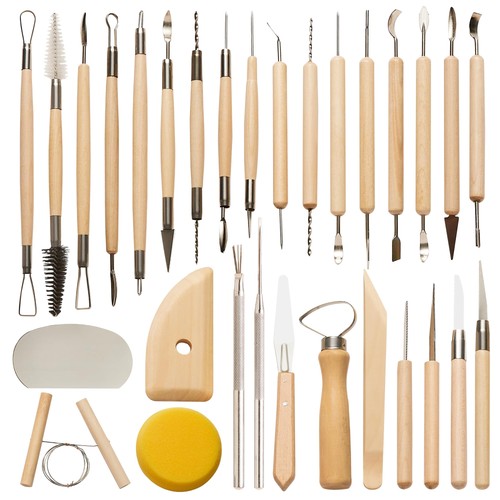
- Trimming and loop tools — for removing clay from leather-hard pots (foot ring, base refinement)
- Ribs — for compressing and smoothing clay walls during throwing and shaping
- Needle tool — for scoring, checking wall thickness, and cutting rims level
- Wire cutter — for cutting the pot off the wheel head or bat
- Sponge — for adding water during throwing and smoothing interiors
Beyond these five, everything else is a specialty tool. Buying additional tools before you can consistently center and pull walls is putting the cart before the horse.
Trimming and ribbon tools: what separates good from cheap
Trimming tools (loop tools with a sharpened wire or steel loop) cut clay from a leather-hard pot. The quality difference between a $2 loop tool and a $12–15 one is real and immediate: cheap loop tools have wires that flex under load, producing uneven cuts. Quality loop tools have rigid steel loops — typically thicker gauge, sometimes hardened — that hold their cutting geometry under pressure.
Ribbon tools are a related variant: flat steel strips bent into cutting shapes, sometimes double-sided with a loop at each end. They're used for faster material removal and for hollowing sculptural forms. Kemper and Xiem make widely-used mid-range versions.
| Tool type | Primary use | Quality indicator |
|---|---|---|
| Loop tool (round) | General foot-ring trimming | Loop rigidity — should not flex under moderate pressure |
| Ribbon tool (flat) | Faster removal, sculptural hollowing | Steel gauge — thin steel warps; heavier gauge holds shape |
| Trimming tool (angled) | Refined foot profile, undercuts | Handle ergonomics — important for long trimming sessions |
Ribs: wood, metal, and silicone explained
Ribs are the tool you hold against a clay wall to compress, smooth, and shape it. The material determines the effect:
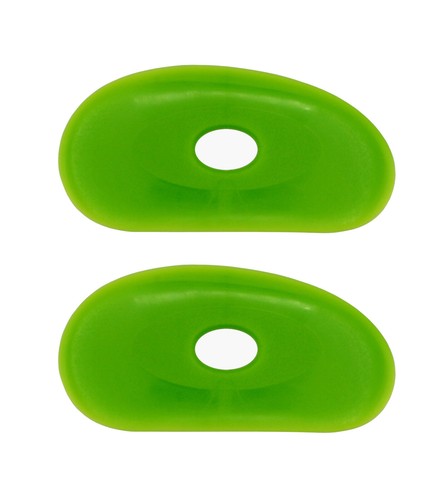
Wood ribs are the gentlest. They compress clay slightly without dragging it, making them ideal for beginners who are still developing consistent wall thickness. Wood ribs are typically kidney-shaped or straight with a slight curve. They absorb water over time; rinse and dry after use.
Metal ribs produce a harder, more defined surface. A flexible steel rib conforms to the clay's curve and can burnish a surface to a near-leather finish. Useful for straightening cylinder walls and defining shoulders on closed forms. The thin edge of a metal rib is also useful for removing slurry from interior walls.
Silicone ribs are flexible and excellent for curved interior forms — bowls, especially — where wood is too rigid and metal is too unforgiving. The flexibility lets the rib follow the interior curve without leaving tool marks. Usually sold in packs with multiple profiles.
A practical beginner set includes at least one of each. If you're buying individually, start with a wood kidney rib for exterior walls and a silicone rib for interior bowl compression.
Shopping for pottery tools? Browse current eBay listings → (we earn a small commission; your price is unchanged).
Needle tools: what to look for
A pottery needle tool is a long, sharp steel needle set in a handle (wood, plastic, or rubber). It has several uses that are not interchangeable:
- Checking wall thickness by inserting through the wall and measuring how far the needle went
- Cutting the rim level — dragging the needle point across the rotating rim while holding a finger as a guide
- Scoring clay surfaces before joining (slabs, coils, handles)
- Popping air bubbles in thrown work before firing
On a cheap needle tool, the needle wiggles in the handle — not useful for any of the above tasks. The handle material matters less than the needle-to-handle joint: it should be solid with no play. A needle that's too fine will bend; thicker gauge needles are more robust for wall-thickness checks.
Wire cutters: twisted vs single-strand, and the toggle
A wire cutter cuts your pot free from the wheel head (or from a bat). The standard type is a length of twisted wire with a wooden toggle on each end — you drag it across the wheel head while the wheel spins slowly or is stopped. Twisted wire grips the clay more aggressively than single-strand; most experienced throwers prefer twisted.
The toggle (wooden knob) matters for a secure grip. Cheap wire cutters use tiny button toggles that give your fingers no purchase. Better cutters have large wooden dowel handles. The wire length also matters: too short and it's hard to pull across a large wheel head smoothly; typically 14–18" is the practical range.
What most starter kits leave out
Most low-price starter kits include a needle tool, a sponge, a wire cutter, and several trim tools — but routinely leave out:
- A sponge on a stick — for adding water to the interior of narrow-necked forms without your hand fitting inside. Sold separately but useful immediately for beginner cylinder work.
- A fettling knife — for trimming slab edges and handles cleanly. Kits often substitute a basic clay knife that doesn't hold an edge.
- Quality ribs — included ribs in budget kits are often plastic with no real flexibility or a single thin wood rib. A set with at least one flexible metal or silicone rib is worth buying separately.
Reading a kit listing honestly
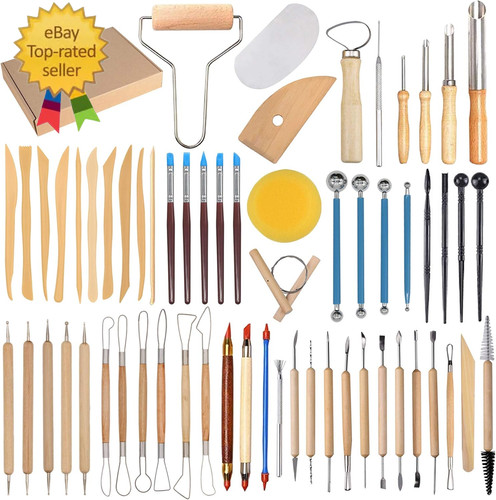
Kit piece counts are often padded with near-identical tools (five wire loop tools in barely different sizes, for instance). Evaluate a kit by asking: Does it contain at least one tool from each of the five core categories? Are the trimming tools described as steel loop, or just "wire"? Is a rib included, and if so what material? Is the wire cutter twisted or single-strand?
A solid 8–12 piece kit at a mid-range price that covers all five categories is more useful than a 30-piece kit that's mostly duplicates of the same shape. At the low end, Kemper makes well-regarded individual tools; at the mid range, Xiem trimming tools and Dolan ribs have strong reputations.
Care and maintenance
Pottery tools are simple to maintain. After each session: rinse clay off wire tools immediately (wet clay doesn't rust; dried clay is harder to remove). Dry metal tools before storing to prevent rust on loop tool wire. Wooden handles will swell slightly with regular water exposure — this is normal and typically self-stabilizing. Store tools in a cup or roll rather than a bag; bent loop-tool wire doesn't unbend well.