
Step one: get the size right
Violins come in fractional sizes — from the tiny 1/16 for very young children to the full-size 4/4 for adults and older teens. The fractions describe the body length relative to a 4/4, but they do not scale linearly: a 1/2 violin is not literally half the size of a 4/4. What matters in practice is the arm-length measurement.
The standard method: hold the arm out straight at shoulder height and measure from the neck to the middle of the palm. Match that measurement to the size chart below.
| Arm length (neck to palm) | Violin size | Typical age range |
|---|---|---|
| Under 16 inches (41 cm) | 1/16 | 3–4 years |
| 16–17.5 in (41–44 cm) | 1/10 | 4–5 years |
| 17.5–20 in (44–51 cm) | 1/8 | 4–6 years |
| 20–22 in (51–56 cm) | 1/4 | 5–7 years |
| 22–23.5 in (56–60 cm) | 1/2 | 6–10 years |
| 23.5–26 in (60–66 cm) | 3/4 | 9–12 years |
| Over 26 in (66 cm) | 4/4 | 11+ years |
Age ranges are guides, not rules. A tall 9-year-old may be in a 4/4 while a petite 13-year-old may still need a 3/4. Measure; do not guess by age. A violin that forces the left arm to stretch to reach the scroll, or that causes the elbow to lock, is too large.
Student vs intermediate: what the money actually buys
The dividing line between student and intermediate violins is not volume or prestige — it is the top wood and the setup. Student instruments typically use laminate tops (thin layers of wood glued together, sometimes with wood-grain veneer). Intermediate instruments use a solid carved spruce top.
Why does this matter? Solid wood vibrates differently from laminate. It is more responsive to bow pressure and produces overtones that make the instrument more expressive under the bow. For a beginner who has not yet developed bow control, the difference is less audible. For a student who has passed the open-string and first-position stage and is developing tone quality, it becomes meaningful.
What a proper setup includes
Many factory violins arrive with inadequate setup even at mid-range prices. A proper setup means:
- Bridge fit: The bridge feet must match the instrument's top curve exactly. A poorly fitting bridge produces buzzing and reduces tone projection.
- Nut height: The nut slots should be cut so that strings sit just above the fingerboard at the first position. Too high creates hand fatigue; too low causes buzzing at open strings.
- Peg fit: Pegs should turn smoothly and hold firmly. Factory pegs often need fitting or replacement with planetary pegs at the student level.
- Sound post position: The sound post (a small wooden dowel inside the body) must be correctly positioned to optimize tone. This is a luthier job, not a DIY adjustment.
Budget roughly $50–$100 for a professional setup on a student instrument purchased new. Some dedicated violin shops include this; most online-only and marketplace sellers do not. The setup cost is often what separates a playable entry-level violin from a frustrating one.
Solid vs laminate tops: the honest trade-off
Laminate tops are not inherently bad — they are more dimensionally stable in humidity changes, which makes them practical for schools and students who do not control their environment carefully. They are also more resistant to cracking. The trade-off is tonal ceiling: a laminate top will not improve as it is played in the way a solid top often does.
Solid spruce tops (the standard) respond to vibration and can "open up" over years of playing — the wood structure loosens and resonates more freely. This is a real phenomenon, not marketing language. For students who stick with the instrument, this matters for the five-to-ten-year arc.
Shopping for a violin? Browse current eBay listings → (we earn a small commission; your price is unchanged).
Strings: what comes in the box and what to consider
Factory strings on student instruments are usually steel-core strings — inexpensive, durable, and stable in tuning. They are fine for beginners. As students develop, many teachers recommend switching to synthetic-core strings (Dominant, Obligato, Warchal Amber) for a warmer tone and more nuanced response. Gut-core strings are the traditional choice but require frequent tuning adjustments and are generally unnecessary below the advanced level.
String replacement on a violin costs roughly $20–$60 for a full set, depending on string brand and type. This is one of the highest-value upgrades for an intermediate player on a student instrument.
The bow: underrated and often underspent
Outfits typically include a fiberglass or low-grade brazilwood bow. These bows often have inconsistent camber (the curve of the stick) and weak grip at the tip, which makes developing clean bow changes harder. A better bow at the same price point can make a student instrument play significantly more musically.
The three bow material categories in practical terms:
- Fiberglass: Durable and inexpensive. Fine for beginners and young students who will drop the bow. Limited response at the tip.
- Brazilwood: A range of hardwoods sold under this label (the species varies). Better balance and flex than fiberglass when quality-controlled.
- Carbon fiber: Consistent weight, balance, and camber from bow to bow. Does not warp with humidity. At $80–$200, carbon fiber bows frequently outperform wooden bows at twice the price for teaching purposes.
- Pernambuco: The professional benchmark — a specific Brazilian hardwood (Caesalpinia echinata) with exceptional acoustic properties. Meaningful above the intermediate level; expensive.
Common buying mistakes to avoid
The mistakes that frustrate new buyers most reliably:
- Buying by age instead of arm measurement. Charts suggest age ranges; measurements determine size.
- Buying the cheapest option without factoring in setup. A $79 violin that needs $80 of setup work is a $159 violin with worse tonewoods.
- Skipping the bow entirely. The bow generates the sound. A student cannot learn dynamics or articulation with a bow that bounces unpredictably at the tip.
- Buying 4/4 "so the child can grow into it." This is the single most common and most damaging mistake. Children cannot grow into a violin any more than they can grow into adult shoes while learning to run.
- Upgrading the instrument before upgrading the setup and bow. A properly set-up student instrument with a decent bow is almost always more playable than a better instrument with a factory setup and included bow.
When to upgrade from student to intermediate
The signal is usually a combination of: the student has been playing for 3–5 years, is practicing 30+ minutes daily, has developed enough ear to hear the limitations of the instrument, and has started playing in ensembles where tone blends matter. At that point, a solid-top intermediate instrument with proper setup typically justifies the spend.
The intermediate price range varies by market, but instruments in the $400–$900 range from reputable violin shops (Eastman, Scott Cao, Stentor Conservatoire, Klaus Mueller) represent genuine construction improvement over entry-level outfits — not just cosmetic differences.
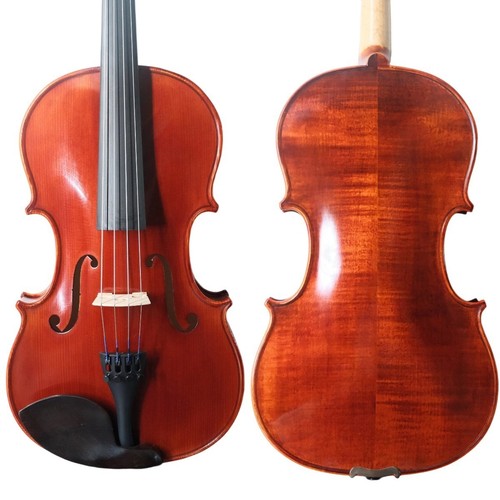 Violin 4/4 outfit
 Student violin
 Intermediate violin
 Violin bow
 Violin case