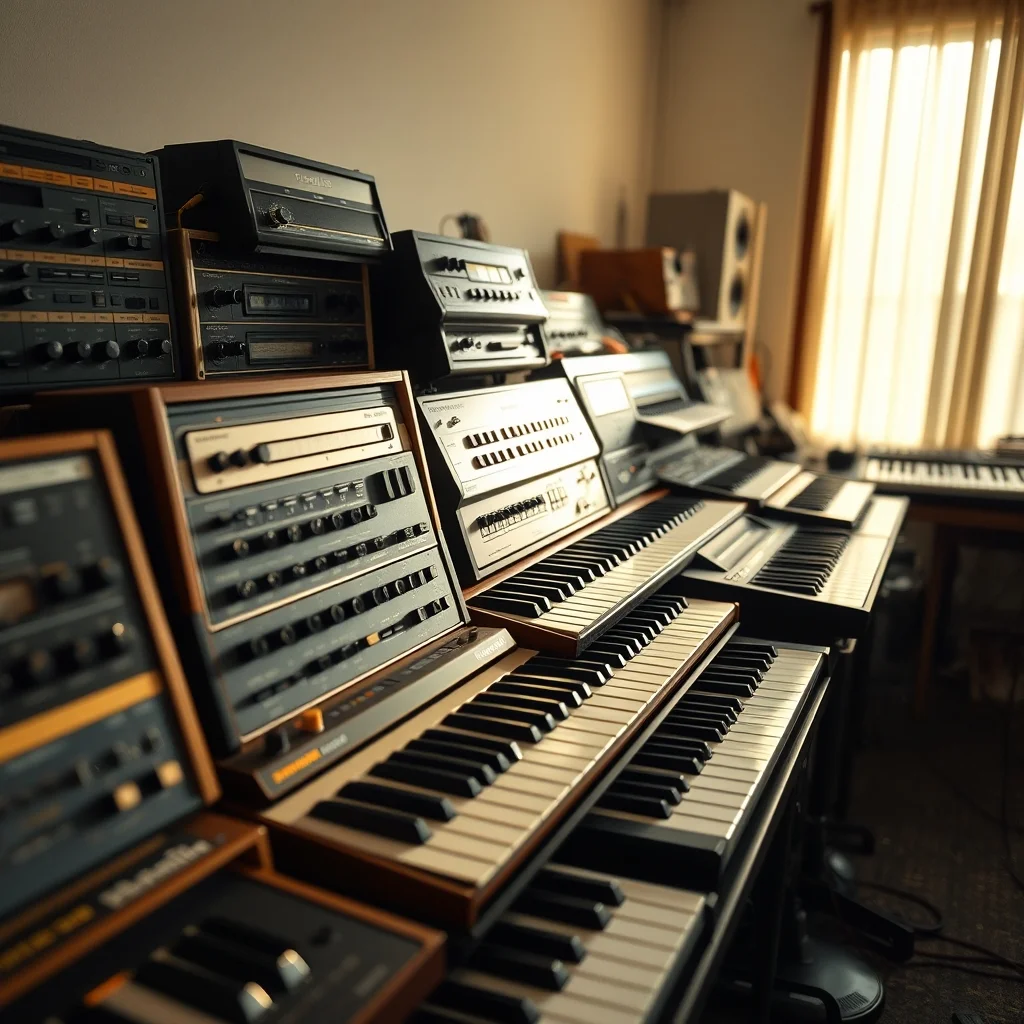
Buying a vintage synthesizer from a private seller involves evaluating an instrument that may be 40–50 years old, has had multiple owners, and has often been "serviced" by people with varying levels of competence. Unlike vintage guitars, where cosmetics and playability are the primary concerns, vintage synths involve electronics that degrade over time regardless of use — electrolytic capacitors, voltage regulators, and battery-backed memory all have finite service lives.
Minimoog Model D: what to check
The Minimoog Model D was produced from 1970 to 1981. Original production ended at approximately serial number 13,000. A reissue was produced by Moog from 2016–2017 and again in 2022, but these are distinct instruments — the reissue uses modern components and lacks the original's discrete transistor ladder filter circuit characteristics.
Voice chip and transistor verification
The Minimoog filter is a discrete ladder filter using matched transistor pairs — not IC chips. This is an advantage for serviceability, as matched transistors are still available. However, the specific transistors influence the character; original 2N3906 types vary, and a Minimoog that has had its filter transistors swapped may sound measurably different from one with period-correct components.
Capacitor condition
Electrolytics in a 40-year-old Minimoog are beyond their rated service life. A unit that has not been recapped is not necessarily failing now, but it is operating on borrowed time. Ask whether the unit has been recapped and by whom. A full recap by a qualified technician using film and electrolytic replacements of correct specifications is a net positive — a partial recap using wrong-spec parts is not.
Pitch CV tracking and calibration
The Minimoog's voltage-controlled oscillators require periodic calibration to track pitch correctly across the keyboard range. Test each oscillator independently across the full 5-octave range. Significant tracking error at the top or bottom of the range indicates the unit needs calibration. This is not a major issue but should be reflected in price.
Sequential Prophet 5: revision differences
The Prophet 5 was produced in three major revisions. The revision determines not only which voice chips are present but the availability of replacement parts and the character of the instrument.
Rev 1 and Rev 2: SSM chips
Revisions 1 and 2 (approximately 1978–1979) used the SSM2030 VCO and SSM2040 filter ICs from Silicon Systems Incorporated. Both chips are long out of production. Functioning Rev 1 and 2 Prophet 5s are increasingly difficult to service when chips fail — SSM2040 substitutes exist (notably the Dave Rossum-designed CEM equivalent approach), but the process is involved. Verify that all 5 voices are fully functional before purchase, and ask for documentation of any chip replacements.
Rev 3.3: CEM chips
Revision 3.3 (introduced approximately 1981) switched to Curtis Electromusic (CEM) chips: the CEM3340 VCO and CEM3320 filter. These chips were restarted in production by Alpha Technologies (as the AS3340 and AS3320) in the 2010s, making Rev 3.3 significantly more serviceable than earlier revisions. Rev 3.3 also improved polyphonic detune and overall tuning stability. For a player-oriented purchase, Rev 3.3 is the practical choice; Rev 1/2 command premiums as collector's items but carry service risk.
Roland Juno-60: DCO architecture and chorus
The Juno-60 (1982–1984) is a 6-voice polyphonic using digitally-controlled oscillators (DCOs) rather than the analog VCOs in the Jupiter-8. DCOs use digital clock generation to control pitch, which provides significantly better tuning stability than analog VCOs at the cost of pitch modulation behavior — the subtle pitch variance that characterizes VCO-based instruments is not present in the same way.
The chorus circuit
The Juno-60's bucket-brigade chorus (the MN3009 BBD chip) is a primary character element. Verify the chorus is functioning in both modes (I and II) and listen for the BBD noise floor characteristics. A Juno-60 with a failed or degraded chorus circuit is a significant repair job — the MN3009 is out of production, and while substitutes exist, original chips are preferable.
Arpeggiator and MIDI
The Juno-60 predates MIDI — it uses Roland's proprietary DCB (Digital Communication Bus) for synchronization. Third-party MIDI retrofit boards are widely available and commonly installed. Ask whether any MIDI retrofit has been performed and which board was used. The Kiwi-60 and similar full firmware replacements significantly expand functionality; the simpler DCB-to-MIDI adapters do not modify the instrument itself.
Roland Jupiter-8: voice chip availability
The Jupiter-8 (1981–1985) uses Roland's IR3109 filter chip and the BA662 VCA chip — both produced exclusively by Roland and long discontinued. These chips are irreplaceable with direct equivalents; substitutes exist but require circuit modification. A Jupiter-8 with failing voice chips faces expensive repair or restoration by a specialist. Before purchase, play every key and verify all 8 voices produce equal volume and consistent timbre. Quiet or missing voices are the primary failure mode.
Panel buttons
The Jupiter-8's membrane panel buttons fail over time. Replacements are available from specialty suppliers, but installation requires significant disassembly. Test every button press — non-responsive buttons are expected on aging units and represent repair costs.
Oberheim OB-Xa: CEM chip verification
The OB-Xa (1980–1982) uses CEM3320 filters and CEM3310 envelope generators per voice. As with the Prophet 5 Rev 3.3, the AS-series reissues of these chips make the OB-Xa more serviceable than the OB-8 that followed with different CEM types. The OB-Xa typically comes in 4, 6, or 8-voice configurations — verify the voice count claimed matches what you can hear in testing. Oberheim's voice card architecture means a failing voice card creates an audible missing voice.
ARP 2600: service checklist
The ARP 2600 (1970–1981, with several variants including the early "tolex" grey/blue and later grey/black versions) is a semi-modular synthesizer with a built-in spring reverb and keyboard controller. Key service concerns:
- Power supply capacitors: The ARP 2600 power supply uses electrolytics that age regardless of use. A power supply recap is recommended before heavy use on any unserviced unit.
- Spring reverb tank: Verify the spring reverb is functioning. Tanks can fail or become mechanically compromised. Replacements are available but require physical fitting.
- 4072 filter chip: Early 2600s used the 4072 filter module (an early implementation related to the Moog ladder filter). Later versions used the 4075 filter — a different circuit with different tonal characteristics. The version matters for collectors; for players, both are functional.
- Patch cable compatibility: The 3.5mm patch points require short 3.5mm mono cables. Verify cables are included or budgeted separately.
General principles for vintage synth buying
Across all vintage synthesizers, the practical buying checklist is consistent:
- Play all voices. Polyphonic instruments should produce equal output from every voice. Missing or quiet voices are the primary value-reducing defect.
- Verify battery condition. Any synth with patch memory (Prophet 5, DX7, Juno-60 with memory expansion) uses a battery. Dead batteries lose patches. Replacements are cheap; the service to install one is not always done proactively.
- Request a service history or tech's contact. A synth that has been maintained by a known specialist is worth more than one with unknown history. The specialist can often provide records.
- Test external inputs and outputs. Check all audio outputs (L/R, headphone), all CV/gate inputs on semi-modular instruments, and any tape sync connections for function.
- Budget for recap. Any vintage synth approaching 40+ years old should have its electrolytic capacitors replaced as a matter of maintenance. Price this into your purchase if the unit hasn't been recapped.
The vintage synth market has matured enough that knowlegeable sellers document their instruments thoroughly. A seller who can't or won't provide service history on a high-value instrument should be treated with appropriate caution.
![Vintage 1980s Roland Jupiter-8 [12-Bit] 61-Key Synthesizer](https://i.ebayimg.com/images/g/Y6cAAeSwa2BqDinO/s-l500.jpg)

