Most vintage amp listings describe cosmetics and claim originality. Few explain how to verify either. The identifiers that actually matter — transformer date codes, chassis stampings, tube chart revisions, serial number ranges — are all readable without removing a single screw from the chassis. Here is a practical field guide to the four most sought-after vintage amp families.
Fender: blackface vs silverface
Fender changed from the "blackface" control panel to the "silverface" cosmetic sometime in 1967–1968 depending on model, which coincided with CBS's operational changes. The panel color is visible immediately, but cosmetic changes alone do not tell you which circuit you have. Some early silverface amps retained the blackface circuit; some were modified back. You need to read deeper.
Transformer date codes
Fender used Schumacher and Triad transformers stamped with a six-digit EIA code. The format is typically: manufacturer code, year (two digits), week (two digits). A transformer stamped 606-7-38 decodes as Schumacher (606), 1967, 38th week. The output and power transformer dates are the most reliable production window indicators — they cannot easily be swapped without evidence.
Tube charts and circuit revisions
Inside the back panel, Fender glued a tube chart that also codes the circuit revision. A Twin Reverb AB763 chassis chart (AB = Twin Reverb Reverb circuit, 763 = July 1963 revision) is the benchmark blackface reference. The silverface transition brought the AA270 revision in late 1967, then the AC568 in 1968 with master volume and pull boost changes. Matching tube chart revision to transformer date codes and serial range is how you confirm what you have.
Serial number ranges
Fender chassis stamps and headstock serial numbers are useful but not conclusive on their own — Fender pulled from stock non-sequentially. For production-year research, the transformer codes and tube charts are more reliable. Cross-reference with the Fender serial number database maintained by Gruhn Guitars and the Vintage Amp Resource for specific model ranges.
Vox AC30: top boost and speaker variants
The Vox AC30 was produced continuously from 1958, but the term "vintage" in the collector market typically means JMI-era manufacture (pre-1969, before Dallas Arbiter acquired the brand). The AC30 "Top Boost" circuit — the separate treble and bass boost section — appeared as an add-on option in 1961 and became standard by 1963. Early non-top-boost AC30s and top-boost units are quite different amplifiers.
JMI-era identification
JMI-era AC30s are typically identified by: original Welson or Woden transformers (usually date-coded), printed circuit boards with a specific layout before the move to later PCB variants, and the original Celestion T530 alnico "blue" speakers. The blue alnico speaker is a significant value driver — original examples are currently quite scarce and reproductions are common. Verify with the original Celestion date stamps on the speaker basket.
Speaker complement matters significantly
The Celestion T530 (silver/blue label, alnico magnet) typically sounds different from the later ceramic Greenback-loaded variants, and the difference in used pricing can be substantial. When buying a vintage AC30, always confirm the speaker identity before evaluating condition of the amp chassis. A reconed or replacement Celestion blue is not the same as an original intact cone.
Cabinet construction
JMI-era AC30 cabinets used a distinctive construction with vynide covering and internal bracing visible from the rear. Later cabinets from the Dallas Arbiter and later Rose-Morris eras changed materials and construction methods. The back panel badge stamping and cabinet join quality are secondary dating markers worth checking.
Marshall: Plexi and JCM800
Marshall's collector market divides broadly into the "Plexi" era (approximately 1965–1969, named for the Perspex/Plexiglas front panel), the aluminum-panel transition era (1969–1972), and then the modern JCM800 era (1981–1989). Each is a distinct circuit.
Dating a Plexi by serial number
Marshall serial numbers from 1965 through 1969 are documented in the "Marshall Number" database (widely reproduced on vintage amp forums and in Hunter's The History of Marshall). The format changed several times. Generally: pre-1969 units are four to five digit serials; the 1969 aluminum panel transition brought six-digit serials. The serial number plate position (chassis stamp vs rear plate) also indicates era.
A critical detail: Marshall replaced panels without changing chassis dates, and the opposite also happened — verify the chassis stamp against the transformer date codes, not just the panel. EIA codes on Marshall transformers typically follow the Drake Manufacturing (606 prefix for some periods) or Dagnall format.
Plexi model variations
The "Plexi" covers at minimum: the 50W JTM45/50 (KT66 tubes, typically 1965–1967), the 100W Super Lead 1959 (EL34 tubes), and the 100W Super Bass 1992. These are distinct circuits. The KT66-equipped JTM45 is the most historically significant, and original Grayhill components and carbon-comp resistors are considered part of the character. Transistor substitutions on original chassis are common and reduce value.
JCM800 variants
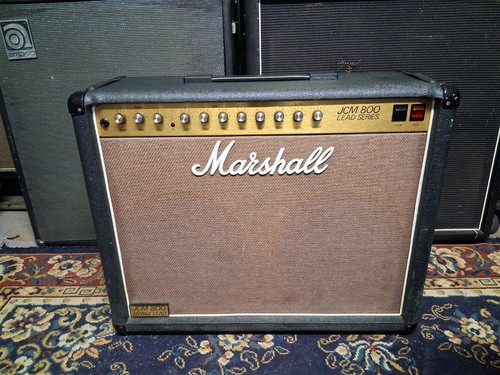
The JCM800 line runs from 1981 to 1989 and splits into meaningfully different circuits. The 2203 and 2204 (50W) are single-channel, all-preamp-gain designs — the "classic" JCM800 sound. The 2205 and 2210 added a second channel and an effects loop, which changed the circuit and the sonic character. The 2203 is the most collected. UK-built units (most pre-1987 export production) are generally preferred over later production; verify by chassis stamp against the known geographic production history.
Mesa/Boogie Mark series
The Mesa/Boogie Mark I through Mark V are sequential refinements that share little circuit DNA with one another. For collectors, the Mark I (1971–1978, produced in very small numbers as a boutique modification of a Fender Princeton circuit) and the Mark IIC+ (1983–1985) are the benchmarks. The IIC+ is particularly sought for its gain structure, and verified original IIC+ chassis can trade at significant premiums above other Mark II variants.
Identifying a genuine IIC+
The IIC+ can be distinguished from the IIC by chassis stamps (Mesa engraved the model on the chassis), the presence of the Simul-Class output stage with a specific power tube complement, and the graphic EQ implementation. Mesa serial number records are partially available through dealers; contact Mesa/Boogie directly for production verification on any high-value purchase.
General buying principles for vintage tube amps
- Check the transformers first. Original transformers are the hardest components to fake convincingly and the most expensive to replace correctly. Date codes should be consistent with claimed production year.
- Ask for the back panel. Tube charts, circuit revisions, and chassis stamps are visible without tools. A seller who won't provide clear photos of the back panel is hiding something.
- Understand recap status. All vintage amps will eventually need new filter capacitors. A professionally recapped amp with correct-spec parts is not devalued by the recap — a butchered one with wrong-spec caps is. Ask who did the work and with what components.
- Original speakers are not always better. A 60-year-old speaker cone may need replacement. Verify integrity before purchase. An original speaker with a torn cone is not better than a correct-era replacement.
- Verify with transformer date codes, not just serial numbers. Serial numbers can be transposed or stamped incorrectly. Transformer EIA codes are independent dating evidence.
The best vintage amp purchases happen when you know exactly what you're looking at before the transaction. Date codes, circuit revisions, and transformer provenance are all readable from the outside of a well-documented amp. If a seller can't provide this documentation, price the risk accordingly.