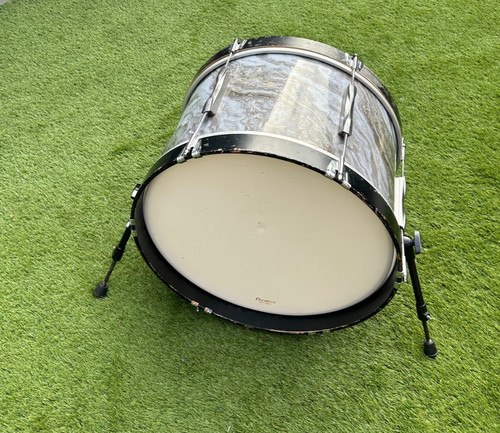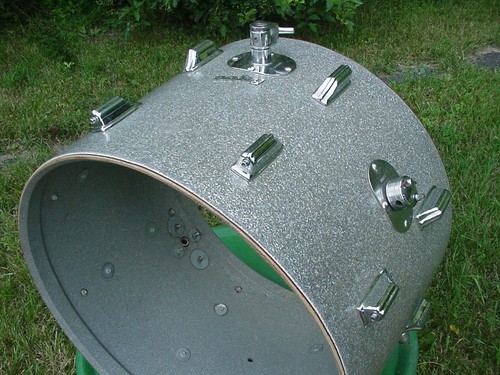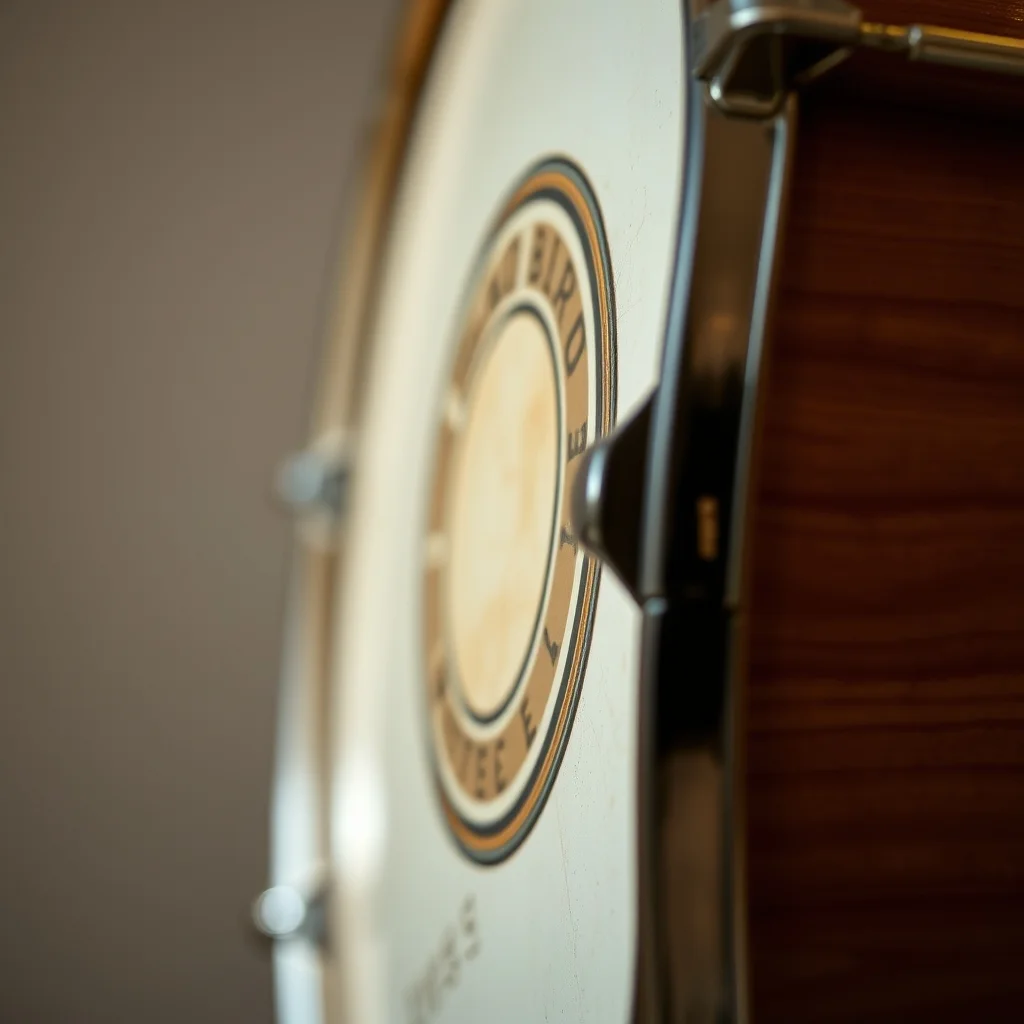
Vintage drum identification relies on a combination of badge dating, serial number records, hardware evolution, and shell construction verification. Unlike guitars, where the headstock and label are primary dating references, vintage drums require cross-referencing several elements simultaneously — because hardware and shells were frequently mixed from stock, and because the same company could produce quite different drums across a decade's production run.
Shell construction fundamentals
Before identifying a specific manufacturer or era, understanding shell construction types clarifies what you're looking at and what it means sonically.
Ply construction
Most production drums use laminated shells of thin plies of wood cross-layered and glued. Ply count and wood species both affect the shell's resonant frequency and projection. Common construction types:
- 3-ply with reinforcement rings: Used by Gretsch (Round Badge era), early Ludwig, and others. The three outer plies are thick; interior reinforcement rings add mass and rigidity near the bearing edges. This construction has a warm, open fundamental tone with pronounced sustain.
- 6-ply continuous stave: Ludwig's transition in the early 1970s moved toward thinner continuous-ply construction without reinforcement rings. More attack, slightly drier sustain compared to 3-ply with rings.
- Solid-shell: Slingerland Radio King snare drums used a single piece of steam-bent solid maple. No ply lines are visible at the shell interior edge.
Wood species
North American manufacturers predominantly used maple; British manufacturers (Premier, Carlton) predominantly used birch. Maple shells typically project more warmly and with a prominent fundamental; birch shells tend toward a brighter, more focused attack with faster decay. These are general tendencies affected significantly by shell thickness, bearing edge profile, and head type.
Bearing edge profile
The bearing edge — where the drumhead contacts the shell — determines how the head vibrates against the shell. A sharp 45-degree edge produces more attack and focus; a rounded edge produces more warmth and sustain. Vintage bearing edges are often checked for damage from improper head changes. A chipped, dented, or reshaved bearing edge is difficult to fully restore and affects value.
Gretsch: Round Badge dating
Gretsch's badge history is the primary dating reference for their drums. The badge design changed with ownership and production transitions.
Pre-1957 badges
Early Gretsch drums used various badge formats including a simple oblong stamped metal badge. These pre-Round Badge examples are less common in the collector market and require specific research per era.
Round Badge era (1957–1972 approximately)
The characteristic circular badge with the Gretsch name and model information is the "Round Badge" designation. Within this era, further dating is possible by:
- Badge text and font changes: The script lettering changed subtly between the early 1960s and early 1970s. "Made in USA" and "Brooklyn NY" text variants help narrow the window.
- Internal dating codes: Gretsch stamped production date codes on the interior of shells — typically a two-digit year and month code. These are more reliable than badge interpretation alone.
- Hardware: The "rail consolette" tom mounting, the "stop lock" strainer on snare drums, and the specific lug design changed across this era. Cross-reference hardware against known production timelines.
Post-1972 production
Gretsch was acquired by Baldwin in 1967, and production changes followed over the next decade. Post-1972 Gretsch drums use a different badge (the "Bow Tie" badge format) and typically use different shell construction. These are valuable instruments but are in a different collector category from Round Badge examples.
Ludwig: serial number dating
Ludwig drum serial number dating is among the best-documented in vintage drums. The Ludwig serial number chart, based on factory records and collector research, allows production year identification to within one to two years across most of the 1960s and 1970s production.
The serial number chart
Serial numbers on Ludwig drums are typically found on a paper sticker inside the bass drum shell, inside the snare drum shell, or on a metal plate on the shell interior. For a 1960s Ludwig, the format is typically a five to six digit number. Cross-referencing against the published Ludwig serial number chart (maintained by the Ludwig Collector's Association and reproduced on drummaking reference sites) gives production year within a documented range.
Shell construction transitions
Ludwig used three-ply maple with interior maple reinforcement rings in the early 1960s. The transition to six-ply construction without rings occurred progressively through the late 1960s into the early 1970s. A six-ply shell snare drum from 1970 is a different instrument from a three-ply with rings snare from 1965, even with identical hardware — verify construction type by inspection of the shell interior edge.
Hardware identification
Ludwig lug designs changed across their production history and provide secondary dating evidence. The "classic lug" (brass, with a vertical slot), "keystone lug," and "imperial lug" each correspond to production periods. Verify that hardware is original and consistent with the claimed serial number era — hardware was frequently replaced or mixed from stock.
Slingerland Radio King: solid-shell verification
The Slingerland Radio King snare drum was produced from the 1930s through the 1970s. The defining characteristic is the solid maple shell — a single piece of steam-bent wood without lamination. Solid-shell construction is verifiable by visual inspection of the bearing edge interior.
How to verify solid shell
On a laminated shell, the bearing edge interior shows horizontal ply lines — the seams between glued layers. On a solid-shell drum, the interior surface is continuous grain with no horizontal lines. Shine a light directly at the bearing edge from inside the drum. Ply lines are immediately visible if present. A truly solid shell shows only wood grain.
Badge eras
Slingerland used several badge formats across the Radio King production run. The "Radio King" badge text and format changed with ownership transitions (Slingerland was acquired by AMF in 1967). Pre-AMF Radio Kings are generally preferred by collectors. Verify badge text and lug style against known pre/post-AMF production characteristics.
Premier: British production verification
Premier drums produced in the UK through approximately the early 1980s are sought for their birch shell construction and British manufacturing quality. Premier's UK production is identifiable by:
- Badge text: "Made in England" or "Leicester, England" on the interior badge. Later production and outsourced models do not carry this marking.
- Lug design: UK Premier used distinctive elongated tube lugs on many models. The specific lug shape changed across eras.
- Shell construction: UK Premier typically used birch in 5-ply construction. Interior shell inspection should show the birch ply layers — lighter in color than maple, with a finer grain texture.
The Premier Genista and Artist models from the 1970s are the most commonly collected UK Premier kits. The later Premier XPK (1980s) and subsequent models used different manufacturing and are not in the same collector category.
General vintage drum buying principles
- Inspect bearing edges first. Damaged bearing edges reduce playability and are expensive to correct correctly. A chip or flat spot on the bearing edge should be reflected in price.
- Verify interior construction. Any claimed "Round Badge Gretsch" or "Radio King" should be verifiable by internal inspection. Insist on photos of the interior edge before remote purchase.
- Check hardware completeness. Vintage lug screws, tension rods, and snare throw-offs are specific to manufacturer and era. Missing or mismatched hardware from a wrong era signals previous repairs or parts mixing.
- Original wrap affects value but not construction. Re-wrapped drums in correct-era wraps are common. A re-wrapped drum with original shells and hardware is not the same as an original-finish example but is not necessarily devalued as a player's instrument.
- Cross-reference badge with serial and hardware. Any of the three in isolation is insufficient dating evidence. Consistent badge, serial, and hardware from the same era confirms a coherent original instrument.
The vintage drum market rewards research. A Gretsch Round Badge in verified original condition with interior date stamp and consistent hardware commands premium pricing for good reason. A drum described only by badge cosmetics without cross-referencing the interior construction is an unknown quantity regardless of asking price.