Guides
Technical identification and restoration guides — model variants, chip markings, and what to check before you buy.
Why this page exists
Vintage computer content splits between Wikipedia-level overviews and deep-cut modder forums. Neither helps a buyer who wants to know what they're looking at before bidding on eBay. The difference between an Apple IIe Rev A and Rev B motherboard, or a "breadbin" Commodore 64 versus a late-revision C64C, affects repair cost and part availability.
This page covers what actually matters for identification and first-power-on safety — not history or mythology, just the practical markers and the order of operations for bringing a machine back to life.
Vintage computers worth searching on eBay
The major 8-bit and early 16-bit platforms with active collector and restorer markets. We earn a small commission on qualifying sales; your price is unchanged. Full disclosure.
 Apple II vintage computer
Original 1977 Apple II through IIe and IIc. Look for keyboard type (Integer BASIC silkscreen vs later), motherboard revision sticker, and whether the power supply has been rebuilt. IIe is the most repairable — widest ROM and slot support.
Apple II vintage computer
Original 1977 Apple II through IIe and IIc. Look for keyboard type (Integer BASIC silkscreen vs later), motherboard revision sticker, and whether the power supply has been rebuilt. IIe is the most repairable — widest ROM and slot support.
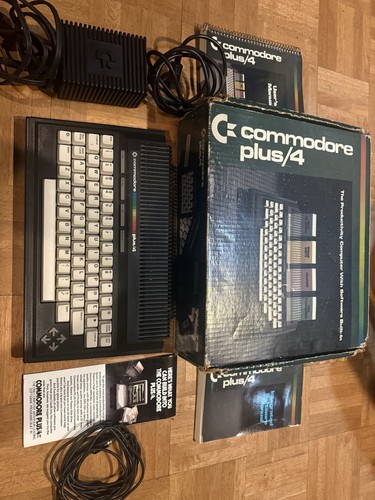 Commodore 64 working
The best-selling home computer of all time. "Breadbin" (1982–1983) vs flat C64C (1986+) cases are immediately identifiable. The SID chip revision (6581 vs 8580) affects audio character — a meaningful difference to chip-music collectors.
Commodore 64 working
The best-selling home computer of all time. "Breadbin" (1982–1983) vs flat C64C (1986+) cases are immediately identifiable. The SID chip revision (6581 vs 8580) affects audio character — a meaningful difference to chip-music collectors.
 IBM PC 5150 vintage
The 1981 original IBM PC. The 5150 motherboard has three revisions identifiable by the number of RAM expansion slots. The PSU contains RIFA X-capacitors that are a fire risk after 40+ years — replace before power-on.
IBM PC 5150 vintage
The 1981 original IBM PC. The 5150 motherboard has three revisions identifiable by the number of RAM expansion slots. The PSU contains RIFA X-capacitors that are a fire risk after 40+ years — replace before power-on.
 TRS-80 Model 3
Tandy's self-contained all-in-one Z80 machine. Model I, III, and 4 are externally similar but not compatible at the software or expansion level. The Model 4 added an 80×24 display mode. Keyboard encoder ICs fail with age and are the most common repair.
TRS-80 Model 3
Tandy's self-contained all-in-one Z80 machine. Model I, III, and 4 are externally similar but not compatible at the software or expansion level. The Model 4 added an 80×24 display mode. Keyboard encoder ICs fail with age and are the most common repair.
 Atari 800 vintage computer
Atari's four-chip architecture (POKEY, GTIA, ANTIC, PIA) gave it graphics and sound capabilities that rivaled machines released years later. The 800 uses cartridge-type OS ROMs that can be swapped; the 800XL simplified this. POKEY ICs are harder to source than Commodore or Apple equivalents.
Atari 800 vintage computer
Atari's four-chip architecture (POKEY, GTIA, ANTIC, PIA) gave it graphics and sound capabilities that rivaled machines released years later. The 800 uses cartridge-type OS ROMs that can be swapped; the 800XL simplified this. POKEY ICs are harder to source than Commodore or Apple equivalents.