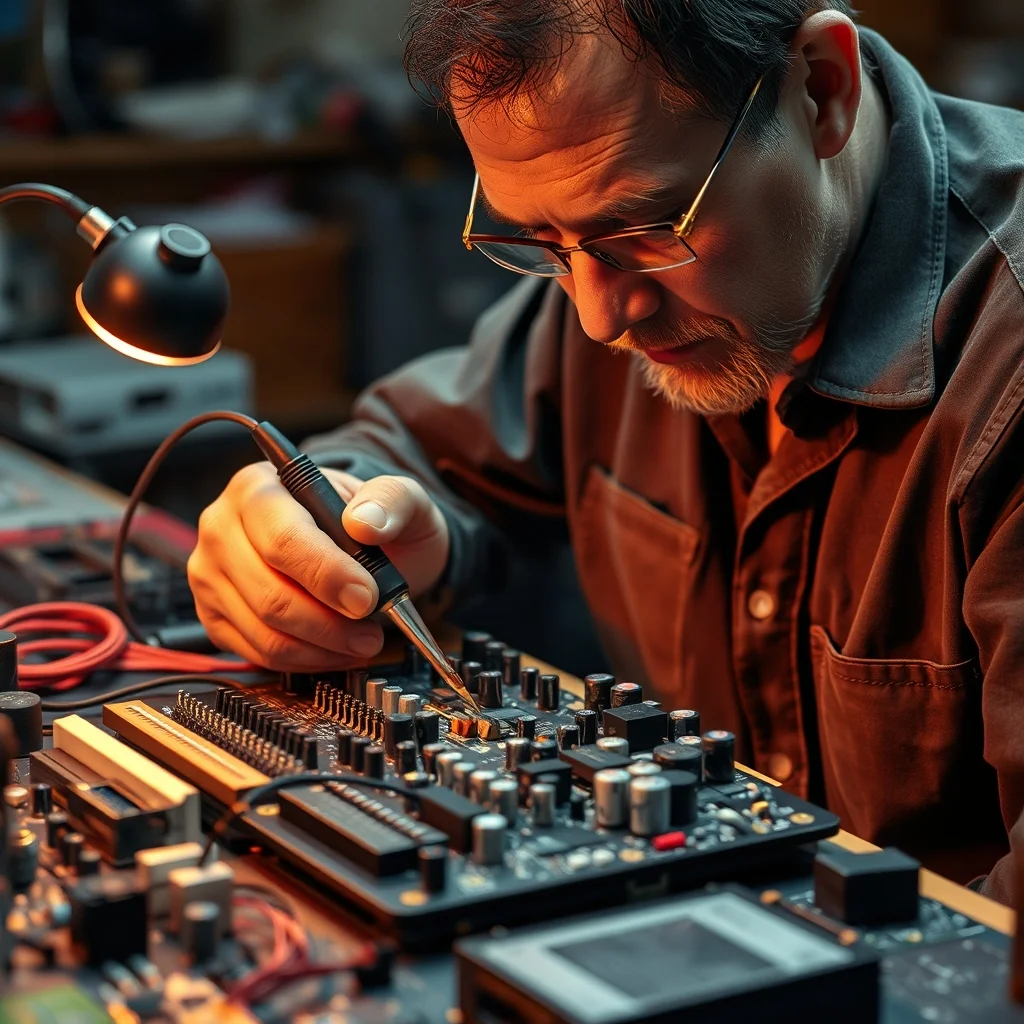
Why variant identification matters before buying
The label "Apple IIe" or "Commodore 64" on an eBay listing spans multiple motherboard revisions, ROM versions, and chip populations. Those differences determine which chips are replaceable with modern equivalents, what the capacitor count is for a full recap, and whether the machine's power supply is an immediate safety risk. Identifying the variant from photos — or knowing what photos to request — is worth doing before bidding.
The same logic applies to any vintage platform: a TRS-80 Model I and a Model III share a name but are separate machines. An Atari 800 and 800XL use different operating systems and have different expansion architectures. Buying the wrong one for your use case is a real outcome if you skip identification.
Apple II platform variants
Apple II (1977) and Apple II Plus (1979)
The original Apple II is identifiable by its Integer BASIC ROM and six peripheral slots. The II Plus added Applesoft BASIC in ROM and made some slot assignments. Physically, the main visual markers are the keyboard legend (early machines show key functions in brown silkscreen) and the motherboard date code stamped near the power connector. The original II lacks a Language Card slot; the II Plus supports one.
Apple IIe (1983–1993)
The IIe is the most practical restoration target: widest software library, best slot support, and the largest community. Motherboard revisions run from Rev A (1983) through the Platinum IIe (1987). The Platinum IIe adds a numeric keypad and uses a revised power supply — its motherboard silkscreen shows "Enhanced IIe" or "Platinum" near the CPU socket area. The Enhanced IIe (Rev B and later) replaced the original CPU and character ROM with versions that added lowercase display support; look for the "65C02" CPU marking rather than the original "6502."
Apple IIc and IIgs
The IIc is a compact all-in-one with no internal expansion slots — correct for portability, wrong for experimenting with cards. The IIgs (1986) added a 16-bit 65C816 CPU and color/sound capabilities far exceeding the 8-bit siblings, but its software library is narrower and its power supply is known to fail with age. Capacitor recap is particularly important on IIgs units, which have more electrolytics than the IIe.
Commodore 64 variants
The breadbin (1982–1983)
Early C64 units use the larger "breadbin" case (named for its rounded profile). These machines use the original 6581 SID chip, which produces a warmer, slightly distorted audio character compared to later revisions. Motherboard designations include ASSY 326298 and 250407. The 6581 has different filter characteristics than the 8580; chip-music made specifically for one revision often sounds wrong on the other. If SID audio character matters to you, confirm the SID revision before buying.
C64C (1986 onward)
The flat, lower-profile C64C case signals a later motherboard (typically 250469 or 250466), which uses the 8580 SID and HMOS chips rather than NMOS. The 8580 requires a different resistor value on the cutoff frequency pin; a breadbin SID dropped into a C64C board without modification will have incorrect audio. The HMOS chips run cooler than early NMOS, which matters for long-term reliability.
Capacitor recap scope on C64
A standard C64 recap replaces 8–12 electrolytic capacitors depending on motherboard revision. The critical ones are near the SID chip and the RF modulator. Failed caps on C64 boards typically manifest as distorted audio before they cause display or boot failures — audio issues are an early warning sign.
IBM PC 5150 identification
The 5150 (1981) motherboard has three revisions, identifiable by the number of RAM chip sockets populated on the board. The earliest revision (April 1981) supports up to 64KB on the motherboard; the later revisions (June and October 1981) support 256KB. The board date code appears near the keyboard connector.
Key identification check for buying: ask for a photo of the power supply label. The 5150 PSU contains RIFA X-capacitors — polypropylene film capacitors used for mains filtering. These were manufactured by RIFA (now part of Kemet) and are known to fail catastrophically after 30–40 years of age or storage, cracking and catching fire when powered on. Any 5150, 5160 (XT), or European PC-compatible from the mid-1980s should have its RIFA caps inspected and replaced before power-on. Typical RIFA caps in these PSUs are rated 250V AC, 100nF or 47nF — replacements must be X2-rated film capacitors of the same or greater voltage rating.
TRS-80 Model I, III, and 4
The TRS-80 Model I (1977) is the original — a separate keyboard unit connected to a monitor/expansion box. The Model III (1980) integrated keyboard, display, and disk drives into one unit. Despite similar appearance at a distance, the Model I and Model III are not software-compatible at the machine-code level. The Model 4 (1983) added an 80×24 80-column display mode and CP/M capability alongside the TRS-80 DOS environment.
For identification, the model number is on a label on the bottom or rear of the unit. More practically: a Model III has a built-in numeric keypad on the right side of the keyboard; the Model I does not. The Model 4 has a revised keyboard with a slightly different key feel and font.
Common failures on TRS-80 systems
The keyboard encoder IC (typically a 74LS145 or similar) fails on Model I and III units, causing keys to register incorrectly or not at all. Disk drive belts degrade and need replacement — foam belts of the era have turned to sticky residue on most machines. The Z80 CPU itself is rarely the failure point; the chips around it are more likely candidates after 40+ years.
Atari 800 and 800XL identification
The Atari 800 (1979) and 800XL (1983) share a common CPU (6502) and broad software compatibility but differ in architecture. The 800 has four cartridge-type ROM slots on the motherboard for OS ROMs — a unique design that allows OS replacement by physical cartridge swap. The 800XL simplified this to a single OS ROM soldered to the board, and added the PBI (Parallel Bus Interface) expansion port.
The 800's four custom chips — POKEY (sound/I/O), GTIA (graphics/television interface), ANTIC (display list processor), and PIA (peripheral interface) — are the core of the Atari 8-bit platform's capabilities. POKEY is the most commonly failed chip on worn units; it handles both audio and serial I/O, so its failure shows up as audio distortion combined with SIO port (tape/disk) errors. Replacement POKEY chips are available from the retro community but are more expensive than Commodore or Apple equivalents.
Recapping electrolytics: which models need it most
Electrolytic capacitors have a finite lifespan — typically 15–25 years under normal operating conditions, often longer in storage but degraded in high-ESR (equivalent series resistance) by age regardless of use. A recap replaces all electrolytics on a board with modern equivalents of the same capacitance, voltage rating, and physical size (or slightly larger, which is acceptable).
| Platform | Recap urgency | Notes |
|---|---|---|
| Apple IIe | Low–medium | Few electrolytics; power supply is the priority item |
| Apple IIgs | High | More caps than IIe; audio and video failures are common symptoms |
| Commodore 64 (NMOS) | Medium | 8–12 caps; audio distortion is the first symptom of cap failure |
| Commodore 64C (HMOS) | Medium | Similar scope; HMOS chips run cooler so thermal stress is lower |
| IBM 5150/5160 | Medium (board) + Critical (PSU RIFA) | Board caps are secondary; RIFA replacement in PSU is safety-critical |
| TRS-80 Model I/III | Low | Primarily TTL logic; few electrolytics on mainboard |
| Atari 800/800XL | Medium | Power regulator section caps degrade; symptoms include random resets |
RIFA X-capacitor replacement
RIFA-brand X-capacitors appear in the mains filter sections of power supplies across a wide range of 1980s equipment — not just IBM PCs. Sinclair Spectrum PSUs, Amstrad CPC monitors, BBC Micro power supplies, and many European Commodore units contain them. The failure mode is consistent: the epoxy body cracks as the capacitor ages, and the next power-up event causes the capacitor to arc internally, producing smoke and a sharp acrid smell (the polypropylene burning).
Replacement is straightforward: X-capacitors connect across the mains input, so they are accessible once the PSU cover is removed. Replace with a modern X2-rated film capacitor of the same or greater voltage rating (250V AC minimum) and within 20% of the original capacitance value. Brands producing current X2 caps include Kemet, WIMA, and Vishay. Do not substitute a standard electrolytic or ceramic capacitor in an X-capacitor position — the safety rating of X-class capacitors is specific to mains-filtering duty.
eBay buying checklist for vintage computers
- Request a photo showing the motherboard revision number or date code
- Ask whether the machine powers on and boots to a prompt (not just "powers on")
- For IBM 5150/5160: confirm whether the PSU has been recapped or RIFA caps replaced
- Check keyboard key travel in any available video — stiff or sticky keys often indicate foam pad degradation
- For C64: ask if the seller knows the SID chip revision (6581 vs 8580) — it's visible on the chip label
- For Atari 800: ask about the RF modulator output vs composite/S-Video mod status — RF-only output on a modern TV requires an upscaler or direct composite mod
- Factor in power supply condition for any unit: a dead or borderline PSU can damage logic chips on first power-up
Search eBay for vintage computers
 Apple II vintage computer
IIe is the most practical restoration target — widest software, best community support.
Apple II vintage computer
IIe is the most practical restoration target — widest software, best community support.
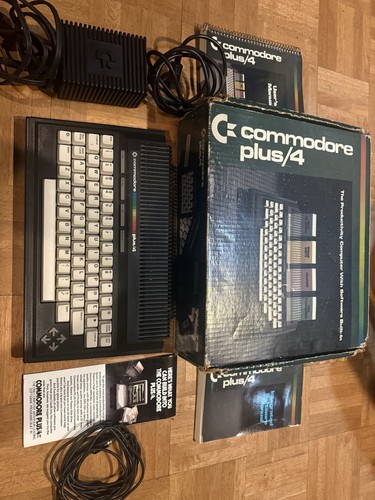 Commodore 64 working
Confirm SID chip revision (6581 vs 8580) before buying if audio character matters.
Commodore 64 working
Confirm SID chip revision (6581 vs 8580) before buying if audio character matters.
 IBM PC 5150
Verify RIFA cap status in PSU before first power-on. Budget for replacement parts.
IBM PC 5150
Verify RIFA cap status in PSU before first power-on. Budget for replacement parts.
 TRS-80 Model 3
Confirm model number — Model I, III, and 4 are not software-compatible at the machine-code level.
TRS-80 Model 3
Confirm model number — Model I, III, and 4 are not software-compatible at the machine-code level.
 Atari 800
POKEY chip sourcing is harder than Commodore/Apple equivalents — factor into restoration budget.
Atari 800
POKEY chip sourcing is harder than Commodore/Apple equivalents — factor into restoration budget.