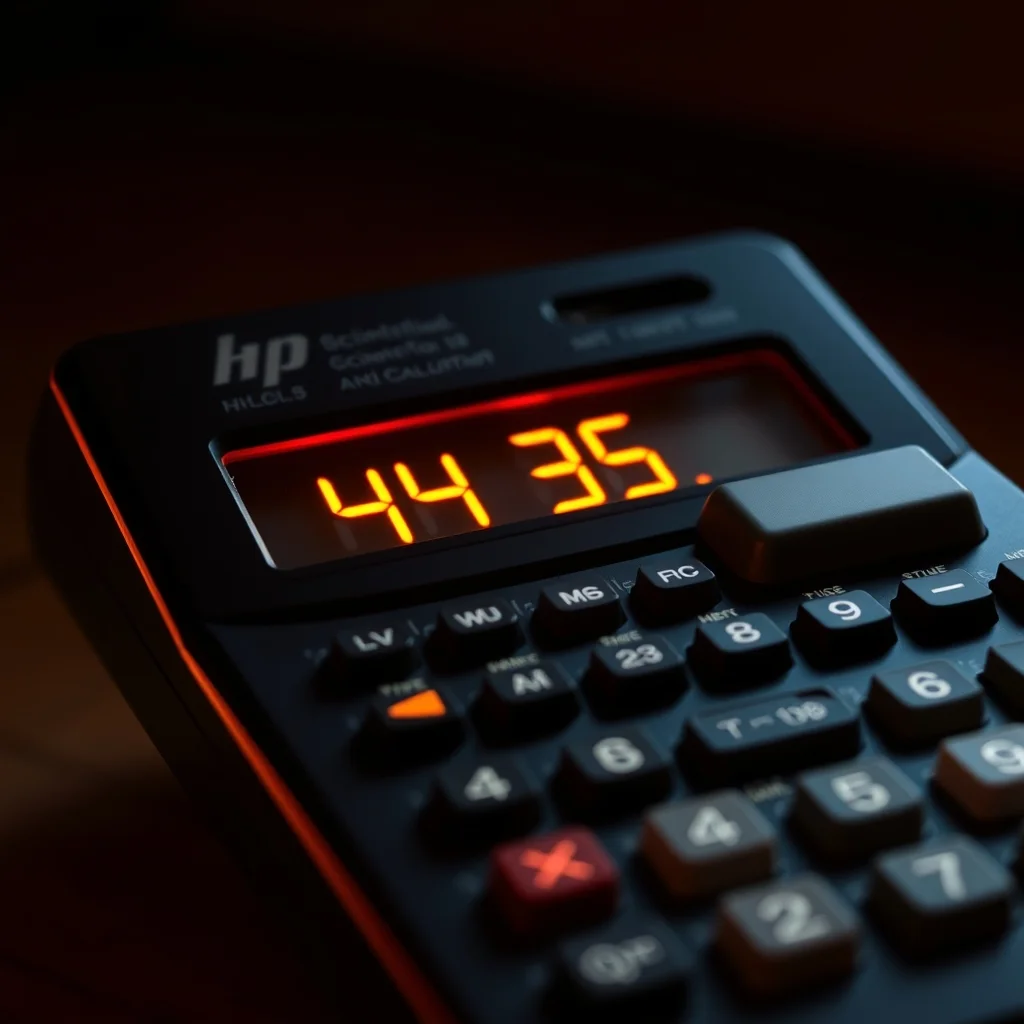
RPN: why it matters for calculator collecting
Reverse Polish Notation — the entry system used by most HP calculators — is not a quirk or a mistake. It is a direct implementation of the stack-based arithmetic used in computer science, and it was chosen by HP deliberately for its efficiency: RPN requires no parentheses, executes operations immediately upon entry, and for complex expressions requires fewer keystrokes than algebraic entry. The notation itself was formalized by Jan Łukasiewicz in the 1920s and adapted for calculators by the Australian philosopher Charles Hamblin in 1957 — HP's engineers at Hewlett-Packard adopted it for the HP-9100A desktop calculator in 1968, and carried it through to the HP-35 and every subsequent HP scientific calculator until the HP-38E in 1977 (which added an algebraic mode option).
For collectors, RPN matters because it determines the entire UX of the calculator, the community around it, and the way the keyboard is laid out. RPN calculators have an ENTER key rather than an equals key. The four-level stack (X, Y, Z, T registers) is fundamental to understanding HP calculator behavior. A collector who learns RPN has access to the full original documentation and the substantial user community; a collector who does not will find early HP calculators simply opaque.
HP-35: the first pocket scientific calculator
Why the HP-35 mattered
Introduced in January 1972, the HP-35 was the first handheld calculator capable of scientific functions — logarithms, trigonometry, and exponential arithmetic. Before it, scientific computing in the field meant a slide rule. The HP-35 was priced at $395 at introduction (roughly $2,800 in 2024 dollars), which positioned it as a professional instrument rather than a consumer product. HP did not believe the mass market existed; the engineering and sales teams were surprised by demand.
The HP-35 display uses a red LED (light-emitting diode) array — 15 digits with a decimal point, sign indicator, and exponent digits. The LED display draws significant current and reduces battery life to approximately three hours on a charge. This was acceptable in 1972; it is a maintenance consideration for collectors today.
HP-35 production variants
The HP-35 went through three production versions, distinguishable by the ROM version stamped on the internal chips and visible through the serial number ranges. The earliest units (version 1 ROM) contain a mathematical error in the 10^x function — specifically, the result of 2.02 raised to the power of ln(9.9999999999)/ln(2) should be 9.9999999999, but the version 1 ROM produces a slightly incorrect result. HP acknowledged the bug and issued a corrected ROM. Version 1 units with the original bug are considered more collectible by some enthusiasts specifically because of the historical defect.
Battery pack condition
The HP-35 uses a rechargeable NiCd (nickel-cadmium) battery pack. After 50+ years, essentially all original packs are either dead or intermittently functional. Rebuilding involves replacing the NiCd cells with modern NiMH cells of the same physical size — 3 × 1/3 AA cells in most HP pocket calculators of this era. The rebuild is documented extensively in the HP collector community and is considered a prerequisite for any working HP-35. A unit offered as "works on AC adapter" with a dead battery pack is priced accordingly; a unit with a rebuilt pack commands a modest premium.
HP-12C: the enduring financial calculator
The HP-12C, introduced in 1981, is the longest-continuously-produced calculator in history. It has never been discontinued. Finance professionals — particularly in real estate, investment banking, and mortgage origination — adopted it as a standard tool in the 1980s and many continue using it because the RPN-based financial functions (TVM, NPV, IRR, amortization, depreciation schedules) are genuinely faster to operate than any algebraic alternative for common finance workflows.
Saturn vs ARM revisions
The original HP-12C uses HP's proprietary Saturn CPU (also known as the NUT processor), a 4-bit architecture designed specifically for HP's calculators. In the early 2000s, HP redesigned the 12C around an ARM processor running a Saturn emulator — the behavioral output is identical, but the underlying hardware changed entirely. A further revision added a faster ARM core that executes some calculations noticeably faster (most visible in the NPV/IRR iterative solvers).
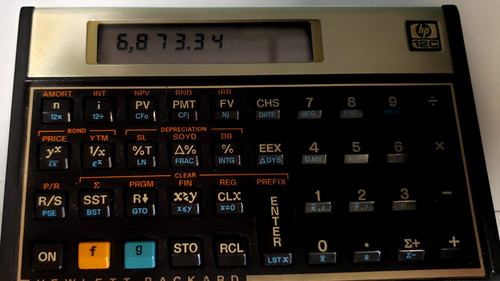
For collectors, the Saturn-based originals are the target. Identification: the original and early production 12C has a gold-colored face label, "Made in USA" on the back, and a longer battery life between changes due to the Saturn CPU's extremely low power draw. Later ARM-based units have a silver or updated face design and "Made in Indonesia" or "Made in China." The gold face combined with the USA manufacturing mark is the clearest visual identifier for the original Saturn-era unit.
| Model | Introduction | Entry system | Display | Collector note |
|---|---|---|---|---|
| HP-35 | 1972 | RPN, 4-level stack | Red LED, 15 digits | Three ROM versions; version 1 has known math bug |
| HP-45 | 1973 | RPN, 4-level stack | Red LED, 15 digits | Added unit conversion and HMS functions vs HP-35 |
| HP-65 | 1974 | RPN, 4-level stack | Red LED | First programmable pocket calculator; magnetic card reader |
| HP-12C | 1981–present | RPN | LCD | Saturn CPU originals most collectible; gold face = early |
| TI-30 (original) | 1976 | Algebraic | Red LED | Distinguished from later TI-30 reissues by LED display |
| Sinclair Cambridge Scientific | 1974 | Algebraic | LED (Bowmar) | Ultrathin; display segment failures are common |
Texas Instruments TI-30: algebraic competition
Texas Instruments launched the TI-30 in 1976 as a direct price competitor to HP's scientific calculators, at a fraction of the cost. Where the HP-35 cost $395 at launch, TI priced the TI-30 at $24.95. The strategy worked: TI sold millions of units and drove down the price of scientific calculators broadly. The TI-30 uses algebraic entry, not RPN, and is aimed at students rather than engineers.
The original TI-30 (1976–1978) uses a red LED display and a TI-manufactured chip set. It is a single-tier scientific calculator covering the major scientific functions but not programming or financial calculations. Its collectibility today rests primarily on its historical significance as the calculator that democratized scientific computing access.
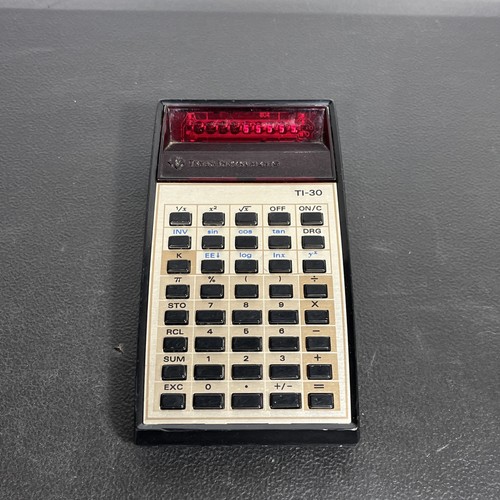
Critical identification note for eBay buyers: TI reused the TI-30 name on unrelated calculators through the 1980s, 1990s, and into the present. Modern TI-30 calculators are algebraic LCD scientific calculators with no connection to the original 1976 design beyond the name. Collectors want the original LED-display units from 1976–1978. The LED display is immediately distinctive — any TI-30 with an LCD is a later reissue.
Sinclair Cambridge: British engineering constraint
Clive Sinclair's Sinclair Radionics produced the Cambridge calculator in 1973, positioning it against HP and TI on thinness rather than function count. The Cambridge was genuinely extraordinarily thin for its era, achieved partly through component selection and partly through a case design that left the battery partially exposed on the back. The Cambridge Scientific (1974) added trigonometric and logarithmic functions.
Sinclair calculators have a reputation for unreliability — battery life was poor, the early units had arithmetic accuracy issues (Sinclair used approximation algorithms to save ROM space), and display segment failures are common on surviving units. That historical reputation is itself a collector point: the Sinclair Cambridge represents what happens when design constraints force compromises, and the results are interesting precisely because they are imperfect.
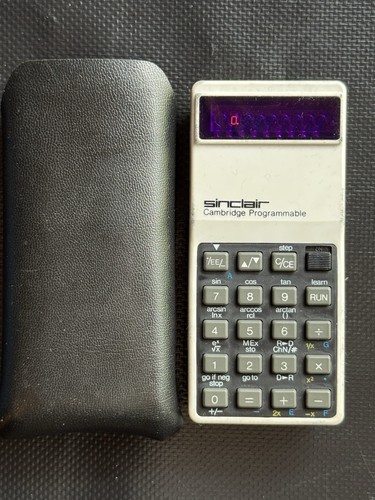
Condition assessment for Sinclair Cambridge: power on and test every function key. Display segment failure (missing digit segments) is the most common fault. The original Cambridge and Cambridge Scientific use a Bowmar LED display module; replacements are effectively unobtainable, so a unit with dead display segments is display-impaired permanently without donor parts from another unit.
Mechanical calculators: Olivetti, Facit, and Marchant
Before electronic calculators, computation was mechanical. The major manufacturers — Olivetti (Italy), Facit (Sweden), Marchant (USA), and Friden (USA) — produced precision mechanical devices that performed addition, subtraction, multiplication, and division through gear-based mechanisms. These machines represent a completely different collecting category from electronic calculators, requiring different assessment and maintenance approaches.
Olivetti Divisumma series
Olivetti's Divisumma calculators (the Divisumma 14, 24, and related models produced from the 1940s through the 1970s) are among the most elegantly designed mechanical calculators ever built. The exterior design by Marcello Nizzoli has been exhibited in design museums; the machines are collected as industrial design objects as much as calculating instruments. The mechanism is fully mechanical for the basic arithmetic operations; later models added an electric motor for the carriage return mechanism.
Assessment: verify that the carriage moves freely, that digit wheels advance and reset without skipping, and that the clearing mechanism (the return lever or button) operates without binding. Seized mechanisms are almost always the result of dried lubricant rather than broken parts; disassembly, cleaning, and relubrication restores most seized machines. Replacement parts are effectively impossible to source commercially — any repair requires mechanical skill and patience.
Facit and Marchant pin-wheel calculators
Facit's pin-wheel calculators (produced in Åtvidaberg, Sweden) used a different mechanism than Olivetti — a rotating drum with retractable pins rather than a gear-and-carry system. The Facit mechanism is known for being particularly reliable and serviceable; the Swedish manufacturing standards of the 1950s and 1960s produced machines that often require only cleaning to restore function after decades of storage.
Marchant (American) machines are the heaviest and most robust of the major mechanical calculator brands — a typical Marchant Silent Speed weighs 25–30 pounds and is built to commercial-grade precision standards. Marchant's automatic division is particularly impressive mechanically: the machine solves division problems by a repeated subtraction and carriage-advance sequence that is visible as the mechanism operates.
Battery pack rebuilding for HP and TI calculators
Virtually all HP pocket calculators from 1972 through the early 1980s use rechargeable NiCd battery packs that have reached end of life. The rebuild process is well-documented in the HP Museum and Museum of HP Calculators communities:
- Open the battery pack by carefully separating the plastic case halves — these are typically held by pressure-fit tabs, not screws
- Remove the original NiCd cells, noting polarity (photograph before desoldering)
- Source NiMH replacement cells of the same physical format — typically 1/3 AA or 2/3 AA depending on the model
- Solder in the replacement cells with the same polarity, maintaining the original tab connections where possible
- Reassemble the pack case with contact cement if the tabs no longer click
- Charge on the original charger for a full cycle before testing
NiMH cells have a higher capacity than the original NiCd cells, which extends battery life. The charging circuit in HP calculators of this era charges at a fixed low rate (trickle charge), which is compatible with NiMH chemistry — unlike fast chargers, which require NiMH-specific charge detection circuits.
eBay buying checklist for vintage calculators
- For HP-35: verify LED display lights on all segments; request a powered-on photo showing a multi-digit number in the display
- For HP-35 collectors: ask for the serial number prefix to identify potential ROM version 1 units
- For HP-12C: check the face design and manufacturing origin for Saturn vs ARM identification
- For TI-30: verify it is an LED-display original, not a later LCD reissue bearing the same name
- For Sinclair Cambridge: test all display segments and all function keys; display segment failures are permanent
- For mechanical calculators: ask whether the mechanism moves freely (not seized) and whether the seller has powered it through a computation cycle
- For any HP LED calculator: factor in battery pack rebuild cost and effort if the pack is original
- Avoid listings with "sold as-is" combined with "no returns" for electronic calculators — these two conditions together typically mean the seller knows of a fault
Search eBay for vintage calculators
 HP-35 calculator
Request the serial number prefix to identify early ROM version 1 units.
HP-35 calculator
Request the serial number prefix to identify early ROM version 1 units.
 HP-12C original
Gold face + Made in USA = Saturn CPU original. Later revisions use ARM with emulator.
HP-12C original
Gold face + Made in USA = Saturn CPU original. Later revisions use ARM with emulator.
 TI-30 original (LED)
LED display = 1976–1978 original. LCD = later reissue, not the same machine.
TI-30 original (LED)
LED display = 1976–1978 original. LCD = later reissue, not the same machine.
 Sinclair Cambridge
Test all display segments — dead segments are permanent without donor parts.
Sinclair Cambridge
Test all display segments — dead segments are permanent without donor parts.
 Olivetti mechanical calculator
Seized mechanisms usually just need cleaning — verify carriage moves freely.
Olivetti mechanical calculator
Seized mechanisms usually just need cleaning — verify carriage moves freely.