This page is for a landowner who wants a camera on their own ground and does not yet know whether a rule applies. We are not lawyers and this is not advice. We read three official pages and we say which. There are fifty states and we did not read fifty. Rules change by season, so use these as examples of what to look for, then read your own agency's current page.
What three official pages say
| State and source | What it says | What it does not say |
|---|---|---|
| Wisconsin. DNR, Online Hunting Regulations, "DNR-Managed Lands" page. Read 2026-11-01. | Placing a trail camera and leaving it overnight on DNR lands is authorized only under conditions. "Placement occurs in areas where hunting is allowed." The camera must carry the owner's name and address, or DNR customer ID number, "permanently attached or engraved to the outside of the camera" where it can be seen without moving it. It must not damage vegetation or other DNR property. Placement is "done at your own risk": the DNR is not responsible for theft or damage. | This page covers DNR-managed land only. It does not cover private land, and it does not mention cellular cameras. |
| Utah. Division of Wildlife Resources, Furbearer Guidebook 2025-26 (PDF). Read 2026-11-01. | The guidebook text: "All trail cameras are prohibited on public land from July 31 to Dec. 31", with exceptions for approved research and monitoring. A camera using internal data storage and "not capable of transmitting live data" "is permitted for use on private land" for legal hunting. The guidebook also bars selling or buying footage that could be used to take big game, cougars or bears. It defines a trail camera as "a device that is not held or manually operated by a person". | It is a trapping guidebook, so it summarizes the rule rather than setting it out in full. It points to a Utah page, wildlife.utah.gov/trailcams. That address returned a 404 error when we fetched it on 2026-11-01, so we did not read it. The guidebook is for the 2025-26 season. It does not say what applies to a camera on private land that does transmit. |
| Montana. Fish, Wildlife and Parks, 2026 Deer, Elk and Antelope regulations (PDF). Read 2026-11-01. | "It is unlawful for a person, while hunting, to use any electronic motion-tracking device" designed to track a game animal's motion and relay it to the hunter. The page says the Fish and Wildlife Commission defines these as "remote operated camera or video devices capable of transmitting real time information, pictures, or videos", plus seismic, thermal and satellite or radio telemetry devices. | It does not say whether a given cellular trail camera counts. It does not name trail cameras as such. Ask FWP. |
What we could not read
The Arizona Game and Fish page we tried (its fair chase page) returned HTTP 403 to our fetch. Idaho Fish and Game pages returned HTTP 503. We found secondary news pages about both states, and we do not use them here. If your state is one of those, go to the agency's own regulations page or call its regulations office.
How to read these without a lawyer
- Land type changes the answer. Utah treats public and private land differently. Wisconsin's page is only about DNR land. Start by writing down who owns the spot.
- The calendar changes the answer. Utah's window is July 31 to Dec. 31. A rule that is quiet in spring may bite in the season you buy for.
- Transmitting changes the answer. Utah's private-land allowance describes a camera that cannot transmit live data. Montana's definition names devices capable of sending pictures in real time. GardePro's own pages say its cellular cameras upload over a 4G network. Whether a particular use is covered is the agency's question to answer.
- Hunting changes the answer. Montana's rule applies "while hunting". If you want deer photos for the family and do not hunt, the same rule may not apply to you. Ask before you assume either way.
- The camera may need your name on it. Wisconsin's page asks for it on DNR land. Engraving or a label with your name is cheap even where it is not required.
What none of these pages covers
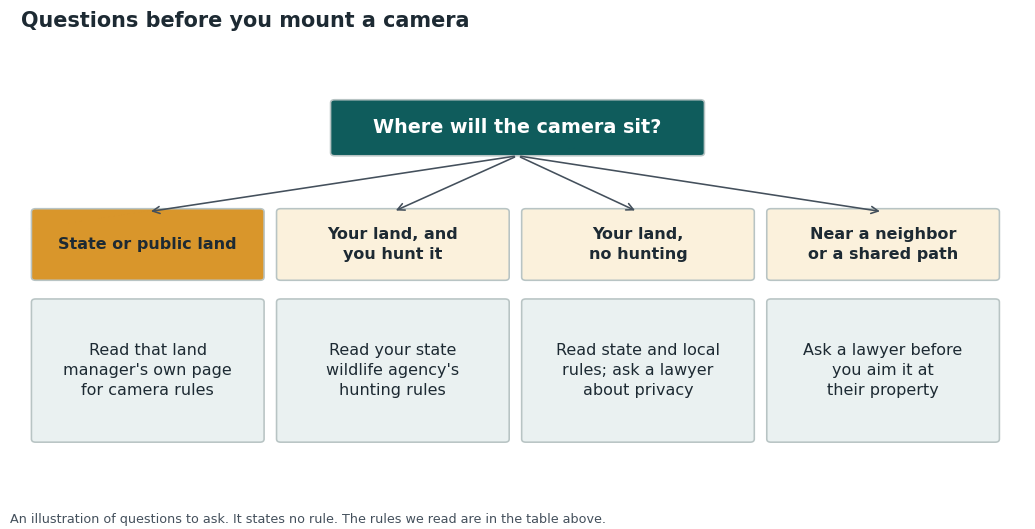
- The line between your land and a neighbor's, and what a camera may point at.
- Privacy. Some of these cameras record sound. GardePro's X66 3.0 Pro manual has a video sound setting. Whether recording sound near a path or a property line is a problem where you live is a question for a lawyer.
- Local rules: county or town ordinances, homeowner association rules, easements, posted land.
Who to ask: your state wildlife agency's regulations office or a conservation officer for hunting and land rules, your county or town office for local rules, and a lawyer licensed in your state for privacy and property-line questions.
The cheaper or simpler option
The cheapest step is a phone call. Ask your state agency, before you buy, whether a camera that transmits is allowed on your land in the season you plan to use it. If the answer is yes, buy what suits the spot. If the answer is that only a camera that does not transmit is allowed, a camera with no radio costs less to run and has no plan. If the answer is no camera at all, you have saved the price of one.
If a camera with no radio fits your state's rule
Our reason to click: GardePro's E5 2.0 page describes a camera with no cellular features that records to an SD card. Whether that type fits your rule is for your agency's page to answer, not ours.
We earn a small commission on qualifying sales, and 90% of it goes to charity (you can pick which); your price is unchanged. Full disclosure.
Sources, all read 2026-11-01
- Wisconsin DNR: DNR-Managed Lands, Online Hunting Regulations
- Utah DWR: Furbearer Guidebook 2025-26 (PDF), the trail camera and night-vision notes
- Montana FWP: 2026 Deer, Elk and Antelope regulations (PDF), "Motion-Tracking Devices (MCA 87-6-401)"
- GardePro: X66 3.0 Pro page and its manual, for the statement that its cellular cameras upload over 4G and the video sound setting