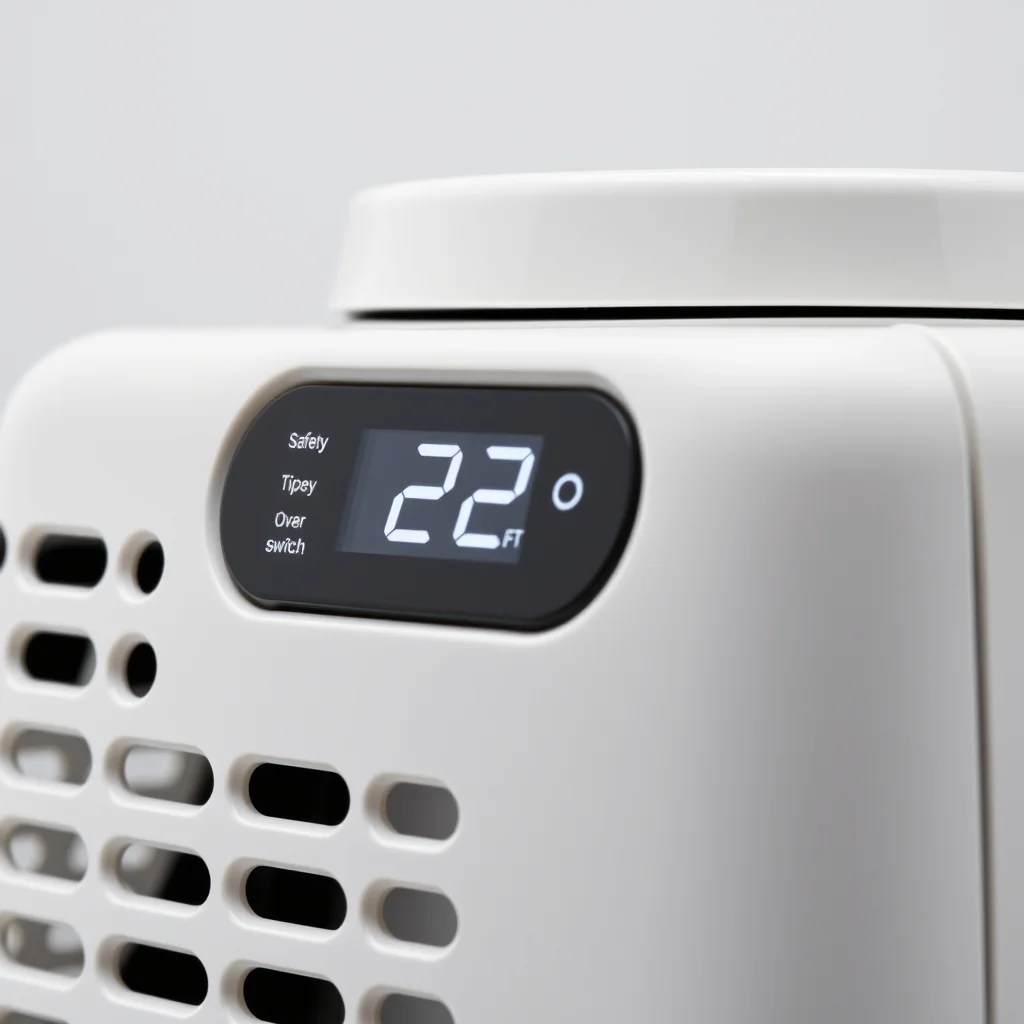
The 1,500-watt ceiling: why all heaters are equal on paper
A standard US 15-amp, 120-volt circuit can safely handle about 1,800 watts. With the common recommendation to keep appliances at 80% of circuit capacity, 1,440 watts is the practical limit — which is why virtually every portable space heater maxes out at 1,500 watts. A "$200 premium heater" and a $30 unit produce the same peak heat output. The price difference buys you control, consistency, and safety features — not more heat.
The practical consequence: do not put a space heater on the same circuit as a hair dryer, electric kettle, or other high-draw appliance. A 1,500-watt heater plus a 1,200-watt kettle will trip a 15-amp breaker reliably.
Ceramic, infrared, and oil-filled: how each technology heats
Ceramic (fan-forced)
A ceramic heating element resists electrical current and generates heat; a fan blows air across it and into the room. Ceramic heaters warm room air quickly — a 150 sq ft room typically reaches comfort temperature within 10–15 minutes. Fan noise is inherent to the design, typically 40–55 dB, which rules them out for light sleepers. The ceramic element itself stays at moderate temperatures (lower than nichrome wire heaters), making it somewhat safer than older resistance designs.
Infrared (radiant)
Infrared heaters emit electromagnetic radiation at wavelengths that warm solid objects — including people — without first heating the air. The sensation is more like sunlight than convective warmth. Infrared heaters are effective for personal workspace heating and garages with open doors (where heated air would escape), but less effective for warming an enclosed room that no one will occupy for 30 minutes. Most infrared heaters run silently. The quartz or halogen tubes glow visibly, which some people find intrusive in dark rooms.
Oil-filled radiator
Dielectric oil sealed inside finned metal columns is heated by an electric element; the fins radiate that heat into the room. Oil-filled units are the slowest to reach operating temperature (typically 20–30 minutes) but hold warmth well after the element cycles off. They run completely silently and have no exposed hot surfaces that can ignite nearby materials. They are the preferred choice for bedroom use where noise and surface temperature matter.
| Type | Heat-up Time | Noise | Best For |
|---|---|---|---|
| Ceramic fan-forced | 5–15 min | Moderate (fan) | Living rooms, offices |
| Infrared radiant | Instant | Silent | Personal workspace, garage |
| Oil-filled radiator | 20–30 min | Silent | Bedroom, all-night use |
| Micathermic panel | 5–10 min | Silent | Medium rooms, slim profile |
Wattage settings and room coverage
Most space heaters offer two wattage settings — typically 750W and 1,500W. The 750W setting is useful for maintaining temperature once a room is up to heat, and draws half the electricity. A well-insulated 150 sq ft room in a mild climate can often be maintained at comfort temperature on 750W after an initial 1,500W heat-up period.
Rule of thumb for sizing: 10 watts per square foot in a reasonably insulated room. A 150 sq ft bedroom needs roughly 1,500 watts maximum — which is exactly what a standard unit provides. For rooms larger than 200 sq ft or with poor insulation, a space heater is supplemental heating that reduces the load on central HVAC, not a standalone solution.
Shopping for space heaters? Browse current eBay listings → (we earn a small commission; your price is unchanged).
Thermostat accuracy and energy efficiency
A space heater without a thermostat runs continuously at full output. One with an accurate thermostat cycles on and off to maintain your set temperature — and will typically use 30–50% less electricity over the course of a night than a unit running continuously.
The problem: analog dial thermostats on budget units are often accurate to ±10°F. Digital thermostats are typically accurate to ±1–2°F. The difference matters for overnight bedroom use — a ±10°F swing means waking up too hot or too cold. Digital thermostat accuracy is worth paying for if overnight comfort is a priority.
Programmable timers and smart plug compatibility let you pre-heat a room before you enter it and shut off automatically. A basic mechanical timer ($5–10) plugged between any heater and the outlet adds this capability cheaply.
Safety features that actually matter
Space heaters account for roughly one-third of home heating fires in the US (NFPA data). The fires typically involve units placed too close to combustibles, knocked over units, or units plugged into extension cords. The safety features that reduce these risks are:
- Tip-over switch: Cuts power immediately when the unit is knocked over. This is standard on most units, but it is worth confirming — it should be listed explicitly in specifications, not just implied.
- Overheat protection: A thermal fuse or thermostat that shuts the unit down if internal temperature exceeds safe limits. Also standard on most units, but varies in response time and reliability.
- Cool-touch housing: The outer casing stays at safe temperatures during operation. Particularly important for households with children and pets. Infrared heaters with exposed quartz tubes do not qualify.
- UL, ETL, or CSA listing: Third-party safety certification from an accredited testing laboratory. This is the minimum bar — avoid units with no safety listing.
What the marketing won't tell you
Ceramic element temperatures are often cited as a safety advantage, but the relevant temperature is the housing surface, not the element — and both ceramic and oil-filled units can have cool-touch housings. The element type matters less than the housing design and the certification.
Choosing for specific use cases
Bedroom overnight use
Oil-filled radiator, or a ceramic unit with verified quiet fan (check measured dB specs, not manufacturer claims). Digital thermostat is essential. Look for a sleep timer, auto-shutoff, and cool-touch housing.
Home office / desk area
Ceramic fan-forced unit for fast heat-up. Infrared personal heater if you want silence and zone heating — you will feel warmer without raising the room temperature, which can save energy if others in the house do not need the space heated.
Garage or workshop
Infrared heaters work well in spaces with poor insulation or frequent door openings because they heat people and work surfaces rather than air that escapes immediately. Propane infrared heaters are more common for large, uninsulated garages where 1,500W electric is insufficient — but require ventilation.
Bathroom
Only use space heaters specifically rated and certified for bathroom use (typically marked GFCI-protected or "bathroom safe"). Standard space heaters near water create electrocution risk. Purpose-built bathroom heaters mount to the wall or ceiling, outside the splash zone.
Space heaters on eBay
We earn a small commission on qualifying sales; your price is unchanged. Full disclosure.
 Ceramic Heater
 Oil-Filled Radiator
 Infrared Heater