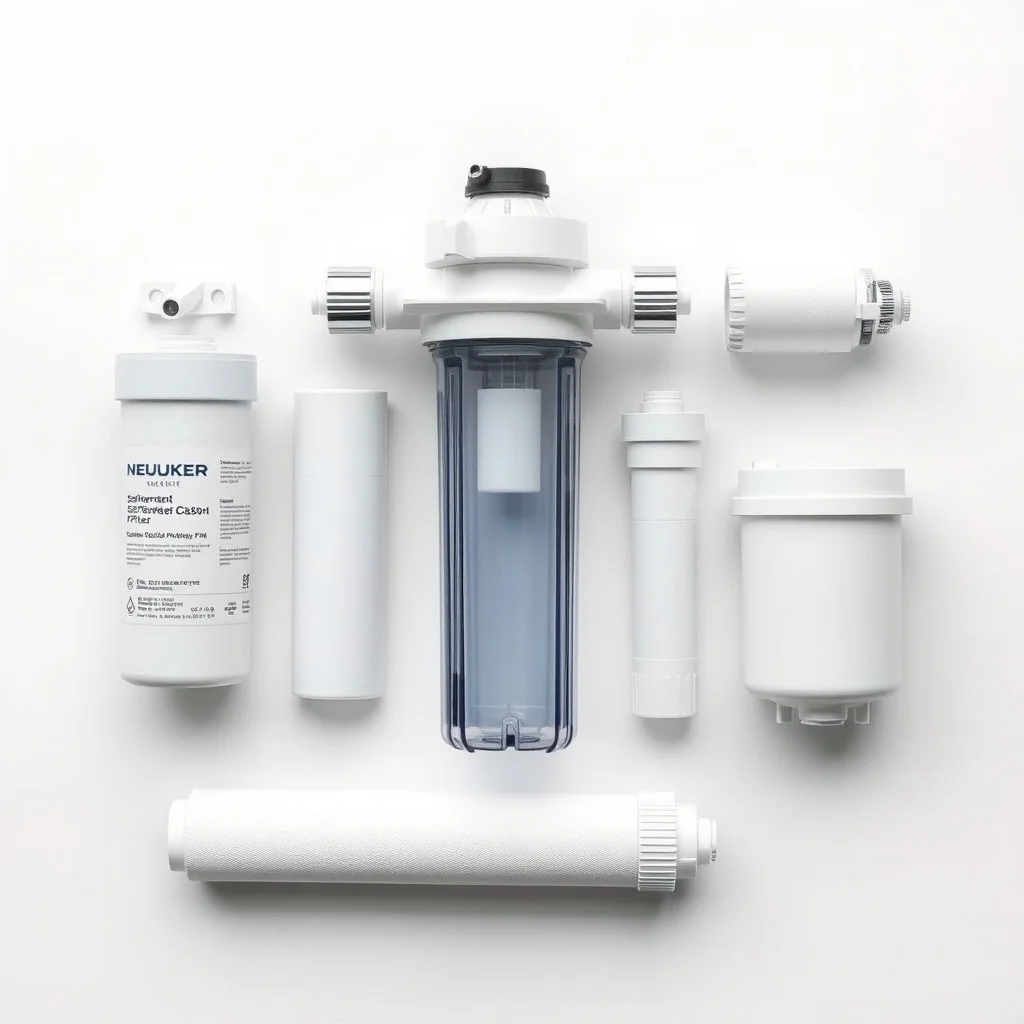
How reverse osmosis actually works
An RO system pushes tap water through a semipermeable membrane at pressure. The membrane's pore size (typically around 0.0001 microns) is small enough to block dissolved salts, heavy metals, nitrates, fluoride, arsenic, and most other inorganic contaminants — things that activated carbon alone cannot remove. The filtered water (called permeate) goes to your faucet or tank; the concentrated reject water (called brine or waste) goes down the drain.
Before reaching the membrane, water typically passes through sediment and carbon pre-filters to remove particles and chlorine that would damage or degrade the membrane. After the membrane, a polishing post-filter removes any residual taste. A remineralization stage, if included, adds calcium and magnesium back to improve taste and restore some mineral content that RO strips out.
Understanding filter stages
Stage counts (3-stage, 5-stage, 6-stage) refer to distinct filter housings, not just membrane stages. A typical 5-stage under-sink system runs:
- Sediment pre-filter (5 micron) — removes rust, dirt, sediment
- Carbon block pre-filter — removes chlorine, VOCs, taste/odor
- RO membrane — the primary filtration step
- Post-carbon polishing filter — final taste refinement
- Remineralization cartridge (on models that include it) — restores alkalinity and minerals
More stages don't always mean better filtration — it depends on what each stage does. A 7-stage system that duplicates carbon stages may not outperform a well-designed 5-stage system. What matters is that the RO membrane is NSF 58 certified, and that pre-filtration adequately protects the membrane from chlorine and sediment in your specific water supply.
Tank systems vs tankless: the real trade-offs
This is the most important decision most buyers get wrong because they focus on price instead of how the systems behave differently day-to-day.
| Feature | Tank (traditional) | Tankless (on-demand) |
|---|---|---|
| How it works | Fills a pressurized tank slowly; dispenses instantly from tank | Filters on demand at high flow; no storage |
| Typical flow rate | 50–100 GPD to membrane; instant dispense from tank | 400–600 GPD; flows at ~0.5–1 GPM at faucet |
| Cabinet space | Larger — tank is typically 2–4 gallon, sits separately | Compact — no tank, mounts directly under sink |
| Water pressure required | 40–80 psi (typical residential range) | Often 40–60 psi minimum; some need booster pump below 40 |
| Upfront cost | Lower (typically $150–350 for good systems) | Higher (typically $300–600+) |
| Wastewater ratio | 3:1 to 4:1 (wastes 3–4 gallons per gallon filtered) | Often 1:1 or 2:1 (more efficient) |
The practical implication: if you have limited cabinet space or want on-demand flow without waiting for a tank to refill, tankless is genuinely better. If you want a simpler, cheaper system and have cabinet space, a traditional tank system is reliable and easier to service.
GPD rating and what it actually means
GPD stands for gallons per day — it describes how much water the RO membrane can produce in 24 hours under standard lab conditions (typically 77°F water at 60 psi). Real-world output is often 50–70% of rated GPD because most households have lower water pressure and colder water than lab conditions.
For a family of four using roughly 1.5–2 gallons of filtered water daily, even a modest 50 GPD system has plenty of headroom. The GPD rating matters more if you're drawing heavily on the system (filling a coffee maker tank frequently, making ice, etc.) or if your water pressure is below 50 psi and you're not using a booster pump.
Cold water slows membrane production significantly — a system rated 75 GPD at 77°F may produce only 40–50 GPD if your incoming water is 55°F (typical in winter in many regions). Factor in your actual water temperature if you're calculating whether a system has adequate capacity.
Wastewater ratio: the hidden cost of RO
RO systems reject a significant amount of water as brine. Traditional 3:1 or 4:1 ratio systems send 3–4 gallons down the drain for every gallon of purified water produced. Over a year, this adds up — for a household using 1.5 gallons/day of RO water, a 4:1 system wastes roughly 2,000 gallons annually.
Newer high-efficiency and tankless systems have improved this considerably. Many modern systems run at 1.5:1 or 2:1 ratios, cutting wastewater by 50% or more compared to older tank designs. If water costs or conservation matter to you, check the wastewater ratio before buying — some manufacturers list it clearly, others bury it in the technical specs.
Shopping for an RO system? Browse current eBay listings → (we earn a small commission; your price is unchanged).
Remineralization: do you need it?
RO removes nearly everything from water — including calcium, magnesium, and other minerals that contribute to water's taste and hardness. The resulting water is very pure but can taste flat or slightly acidic (lower pH). Remineralization stages add calcium and magnesium back, raising pH and improving taste.
Whether you need remineralization depends on taste preference. Some people prefer the neutral taste of straight RO water; others find it flat. If you're replacing a water supply that you currently find palatable (standard municipal water), you may want a remineralization stage. If you're filtering well water that has a strong taste or odor problem, the neutral RO output might be exactly what you want without adding minerals back.
Remineralization cartridges add a modest ongoing replacement cost (typically every 6–12 months) and may add slightly to the footprint. Some systems include it as a stage; on others it's an optional add-on you buy separately.
Installation requirements to check before buying
- Dedicated faucet hole: Under-sink RO systems need a separate faucet at the sink. Most sinks have an unused hole (where a sprayer or soap dispenser was), but if yours doesn't, you'll need to drill or use an air-gap faucet adapter.
- Water pressure: Most systems need 40–80 psi. If your home runs below 40 psi, you need a booster pump (sold separately for most tank systems; some tankless systems include one).
- Drain connection: The waste line connects to the drain pipe under the sink. Most systems include a saddle clamp that fits standard drain pipes.
- Cabinet clearance: Tank systems are bulkier — the tank alone is typically 10–16 inches tall. Measure your under-sink cabinet before ordering anything.
Filter replacement schedule and cost
RO systems have multiple filters on different replacement schedules. A typical 5-stage system might require:
- Sediment pre-filter: every 6–12 months (faster in high-sediment water)
- Carbon pre-filter: every 6–12 months
- RO membrane: every 2–5 years (the most expensive cartridge)
- Post-carbon polishing filter: every 12 months
- Remineralization cartridge (if applicable): every 6–12 months
Annual filter cost for a standard 5-stage system typically runs $50–120 depending on brand and filter life. The RO membrane replacement (every few years) may cost $30–80 on its own. Budget for this before buying — the ongoing cost varies significantly between budget and name-brand systems, and membrane compatibility isn't always interchangeable.
Shop reverse osmosis systems on eBay
We earn a small commission on qualifying sales; your price is unchanged. Full disclosure.
 Reverse osmosis system
Under-sink standard. Compare NSF 58, stage count, and wastewater ratio. View on eBay →
Reverse osmosis system
Under-sink standard. Compare NSF 58, stage count, and wastewater ratio. View on eBay →
 Under-sink reverse osmosis
Permanent install below sink. Requires faucet hole. Measure cabinet depth. View on eBay →
Under-sink reverse osmosis
Permanent install below sink. Requires faucet hole. Measure cabinet depth. View on eBay →
 Tankless RO system
Compact, on-demand flow. Better wastewater ratio. Needs 40+ psi inlet. View on eBay →
Tankless RO system
Compact, on-demand flow. Better wastewater ratio. Needs 40+ psi inlet. View on eBay →
 Countertop RO system
No permanent install. Good for renters. Faucet adapter connects without drilling. View on eBay →
Countertop RO system
No permanent install. Good for renters. Faucet adapter connects without drilling. View on eBay →
 5-stage RO system
Standard 5-stage with sediment, dual carbon, membrane, and post-polish. Most common household setup. View on eBay →
5-stage RO system
Standard 5-stage with sediment, dual carbon, membrane, and post-polish. Most common household setup. View on eBay →