A microphone is a transducer — it converts acoustic pressure into an electrical signal. The design choices that define how it does this (transducer type, diaphragm size, polar pattern implementation, amplifier topology) determine the applications it suits. Buying by brand reputation without understanding these choices leads to expensive mismatches between microphone and application.
Transducer types: dynamic vs condenser vs ribbon
Dynamic microphones
Dynamic microphones use a moving-coil transducer: a diaphragm attached to a voice coil suspended in a magnetic field. Movement of the diaphragm induces current in the coil. Dynamic mics require no phantom power, have high output impedance tolerance, and handle high SPLs well. They have slower transient response than condensers, which translates to a slightly softer, more rounded high-frequency character. For close-miked guitars, drums, brass, and anything in a loud, uncontrolled acoustic environment, dynamics are often the practical choice.
Condenser microphones
Condenser microphones use a capacitor with one plate as the diaphragm. Voltage across the capacitor changes as the diaphragm moves. Condensers require an amplifier circuit (powered by 48V phantom power from the preamp or an internal battery) and have faster transient response and extended high-frequency sensitivity compared to dynamics. Large-diaphragm condensers (typically 1-inch or greater capsule diameter) have lower inherent self-noise, making them suited for quiet sources like acoustic guitar, voice, and orchestral instruments.
What "large-diaphragm condenser" means in practice
A larger capsule captures more acoustic energy, which translates to a higher signal level before the amplifier stage. This improves the signal-to-noise ratio — the microphone's self-noise (measured in dB-A) is effectively a floor below which you cannot hear the source. A large-diaphragm condenser with 7 dBA self-noise picks up quieter acoustic sources more cleanly than a small-diaphragm model at 20 dBA self-noise. The tradeoff is that large diaphragms are more sensitive to loud SPLs; most include pad switches (typically -10 or -20 dB) to handle close-miked loud sources.
Shure SM57 vs SM7B: different applications
The SM57 and SM7B both use the Shure moving-coil transducer design and the same capsule lineage, but they are optimized for different applications and behave differently.
SM57: instrument miking
The SM57 has a cardioid polar pattern with a presence peak centered around 8–10 kHz. It is designed for close-miking instruments at higher SPLs — guitar cabinets, snare drums, brass instruments. The narrow grille is shaped for tight positioning against instrument surfaces. Sensitivity is relatively low; the SM57 does not flatter quiet acoustic sources at distance.
SM7B: broadcast vocal
The SM7B has a flatter frequency response than the SM57 with a larger, more integrated windscreen designed for close-talking vocal use. Switchable presence boost and bass rolloff filters (3 and 5 dB) allow tailoring for voice characteristics. The SM7B requires substantially more preamp gain than most condensers — expect to need 55–65 dB of clean gain from your preamp. An in-line preamp booster (such as the Cloudlifter CL-1) adds approximately 25 dB of clean gain and is commonly used to reduce the SM7B's noise floor on quiet vocal sources.
Neumann U87 vs U47: capsule and amplifier differences
The U87Ai (current production)
The current Neumann U87Ai uses the K870/K67 capsule and a transformerless FET amplifier. Self-noise is specified at approximately 15 dB-A. Three polar patterns (cardioid, omni, figure-8) are switchable via a front panel switch. The U87Ai is a robust, predictable large-diaphragm condenser suited for vocal tracking, overhead miking, and room recording. It is specifically not the same microphone as the original U87 from 1967, which used different capsule geometry and a transformer-coupled output.
The original U47 (vintage)
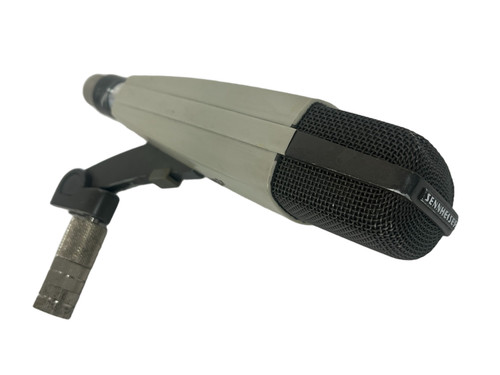
The Neumann U47, produced from approximately 1947 to 1966, is a tube condenser using the M7 capsule (or K47 in later production) and a tube amplifier with the Telefunken VF14 tube. The VF14 is a specialty subminiature tube that is no longer manufactured; serviceable originals and some reproduction types exist but are expensive and vary in quality. The U47's character derives from the M7/K47 capsule combined with the VF14's amplifier behavior — this combination is not reproducible by swapping tubes in an otherwise different circuit.
The U47 is sold under both Neumann and Telefunken branding; the physical microphone was the same instrument. The Telefunken ELAM 250 and ELAM 251 are distinct related microphones with different capsule designs (the AC701 tube vs VF14) that are separately collected.
What this means for buyers
A used U87Ai is a serviceable, predictable professional condenser with readily available parts. A vintage U47 is an irreplaceable historical instrument with a serviceability bottleneck in the VF14 tube. Buy the former for working use; buy the latter for a specific sonic character you need and can afford to maintain.
AKG C414: variant history
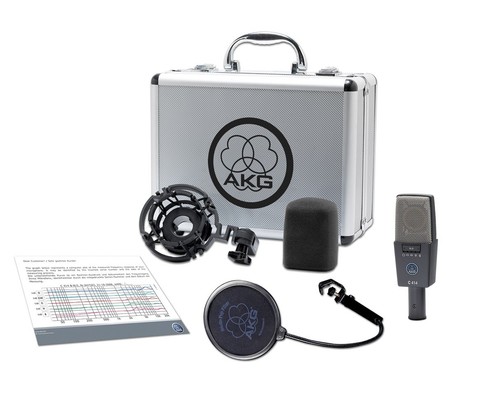
The AKG C414 has been in continuous production since 1971 and encompasses several distinct variants. The current XLS and XLII share the same body with different capsule tunings.
- C414 B-ULS (1971–1991 era): Considered by many engineers to have the most linear midrange of any C414 variant. Uses the CK12 brass-capsule variant. The most sought-after for instrument miking applications where midrange accuracy is prioritized.
- C414 B-TL II (1992–2002 era): Switched to a different capsule design. More compressed high-frequency response compared to B-ULS.
- C414 XLS (current): Flat frequency response, nine polar patterns (cardioid, wide cardioid, hypercardioid, figure-8, and five intermediate patterns). Three pads (-6, -12, -18 dB), three high-pass filters. Designed to be a versatile tracking mic.
- C414 XLII (current): Same body as XLS with a "vintage presence peak" in the high-frequency response — a tuned rise around 9–12 kHz. Often preferred for lead vocals where forward presence is desired.
Polar pattern selection: practical implications
Polar pattern determines from which directions the microphone is sensitive to sound. For buyers of multi-pattern condensers (U87Ai, C414), pattern selection is often underutilized:
- Cardioid: Front-sensitive, strong rear rejection. Standard for close-miking and isolation applications.
- Omni: Equal sensitivity in all directions. No proximity effect. Suited for room ambience capture, orchestral recording, and cases where a natural, non-proximity-boosted low end is needed. Omni is often underused by engineers trained primarily on close-miking techniques.
- Figure-8: Front and rear sensitivity, strong side rejection. Suited for Blumlein pair stereo recording and mid-side (MS) technique. Required for MS decoding (figure-8 as the "side" mic).
Preamp gain requirements: a practical constraint
Any microphone buying decision should account for the preamp gain available. A Neumann U87Ai with 10 mV/Pa sensitivity needs far less gain than a Shure SM7B at approximately 1.12 mV/Pa. A preamp capable of clean 60–70 dB of gain is needed to get the SM7B to a usable level on quiet sources without introducing significant noise floor from the preamp itself. Many budget audio interfaces provide only 40–50 dB of gain, which is insufficient for the SM7B on acoustic instruments or quiet vocalists. Verify your interface's gain specification before selecting a low-sensitivity dynamic mic.
The matching principle: condenser microphones with their higher sensitivity work with a wider range of preamps; low-sensitivity dynamic mics are not universally compatible with low-gain preamp stages and should be verified against your specific interface before purchase.