Size requirements: what welfare guidelines actually say
The Rabbit Welfare Association and Fund (RWAF), the RSPCA, and the British Veterinary Association recommend a minimum living space for a pair of rabbits of 3m × 2m × 1m high (roughly 10 ft × 6 ft × 3 ft) — a combined hutch-plus-run space of approximately 60 square feet with the ability to stand fully upright. This is substantially larger than most retail hutch-only products provide.
For context: a hutch sold as "suitable for 2 small rabbits" typically provides a footprint of 4–5 sq ft (120cm × 60cm is a common size). The same guidelines recommend that a sleeping/enclosed area (the hutch portion alone) should be at minimum 6 ft × 2 ft for a pair of medium-sized rabbits, with a run area of similar or greater size attached or accessible.
These guidelines reflect rabbit biology: rabbits are crepuscular animals that naturally cover 1–3 km per day in the wild. Confinement in small hutches without adequate run space causes muscle atrophy, spinal conditions, and stress-related stereotypic behaviors.
| Setup | Minimum hutch (sleeping area) | Minimum attached run |
|---|---|---|
| 1 dwarf rabbit | 4 ft × 2 ft (0.75 m²) | 6 ft × 4 ft minimum |
| 1 medium rabbit | 6 ft × 2 ft (1.1 m²) | 8 ft × 4 ft minimum |
| Bonded pair (dwarfs) | 6 ft × 2 ft (1.1 m²) | 8 ft × 6 ft minimum |
| Bonded pair (medium) | 6 ft × 3 ft (1.7 m²) | 10 ft × 6 ft minimum |
Indoor vs outdoor: the real tradeoffs
Indoor rabbits
Indoor rabbits are easier to monitor for health changes, safer from predators and temperature extremes, and typically become more socialized with people through regular proximity. Indoor keeping generally uses an exercise pen (metal or mesh panel systems) rather than a traditional wooden hutch — exercise pens provide more floor space for the cost, are easier to configure and clean, and allow the rabbit to interact with household activity.
The practical challenges: rabbits chew — cables, baseboards, furniture legs. Any free-roam area must be rabbit-proofed (cables covered or removed, dangerous plants eliminated, under-furniture gaps blocked). Indoor rabbits also litter-box train readily, which makes free-roam keeping genuinely practical once training is established.
Outdoor rabbits
Outdoor keeping allows larger run spaces and natural behaviors like grazing. The key challenges are temperature management, predator security, and weatherproofing. Rabbits are vulnerable to heat stress above 25–28°C (77–82°F) and to cold-damp combinations; they tolerate dry cold reasonably well but wet, drafty conditions are dangerous.
Outdoor hutches should be sited in a position that receives morning sun but is shaded through the hottest afternoon hours in summer. In cold climates, a hutch cover, moving the hutch to a sheltered outbuilding in winter, or an insulating hutch snuggle safe (heated pad) provides additional protection during extreme cold snaps.
Weatherproofing: what actually protects an outdoor hutch
The most common failure point of budget outdoor hutches is the roof. Roofing felt (the black mineral-surfaced felt standard on most wood hutch roofs) typically lasts 2–4 years before cracking and allowing water ingress. Check and replace hutch felt regularly; a wet sleeping area is a rapid route to respiratory illness in rabbits.
Features worth paying for in an outdoor hutch
- Roof overhang: A roof that extends 4–6 inches beyond the hutch walls on the front and sides keeps rain off the mesh panels and prevents wind-driven rain from entering the sleeping compartment.
- Raised legs: A hutch sitting directly on the ground collects moisture underneath, accelerating rot in the floor boards. Legs of at least 4–6 inches elevation also help exclude ground-level predators like rats.
- Solid wood sleeping compartment: The sleeping area should be fully enclosed solid wood (no mesh panels in the sleeping chamber). This provides insulation and draft exclusion.
- Water-resistant finish: Pressure-treated or pre-painted/stained external surfaces. Untreated wood outdoors deteriorates within a few seasons.
Predator-proofing for outdoor hutches
The main predator risk categories vary by region: foxes and badgers (UK and Europe), raccoons and coyotes (North America), domestic dogs, and in some areas, large raptors attacking run-access areas.
Shopping for rabbit hutches? Browse current eBay listings → (we earn a small commission; your price is unchanged).
Wire mesh gauge
Most budget hutch mesh is 19-gauge (thin) hexagonal chicken wire. As with chicken coops, this is designed to keep rabbits in, not to exclude foxes or raccoons that can pull the wire apart at connections. For an outdoor hutch with overnight unsupervised access, replace or reinforce chicken wire panels with 14-gauge welded wire mesh (often sold as hardware cloth). A determined fox will work at a weak panel for extended periods.
Latches
Foxes and raccoons can open simple latches. Spring bolts, combination-style two-step closures, and padlocks provide reliable security. At minimum, ensure every door has a bolt-style latch that can't be lifted or pushed open, rather than a single-step hook latch.
Ground security
If the hutch's attached run sits on bare ground without a floor, predators can dig in. An apron of hardware cloth pegged flat around the run perimeter (extending 12–18" outward) deters digging. Alternatively, a run with a solid or mesh floor eliminates digging access entirely, though a mesh floor creates foot health concerns (discussed below) unless covered with substrate.
Flooring: the issue most listings don't mention
Wire mesh flooring is a welfare concern for rabbits. Unlike cats and dogs, rabbits have no foot pads — their hocks are covered in fur, and prolonged contact with wire mesh causes the fur to compress and skin to rub against the wire, leading to sore hocks (pododermatitis). Sore hocks begin as hair loss and progress to open sores and infection if untreated.
Recommendations for flooring:
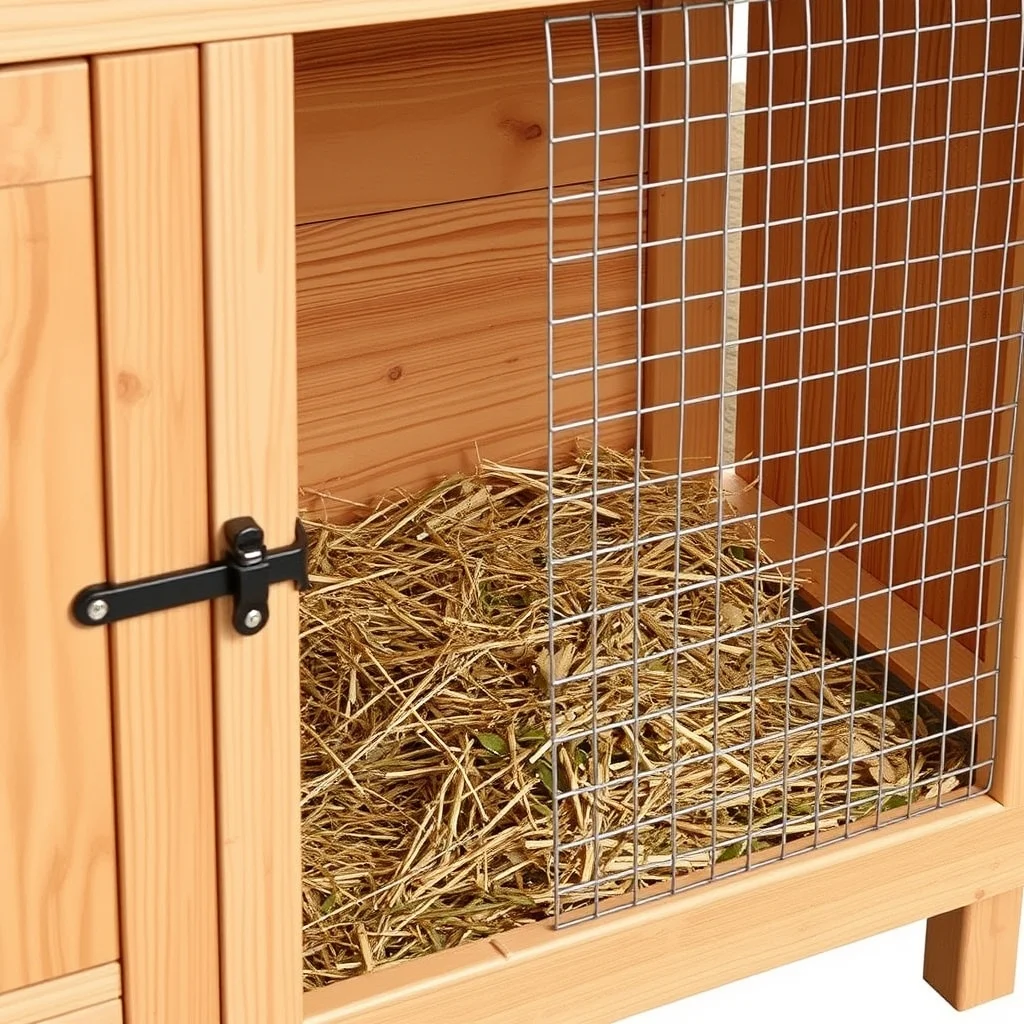
- Sleeping area: Should always be solid wood or other smooth solid material. A thick layer of clean bedding (hay is ideal — it's also food) provides cushioning and insulation.
- Run area: If the run has a wire mesh floor, cover it with solid boards, rubber matting, or a thick layer of hay or straw. Rabbits can also be given a solid "rest board" in the mesh-floored run area so they have the option to rest off the wire.
- Ground runs: The most natural and foot-friendly option. Risks are digging escape and predator access, both manageable with appropriate ground-level measures.
| Consideration | What to look for | What to avoid |
|---|---|---|
| Hutch size | 6 ft+ length, 2 ft+ depth per rabbit pair | Listings claiming 4 rabbits fit in a 4 ft hutch |
| Run access | 24/7 access, adequate size for locomotion | Run locked off overnight, too small to binky |
| Sleeping area floor | Solid wood with deep hay bedding | Wire mesh floor in sleeping compartment |
| Outdoor roofing | Overhanging roof, quality felt or metal cover | Flat roof with no overhang, cheap thin felt |
| Mesh gauge | 14-gauge welded wire minimum for fox areas | 19-gauge hexagonal chicken wire on outer panels |
| Latches | Bolt-style or two-step closures | Single hook-and-eye latches |
Indoor alternatives to wooden hutches
Many rabbit welfare advocates recommend against traditional wooden hutches entirely for indoor use, favoring instead:
- Exercise pens (X-pens): Metal panel systems originally sold for puppies that fold into adjustable configurations. A 6-panel or 8-panel pen gives substantially more floor space than a hutch of equivalent cost. Floor is open so rabbits can sit on carpet, rugs, or a mat.
- Free-roam with a retreat space: A dedicated rabbit room or rabbit-proofed section of a living space, with a covered retreat box for privacy and sleep. The most space-generous option.
- NIC (Neat Idea Cube) grids: Wire storage cube panels assembled into custom enclosures. Highly configurable, allows multi-level builds, easy to clean. Popular in the rescue and welfare community.
Wooden hutches remain the dominant retail format because they're recognizable and easy to stock in pet stores. For indoor keeping specifically, the alternatives above typically provide better welfare outcomes for comparable or lower cost.