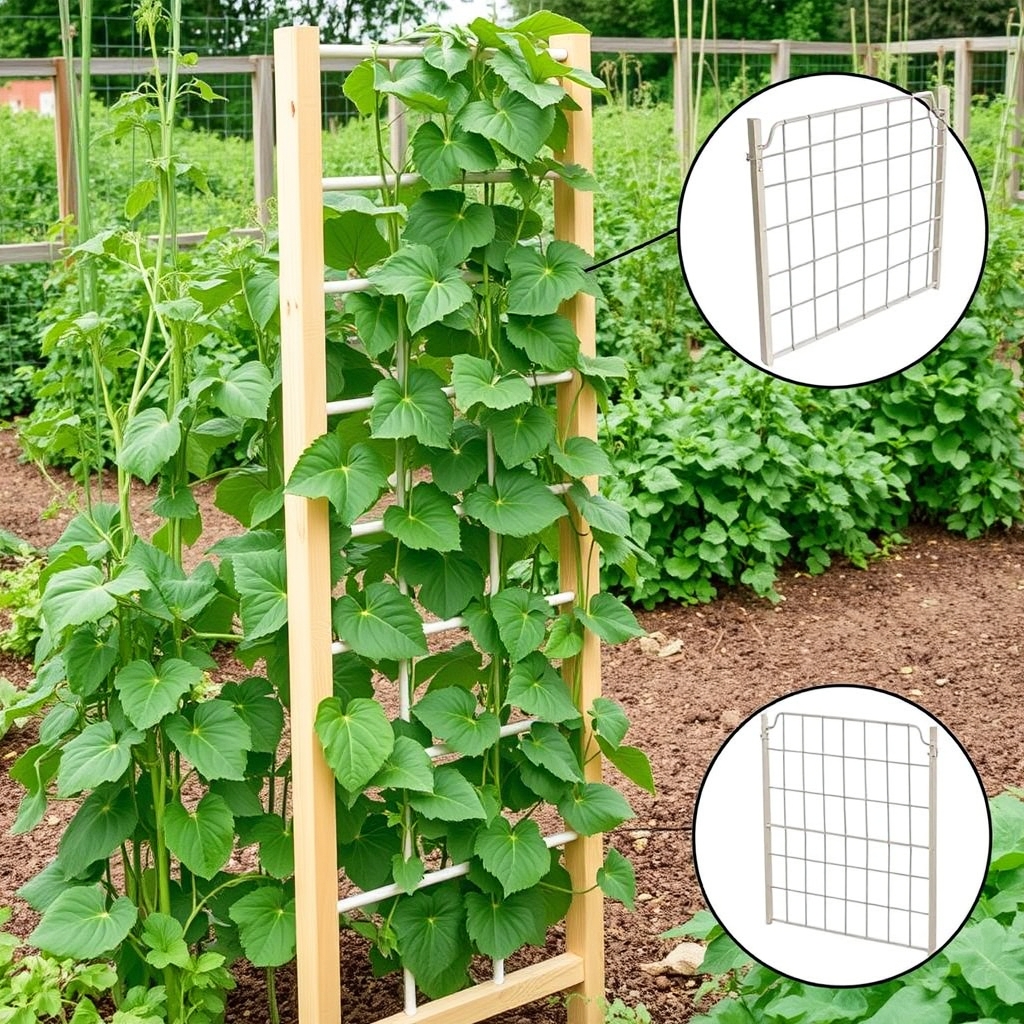
How climbers climb: matching support to mechanism
Different climbing plants use different mechanisms to ascend — and the trellis structure needs to match the mechanism. Getting this wrong means the plant won't attach on its own and will need constant tying, or will outgrow the support structure entirely.
Twining stems
Beans (both pole beans and runner beans), morning glory, hops, and wisteria climb by wrapping their stems in a spiral around a support. They need something narrow enough to grip — a string, bamboo cane, or vertical rod. A solid wooden panel doesn't give them a suitable surface; they need lines or bars at roughly 6-inch spacing or less to grab.
Tendrils
Cucumbers, peas, and grapes produce small curling tendrils that grab onto horizontal elements. Netting (typically 4–6 inch mesh) works perfectly — each tendril finds a horizontal strand within reach and coils tightly. Fine-mesh netting also works; large-mesh cattle panels let tendrils pass through without catching. Tendrils are weaker than twining stems and need the support structure within reach at all times — if the plant outgrows the trellis height, tendril climbers simply flop over.
Scrambling / leaning (no self-attachment)
Tomatoes, squash, and melons don't climb on their own — they need to be tied to a support as they grow. Tomatoes in particular grow heavy clusters of fruit that require robust support, not just somewhere to lean. Cages work for determinate varieties; tall stake-and-tie systems work for indeterminate varieties. The trellis needs to be strong enough to support the full weight of the plant plus its fruit load — which can exceed 20 pounds for a full-grown indeterminate tomato with a heavy fruit set.
Clinging (adhesive pads or aerial roots)
Climbing hydrangeas, Virginia creeper, and ivy attach directly to surfaces via adhesive pads or aerial roots. These plants don't need a freestanding trellis in the traditional sense — they'll attach to fences, walls, and masonry. Where a trellis is used, it's usually to establish the initial direction of growth or provide structure before the plant self-attaches. Note: adhesive-pad climbers cause surface damage and are difficult to remove — not appropriate for painted or wooden surfaces you care about.
| Crop / Plant | Climbing mechanism | Best trellis type | Typical height needed |
|---|---|---|---|
| Pole beans / runner beans | Twining stems | A-frame, string trellis, or teepee | 5–8 feet |
| Peas | Tendrils | Netting, pea brush, fine-wire fence | 3–6 feet (varies by variety) |
| Cucumbers | Tendrils | Netting, flat panel trellis (4–6 inch mesh) | 5–6 feet |
| Indeterminate tomatoes | None (must be tied) | Heavy-gauge stake or Florida weave | 6–8 feet |
| Determinate tomatoes | None (must be tied) | Heavy-duty cage (18-inch diameter minimum) | 3–5 feet |
| Summer squash / zucchini | None (must be trained) | A-frame with netting or horizontal ties | 4–5 feet |
| Climbing roses | Hooks/thorns (scratch-climbing) | Arch, fan trellis, or wall wires | 6–12 feet |
| Clematis | Leaf petioles coil | Wire mesh, lattice, obelisk | 6–15 feet depending on variety |
Material: wood, metal, and netting compared
Wood trellises
Cedar and redwood are naturally rot-resistant and can last 10–20 years untreated; pine and most softwoods need pressure treatment or paint/stain to last beyond 2–3 seasons. Wood is heavy, which means it's stable when anchored in soil but cumbersome to move. Lattice panels (criss-cross pattern) are decorative but have small gaps that limit what can climb them; open-frame trellis panels with horizontal rails spaced 6–8 inches are more practical for vegetable climbing crops.
Metal (powder-coated steel and galvanized)
Powder-coated steel lasts well outdoors but will rust where the coating chips — an inevitable occurrence at ground contact points over several seasons. Galvanized steel is more corrosion-resistant at contact points. Metal trellises are the most rigid option and handle heavy wind loads and heavy crops (squash, climbing roses) better than wood lattice of equivalent size. Heavier per square foot than netting; lighter per square foot than solid wood.
Netting (polypropylene and jute)
Polypropylene or nylon mesh netting is the most cost-effective option for large plantings. Stretched between posts or a simple frame, a 5-foot-tall by 10-foot-wide section of polypropylene netting can support cucumbers, beans, and peas across an entire raised bed for under $10 in material. The limitation is longevity: polypropylene mesh UV-degrades after 3–5 seasons; jute netting composts in one season and must be replaced annually (though it leaves no waste). Netting without a rigid frame will sag under heavy fruit — center posts or additional horizontal lines keep it taut.
Shopping for garden trellises? Browse current eBay listings → (we earn a small commission; your price is unchanged).
Trellis types: flat panels, obelisks, arches, A-frames
Flat panel trellises
The most common form. A rectangular frame, either freestanding (with legs driven into soil) or leaned against a fence or wall. Practical for most vegetable applications — cucumbers along a fence line, beans in a raised bed. Key spec to verify: the frame material and connection method. Panels that connect at friction joints (no fasteners, just slot together) are convenient but fail at wind loads; welded or bolted joints are much more durable.
Obelisks
Four-legged pyramid structures typically 4–6 feet tall. Used for climbing roses, clematis, small bean plantings, and ornamental purposes. More stable than flat panels in freestanding use because the pyramid geometry distributes weight evenly. Harder to use for row crops; better suited for a single plant focal point in a flower or kitchen garden.
A-frames and teepees
A-frames are two-sided structures, typically made of wood or bamboo, angled outward at the base and joined at the top. Beans and cucumbers climb both sides. Teepees are three or more poles lashed at the top — excellent for pole beans and easy to make from bamboo. Both are inherently stable because the base is wider than the top.
Arches
Arches span a walkway or bed entrance. Used primarily for climbing roses, squash, and flowering vines. The visual impact is high; the structural requirement is also high — a full squash plant across an arch can weigh 30+ pounds plus wind load. Look for arches with legs at least 12 inches long (18 is better) for in-ground anchoring, and welded or bolted crosspieces rather than friction-fit joints.
Height: matching the trellis to the crop's mature size
The common error is buying a trellis that's too short. Pole beans regularly grow to 8 feet; indeterminate cucumbers will reach 6 feet without pruning. A 4-foot trellis makes sense for peas and short compact varieties but is inadequate for most vigorous climbers.
If you're limited on height (rooftop garden, low clearance), choose determinant varieties specifically bred for compact growth — bush cucumbers, dwarf pole beans, and patio tomatoes — and size the trellis to them. Don't buy a full-size indeterminate climbing variety and then try to keep it small; that creates a constant management burden and reduces yields.
Anchoring against wind load
A mature cucumber trellis fully leafed out acts like a sail. Wind forces on a 6-foot-tall by 8-foot-wide trellis covered in foliage in a 20 mph wind can exceed 100 pounds of lateral force. Most lightweight trellises aren't designed for this load, and the failure mode — collapsing outward in a storm, flattening the crops — is common.
Practical anchoring approaches:
- Deep leg stakes: Minimum 12 inches, ideally 18 inches, in the ground per leg. At 18 inches depth, the soil overburden is sufficient to resist most reasonable wind loads. Stake diameter matters: thin bamboo stakes at 18 inches will lever out under load; 3/4-inch rebar or 1-inch conduit at 18 inches is dramatically more stable.
- Rebar backing: Driving a piece of rebar or steel conduit immediately behind a wooden or light metal trellis leg, then lashing them together, upgrades any trellis's wind resistance without replacing it.
- Guy wires: For very tall trellises (6+ feet) or arches, guy wires anchored at an angle to the ground — like tent guys — prevent toppling in high winds. Common on hop trellises and large arch structures.
- Fence integration: Attaching a flat panel trellis directly to an existing fence post transfers the load to the fence structure, which is typically much more robust than the trellis alone.
Seasonal storage and longevity
Metal trellises stored through winter where the ground freezes heave and shift over freeze/thaw cycles if left in soil. The better approach is to pull metal stakes out of the ground before hard frost, clean them, and store horizontally — this adds years to the life of the structure. Powder-coated panels stored away from UV and moisture last significantly longer than those left outdoors year-round.
Bamboo cane teepees and A-frames are generally one- to three-season structures. Bamboo in contact with moist soil at the base rots from the bottom up; pulling the structure and letting it dry end-of-season extends it one or two additional seasons.
Search eBay for garden trellis and support gear
 Garden trellis panels
Flat panel and obelisk trellises. Check connection joints — welded or bolted beats friction-fit for longevity.
Garden trellis panels
Flat panel and obelisk trellises. Check connection joints — welded or bolted beats friction-fit for longevity.
 Cucumber trellis netting
Polypropylene mesh for cucumbers, beans, and peas. 4–6 inch mesh is the right size for most tendril climbers.
Cucumber trellis netting
Polypropylene mesh for cucumbers, beans, and peas. 4–6 inch mesh is the right size for most tendril climbers.
 Tomato cage heavy duty
6-gauge wire, 18-inch base minimum. Don't waste a season on the cheap cone cages that collapse under full fruit load.
Tomato cage heavy duty
6-gauge wire, 18-inch base minimum. Don't waste a season on the cheap cone cages that collapse under full fruit load.