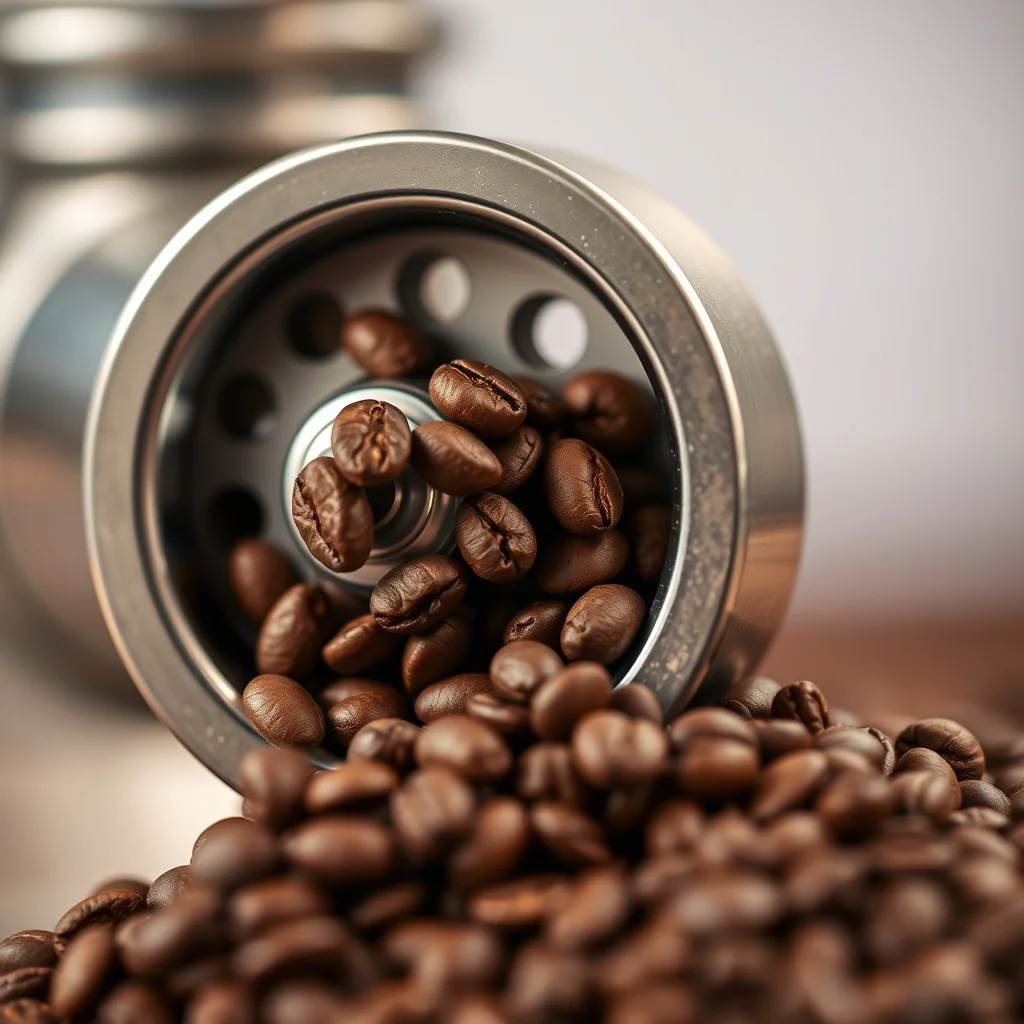
Why the grinder matters more than most people expect
Coffee extraction is a function of surface area, water temperature, and contact time. The grinder controls surface area by determining particle size and how uniform those particles are. A blade grinder produces particles ranging from powder to chunks in the same batch — different-sized particles extract at different rates, which means your cup contains simultaneously over-extracted (bitter) fines and under-extracted (sour) coarse pieces.
A burr grinder — whether conical or flat — produces particles of consistent size by crushing coffee between two abrasive surfaces set at a fixed distance. Consistent particle size means consistent extraction, which means you can actually control your brew. This is the fundamental reason burr grinders produce better coffee than blade grinders at any price point.
Blade grinders: what you need to know
A blade grinder uses a spinning metal blade (like a propeller) to chop coffee. It is cheap, compact, and widely available. The problems are structural: the blade generates heat that degrades aromatics, and the particle size distribution is random. You cannot control grind size except by varying how long you run the motor — and even that produces inconsistent results batch to batch.
Blade grinders work adequately for drip coffee if you accept variable results. They are poor choices for espresso (requires very fine, consistent grind), French press (coarse and consistent), or any method where you want to dial in extraction. If you brew by method rather than just "make something hot," a burr grinder is the right tool.
Conical vs flat burr: the real difference
Both conical and flat burr grinders crush coffee between two abrasive surfaces. The geometry differs.
A conical burr has a cone-shaped inner burr that rotates inside a ring-shaped outer burr. Coffee travels through the gap between them by gravity and centrifugal force. Conical burrs typically run at lower RPM (300–800 RPM), which generates less heat and noise. They tend to produce a bimodal distribution — a primary particle size plus a secondary smaller peak of fines. Many espresso brewers find this distribution works well for espresso extraction.
A flat burr has two parallel disc-shaped burrs facing each other. Coffee passes through horizontally. Flat burrs often run at higher RPM and produce a tighter, more uniform particle distribution — closer to a single peak. This can be advantageous for filter brewing methods (pour-over, drip) where you want clean, even extraction. High-end flat burr grinders are often preferred by competition-level brewers for their clarity and separation of flavor.
| Feature | Conical burr | Flat burr |
|---|---|---|
| Burr geometry | Cone inside ring | Two parallel discs |
| Typical RPM | 300–800 | 1,000–1,500+ |
| Heat generation | Lower | Higher (varies by model) |
| Particle distribution | Bimodal (two peaks) | Unimodal (one peak) |
| Common use case | Espresso, filter, versatile | Filter, specialty espresso |
| Price range | $30–$2,000+ | $100–$3,000+ |
| Retention | Typically low | Varies; can be higher |
Grind range: why it matters for your brewing method
Different brewing methods require different grind sizes:
- Espresso: Very fine — roughly the texture of talcum powder. Requires precise stepless adjustment because a 0.1mm burr gap change can alter extraction significantly.
- Moka pot: Fine to medium-fine — slightly coarser than espresso to prevent clogging the filter plate.
- Pour-over (V60, Chemex): Medium — similar to coarse sand. Grind size varies by recipe and filter type.
- Drip coffee maker: Medium — the most forgiving range; most burr grinders cover this well.
- French press: Coarse — roughly breadcrumb texture. Fines pass through the mesh filter and create bitterness, so particle uniformity at the coarse end matters.
- Cold brew: Extra coarse — the longest steep time benefits from very coarse grinds to slow extraction.
If you brew multiple methods, check that the grinder's adjustment range actually covers all of them. Some entry-level burr grinders are marketed as "versatile" but their coarse end is too fine for French press, or their fine end can't reach true espresso fineness. Manufacturers' step counts (like "40 settings") say nothing about whether those steps are in the right range.
Stepped vs stepless adjustment
Stepped grinders have discrete click positions — you move from setting 5 to setting 6 with no option in between. This is convenient and repeatable: you return to a known setting easily. The limitation is that the steps may not be granular enough for dialing in espresso, where the ideal grind can sit between two positions.
Stepless grinders adjust continuously with no fixed positions. This gives maximum control and is standard on most dedicated espresso grinders. The tradeoff is that returning to a previous setting requires noting the exact position, often by marking the adjustment ring with tape or a marker.
Some grinders use a "stepless with macro/micro" system — coarse steps between brew methods, plus a fine ring for within-method adjustment. This is typically the most practical configuration for home espresso.
Grind retention: the number most buyers ignore
Grind retention is the amount of ground coffee that stays inside the grinder after you've finished grinding — trapped in the burr chamber, chute, or grind bin. This retained coffee goes stale between uses and contaminates the next batch with stale grounds.
For filter coffee, a few grams of retention is tolerable — you typically grind a full batch at once and the stale portion is a small fraction. For espresso, where a single dose might be 18g, 1–2g of stale retained grounds represents 5–10% of your shot. Dedicated espresso grinders aim for under 0.5g retention; some single-dose designs target near-zero retention.
Single-dose grinders (where you weigh beans and grind exactly what you need, with no hopper) have become popular specifically because they eliminate the retention and staleness problem. You load beans fresh for each session.
Dosing: by timer vs by weight
Most entry-level electric grinders dose by time — you set a timer and the grinder runs until it stops. This works but has a limitation: grind output varies with bean density, humidity, and burr wear, so the same time setting produces slightly different doses day to day.
Dosing by weight — where a built-in scale stops the grinder when the target mass is reached — is more accurate and eliminates that variability. Weight-based dosing is available on some mid-range and most prosumer grinders. If you dial in by recipe and care about shot-to-shot consistency, weight-based dosing is worth the premium.
Shopping for coffee grinders? Browse current eBay listings → (we earn a small commission; your price is unchanged).
Manual vs electric: the actual tradeoffs
Manual grinders (hand grinders) use the same burr technology as electric grinders but are powered by a hand crank. The key practical tradeoffs:
- Cost: Manual grinders offer better burr quality per dollar since there's no motor to budget for. A $80 manual grinder often uses burrs comparable to a $200 electric.
- Speed: Grinding 18g for espresso takes 1–2 minutes by hand; 30g for pour-over takes 2–4 minutes. This is acceptable for one or two cups but tedious for larger batches.
- Noise: Near-silent. A significant advantage if you brew early mornings in a shared space.
- Portability: Most hand grinders are compact and travel easily. They are standard equipment for camping coffee or travel brewing setups.
- Consistency: Good manual grinders produce consistent results, though they require consistent hand crank speed to avoid variation.
Manual grinders are a legitimate first step into quality burr grinding, particularly for single-dose espresso or pour-over. If you grind more than 20g at a time daily, an electric grinder will save significant effort.
RPM and heat: why slower can be better
Electric burr grinders run at widely varying motor speeds. Higher-RPM grinders grind faster but generate more heat through friction. Heat accelerates the volatilization of aromatic compounds in coffee — the same aromatics that produce the flavors and scents you're paying for in quality beans. Low-RPM grinders (typically gear-reduced motors running at 300–500 RPM) are often called "slow speed" or "direct drive" and are marketed partly on heat reduction grounds.
In practice, the heat difference between a mid-range grinder and a premium low-RPM grinder matters most for espresso with delicate light roasts, where the flavor window is narrow. For dark roasts or drip coffee, RPM-related heat differences are less perceptible. Don't let low-RPM marketing be the deciding factor unless you're brewing specialty light roast espresso.
What to check before buying
When evaluating a specific grinder:
- Does the grind range cover your brew methods? Look for user reviews from people brewing the same method you use.
- What is the retention? Manufacturer specs are sometimes available; user teardowns and reviews are more reliable.
- Stepped or stepless? For espresso, stepless or macro/micro is strongly preferred.
- Hopper vs single-dose? If you keep multiple coffees or prioritize freshness, single-dose designs are worth the extra steps.
- Burr replacement cost and availability? Burrs wear over time (typically years of daily use). Check that replacement burrs exist and aren't prohibitively expensive.
- Noise level? Relevant if you live with others or grind early. Electric grinder noise varies considerably — some models include noise-dampening enclosures.
Common buying mistakes
Choosing by step count. "40 settings" means nothing without knowing what range those settings span and how useful the positions are for your brew method.
Assuming higher wattage means better grinding. Motor wattage doesn't correlate with burr quality or grind consistency. A low-wattage gear-reduced motor can outperform a high-wattage direct-drive motor in grind quality.
Overlooking retention for espresso use. A grinder with 3g retention that otherwise reviews well for espresso will frustrate single-dose espresso drinkers. Check retention specs before buying.
Buying a dedicated espresso grinder then trying to use it for French press. Most dedicated espresso grinders top out at medium grind — they cannot reach the coarse setting required for French press. If you want one grinder for multiple methods, buy a wide-range grinder rather than a method-specific one.
The honest bottom line
For drip coffee or filter brewing, any decent conical burr grinder with a medium grind range will produce noticeably better results than a blade grinder. You don't need to spend more than $80–$120 to see that improvement.
For espresso, the requirements are stricter: stepless or macro/micro adjustment, low retention, and a burr set that can reach true espresso fineness. Plan on $150 minimum for an electric option that handles espresso properly; $250–$400 for something that can genuinely dial in a shot.
For both methods with one grinder: wide-range adjustable conical burr grinders exist in the $150–$300 range that handle the full spectrum from espresso to French press. They make acceptable compromises at both ends rather than excelling at one.
Search eBay for these grinders
 Conical burr coffee grinder
Versatile option for espresso and filter. Check adjustment range covers your brew methods.
Conical burr coffee grinder
Versatile option for espresso and filter. Check adjustment range covers your brew methods.
 Espresso grinder
Stepless adjustment, low retention. Verify it reaches true espresso fineness before buying.
Espresso grinder
Stepless adjustment, low retention. Verify it reaches true espresso fineness before buying.
 Manual coffee grinder
Better burrs per dollar. Good for single-dose espresso or travel use.
Manual coffee grinder
Better burrs per dollar. Good for single-dose espresso or travel use.