Most clay shooters own three or four choke tubes and use one of them for everything. That is not a disaster — modified is a reasonable compromise across a lot of situations — but understanding why different disciplines reward different constrictions lets you make deliberate choices rather than default ones. The difference between breaking 72 targets out of 100 and breaking 84 is often not the gun, not the shell, and not the day's focus: it is the three stations where you were running the wrong choke for the presentation.
What a Choke Tube Actually Does
A choke tube is a constriction at the muzzle end of a shotgun barrel, measured in thousandths of an inch. The constriction controls how quickly the shot column expands after it leaves the muzzle. More constriction means a tighter, more elongated pattern at any given distance. Less constriction means the pattern opens up faster.
Standard US constriction names and approximate measurements for 12-gauge:
- Cylinder (CYL): 0.000" constriction — the widest pattern, opens fastest
- Skeet (SK or SK1): 0.005" — slightly tighter than cylinder, common for close skeet presentations
- Improved Cylinder (IC): 0.010" — the most versatile close-to-mid-range choke
- Light Modified (LM): 0.015" — rarely stocked at clubs, fills the gap between IC and M
- Modified (M): 0.020" — the workhorse middle choke
- Improved Modified (IM): 0.025" — tight, appropriate for trap distances and long crossers
- Full (F): 0.030" to 0.040" — maximum constriction, dense pattern at distance
The pattern a choke produces is usually described as the percentage of pellets that land inside a 30-inch circle at 40 yards. Full choke delivers roughly 70% in that circle; modified around 60%; improved cylinder around 50%. At 20 yards, the circle expands dramatically for all chokes — but the difference between tight and open constriction is what matters.
Sporting Clays: The Variable-Distance Problem
Sporting clays is the discipline that makes choke selection most important, because no two stations are the same. A round of sporting clays might include a close crosser at 15 yards, a long driven bird at 45 yards, a battue at 35 yards dropping fast, and a teal going nearly straight up. No single choke is optimal for all of those presentations.
The case for carrying at least two chokes
Most serious sporting clays shooters carry a choke roll and swap between stations or between pairs. The minimum practical combination is improved cylinder and modified — IC handles everything inside 25 yards, modified handles 25–40, and you accept slightly sub-optimal performance at the extremes. If you add one more tube, IM or light full covers the genuine long-range presentations (driven birds at 50+ yards, long crossers on dedicated long-range stations).
Station-by-station choke logic
Before each station, ask two questions: what is the approximate distance when I am taking the shot (not when the bird is thrown), and what angle is it crossing at? A target crossing at 90 degrees is a harder shot than one quartering away at 30 degrees — you need more pattern density to deal with the lead margin of error on a hard crosser.
- Close crossers and rabbits (under 20 yards): IC or SK. The pattern needs to be opening up, not tightly focused. If you miss these with IC, the problem is lead, not choke.
- Mid-range crossing birds (20–35 yards): Modified. This is the classic modified use case and it performs well here.
- Long crossers and driven birds (35–50+ yards): IM or Full, depending on distance. A full choke at 45 yards is delivering a pattern roughly 36–42 inches in diameter — still forgiving — but it has the pellet density to break the target if you are on it.
- Incoming birds (quartering toward you): One choke open from your crossing selection. An incoming bird at 30 yards is effectively a shorter shot because you are seeing the face of the target. IC or SK is appropriate even at moderate distances for incoming presentations.
- Outgoing and quartering-away birds: One choke tighter. A quartering-away bird at 30 yards that is also rising is effectively a 35–40 yard shot by the time you fire. Modified or IM is appropriate.
Skeet: The Argument for Consistency
American skeet presents birds on fixed flight paths from two houses (high house and low house) at eight stations arranged in a semicircle. The crossing point is the center peg (station 8's shooting position), and the maximum distance on any standard skeet shot is approximately 21 yards at the breakpoint for most stations when shot at the correct lead point.
This makes skeet the discipline with the strongest argument for a single fixed choke. Most experienced skeet shooters use Skeet 1 (0.005") or Improved Cylinder for all eight stations and simply do not swap. Station 1 (high house) and station 7 (low house) present the birds at their closest — often 10–15 yards at the breakpoint — and benefit from an open pattern. Station 3 and 5 present the longest lead crosses, but still at distances well within IC's effective range.
Where tighter chokes are used in skeet
International (Olympic) skeet is a faster, more challenging game where the birds are thrown at a higher velocity and with a random delay after the shooter calls. Many international skeet competitors use Modified or Light Modified for their first shot to account for the additional distance that can accumulate when the bird is already well past center before you fire on a delayed presentation. For American recreational skeet, SK or IC is the standard recommendation and there is not much evidence that going tighter improves scores.
Trap: The Case for Full or Improved Modified
Trap presents birds thrown away from the shooter in a 44-degree spread from a single house. In 16-yard trap (standard handicap position is the 16-yard line), the bird is typically broken at 30–40 yards from the shooter. Handicap trap backs shooters up to 27 yards, adding 10+ yards to the break distance. This is a genuine long-distance game.
16-yard trap choke selection
Modified is the minimum appropriate choke for 16-yard trap, and many shooters find Improved Modified performs better — the tighter pattern at 30–40 yards gives more pellet density on the target. Full choke is also commonly used and is appropriate. The argument against full choke for beginners is that it reduces the margin for error in lead, but for experienced shooters the tighter pattern is a net positive at trap distances.
Handicap trap
At the 27-yard line, birds can be broken at 45–55 yards. Full choke is the standard choice at longer handicap positions. Some dedicated handicap shooters use aftermarket extended full or extra-full tubes — constriction beyond 0.030" — specifically for handicap distances. Extended full chokes are legal in most trap competition; verify your club's rules before using a constriction tighter than standard full.
Doubles trap
Doubles trap (two birds thrown simultaneously, one left, one right) requires two shots at birds that are diverging from each other. The first bird is taken relatively close; the second bird has traveled farther. The classic setup is Modified for the first shot, Full for the second — with the second tube installed in the bottom barrel of an O/U for quick access. Many shooters use IM/IM or IM/Full for a less dramatic shift between shots.
The Over-Choking Problem in Practice
Over-choking — running a tighter tube than the distance warrants — is one of the most common reasons intermediate clay shooters plateau. The symptom is a specific pattern of misses: close targets that seem to pass right through the shot string without breaking, or broken targets where the clay shows only edge contact (one or two pellets) rather than centered hits. Both indicate you need more pattern, not more lead.
A tighter pattern also punishes timing errors. At 20 yards with a Full choke, the effective pattern is about 14–18 inches in diameter. If you are even slightly behind or above the target, the edge of the pattern catches it instead of the center. At 20 yards with IC, the pattern is 22–26 inches — you have 4–8 more inches of margin in any direction. That margin translates directly to breaks on off-timing shots.
The myth of more pellet density at close range
Tighter chokes do not add pellets — they concentrate the same pellets into a smaller area. At 20 yards, a Full choke does not give you more pellets per square inch than Improved Cylinder gives you at 40 yards — it gives you more pellets per square inch than IC does at the same 20 yards. But at 20 yards, any standard 12-gauge load with IC is already delivering plenty of pellet density to break a clay. The additional density of Full choke does not help break the target any more definitively; it only reduces the pattern size that could have saved you on a slightly off shot.
The Two-Tube Practical Setup
For a shooter who wants a practical starting system without carrying a full choke roll:
- For sporting clays: IC in the top barrel, Modified in the bottom. Fire IC first (first birds are usually the closer, cleaner presentation), follow with Modified. For known long stations, swap to Modified/IM before the stand.
- For skeet: SK or IC. Do not swap. The discipline does not reward it.
- For trap singles: Modified minimum; IM or Full preferred. Do not swap during a round.
- For trap doubles: Modified or IM for the first barrel, Full for the second.
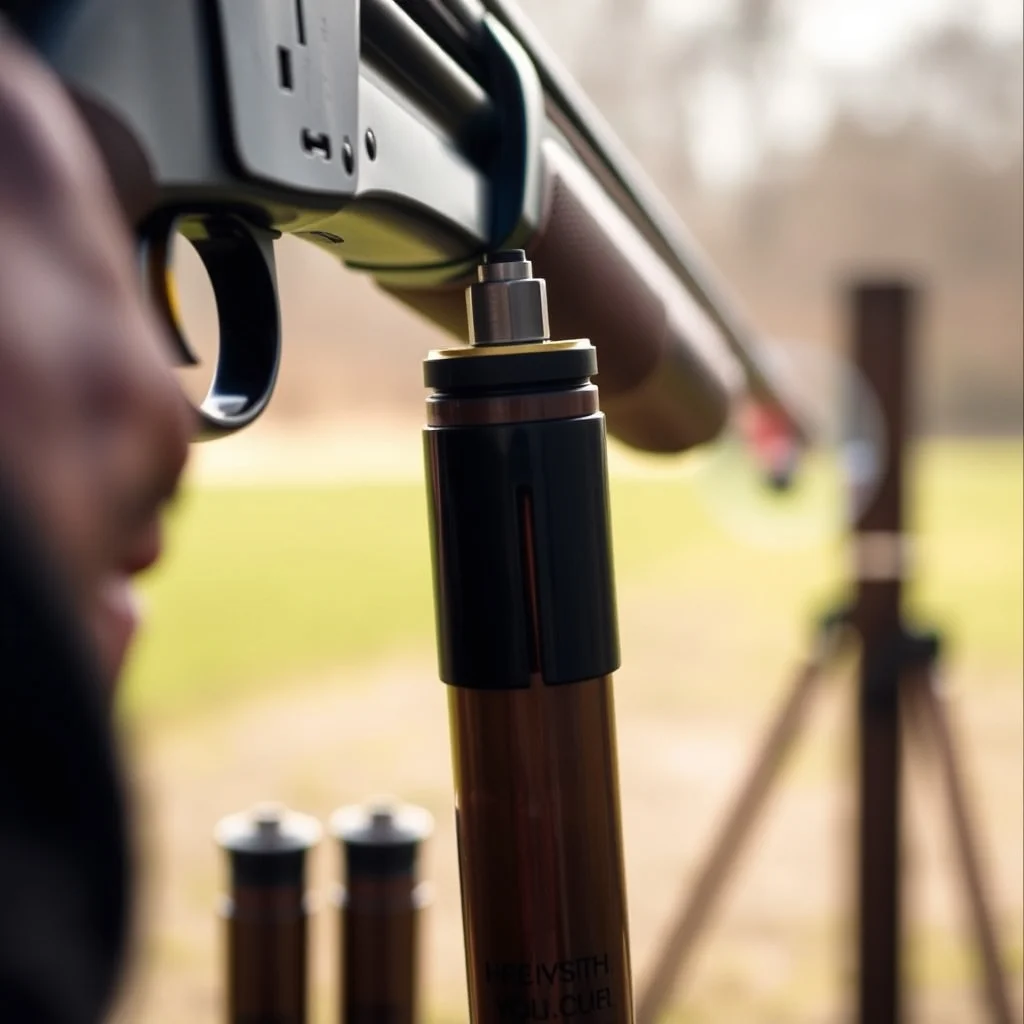
The extended choke tube design — where the tube protrudes slightly beyond the muzzle — is worth considering for sporting clays specifically. Extended chokes are faster to swap with fingers rather than requiring a wrench, which makes station-by-station swapping practical. Standard flush-mount chokes require a wrench or choke key and are harder to change between stations without adding setup time.
When Choke Is Not the Variable to Change
If you are missing consistently at a particular station or distance, spend the first diagnostic pass on lead, not choke. The majority of missed clay targets are missed in front or behind, not because the pattern was wrong size. Pattern a consistent width of misses on a patterning board at the distance of your problem station before you conclude choke is the issue. A centered pattern with the right constriction, combined with consistently late targets, is a lead problem — and a lead problem requires a different fix than a choke problem.
Choke selection is one variable in a multi-variable system. Gun fit, stance, mount consistency, lead calculation, and follow-through all affect where the shot goes. Choke affects how much error margin you have in any direction after the shot is on its way. Get the other variables right first; then optimize choke to match the distances you are actually shooting.
Gear actually worth buying
Smart eBay searches we'd start with ourselves. We earn a small commission on qualifying sales through these links; the price you pay is the same whether you use them or go direct to eBay. Full disclosure.
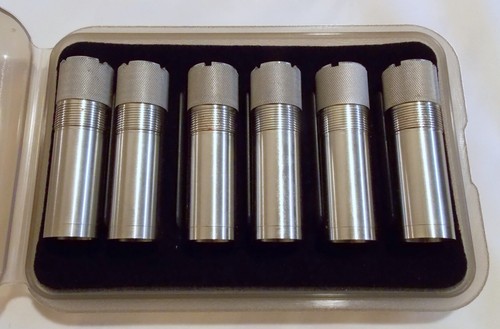 Briley extended choke tubesExtended design means finger-swappable between stations. Available for most Beretta/Benelli and Browning/Winchester thread patterns.
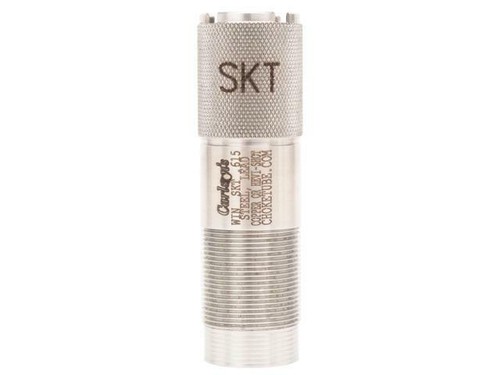 Carlson's choke tubesConsistently accurate constriction at a lower price point than premium custom tubes. Good starting point before investing in a full Briley set.
 Choke tube roll / pouchCarrying 4–6 tubes without a roll means losing one in a bag. A dedicated roll keeps tubes labeled, protected, and accessible between stations.
 Choke tube wrenchRequired for flush-mount tubes; optional for extended. T-handle wrenches are faster than rod-style. Keep one in your shooting vest.
 Patterning targetsPattern your chokes at the distances where you actually shoot. The difference between IC and Modified on paper at 25 yards is more informative than any choke chart.