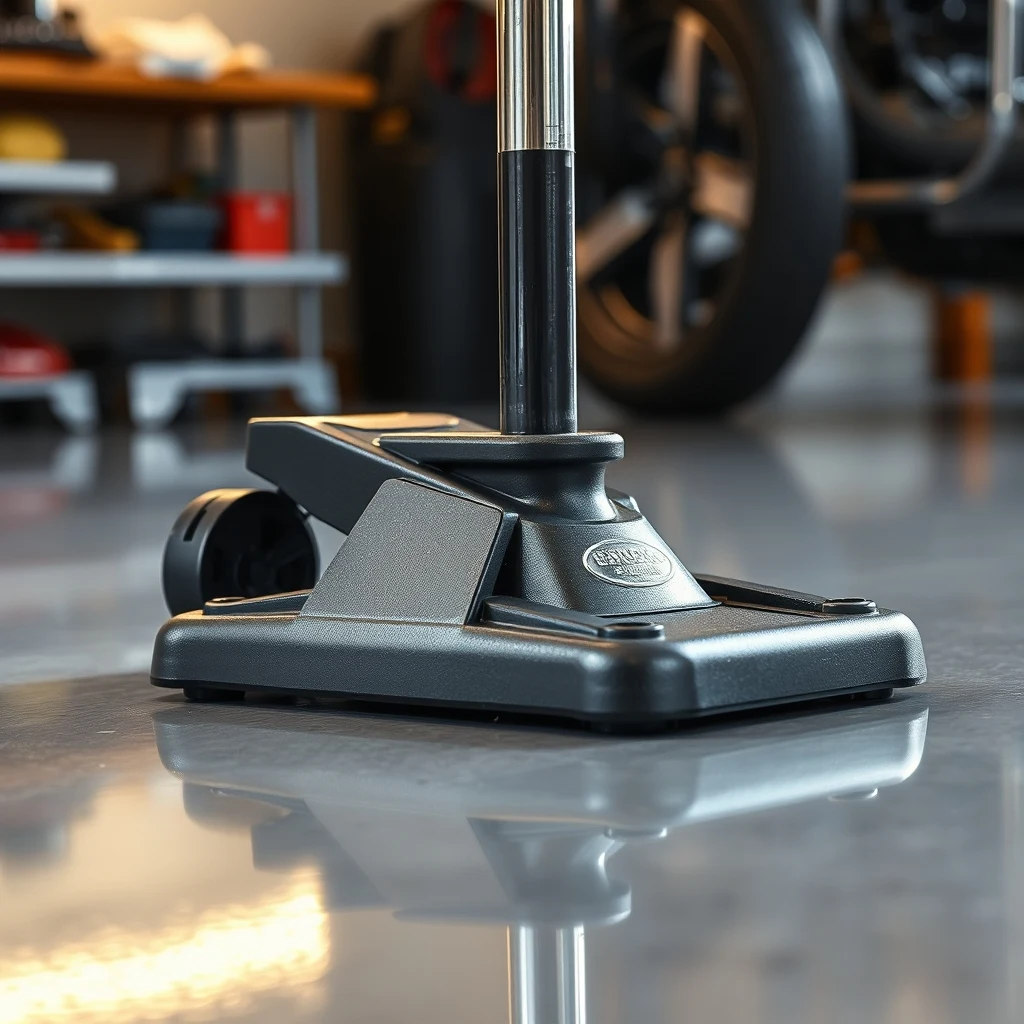
Start with tonnage: what capacity actually means
A floor jack's tonnage rating describes the maximum weight it can lift at the saddle. A 2-ton jack is rated for 4,000 lbs; a 3-ton jack handles 6,000 lbs. The number you need is not your vehicle's total weight — it's the maximum load on one lifting point.
For most passenger cars and crossovers, lifting at a pinch-weld or designated frame point puts roughly 30–40% of the vehicle's total weight on the jack. A 3,800 lb sedan might load a jack with 1,400–1,520 lbs at a front corner lift point — well within a 2-ton rating. But full-size trucks and SUVs change the math considerably. A 6,500 lb truck with weight biased toward the rear could put over 2,000 lbs on a single rear lift point, which exceeds a 2-ton jack's rating.
The practical guide: a 2-ton jack works for most cars under 4,500 lbs GVW. A 3-ton jack covers full-size trucks and SUVs up to around 8,000 lbs GVW and gives more working margin for heavier vehicles. Buying a 2-ton jack to save money on a truck you'll jack quarterly is a false economy.
Minimum lift height: the measurement that's usually ignored
Minimum saddle height — the measurement from the floor to the top of the saddle when fully lowered — determines whether the jack can even fit under your vehicle. This is where many buyers go wrong, especially with lowered or stock sports cars.
A standard floor jack typically sits at 5–6 inches in its lowered position. Many sedans and sports cars have rocker panels 4–5 inches from the ground, and some modified or lowered cars sit even lower than that. A standard-height jack physically cannot fit. You need a low-profile model.
Low-profile floor jacks typically achieve minimum saddle heights of 2.5–3.75 inches, accomplished through angled arm geometry, smaller saddle pads, and narrower base profiles. They usually trade off maximum lift height — a low-profile jack might max out at 18 inches, versus 20–24 for a standard model. For most passenger car work, 18 inches is sufficient. For lifting a truck high enough to remove tires, you may need a standard-height jack or the truck's jack stands at full extension.
| Vehicle Type | Min. Saddle Height Needed | Jack Type |
|---|---|---|
| Stock sedan / crossover | 4.5–5.5 in. | Standard or low-profile |
| Lowered sedan (–1 in. drop) | 3.5–4 in. | Low-profile required |
| Sports car / widebody | 3–3.5 in. | Low-profile required |
| Truck / full-size SUV | 5–6 in. | Standard works fine |
Lift range and pump speed
Lift range (the difference between minimum and maximum saddle height) determines how high you can get the vehicle. Most jobs — tire changes, brake work, oil pans — need 12–16 inches of lift at the jack point. More range helps when working on trucks with large tires or when you need jack stand height well above the rocker panel.
Pump speed matters more than buyers expect. A basic single-stage jack requires 10–15 full pump strokes to reach maximum height. A quick-lift (two-stage or rapid-rise) jack uses a large-bore stage to cover the distance quickly and a smaller bore for the final load-bearing lift, cutting pump strokes roughly in half. If you're doing multiple tire rotations on a service day, that difference is genuinely noticeable.
Most quick-lift mechanisms add modest cost. On low-profile jacks where you're starting from 2.5 inches and lifting 12–15 inches, it's worth paying for.
Aluminum vs steel: weight vs cost
Steel floor jacks are heavier, typically 35–65 lbs for a 3-ton model. They're durable, resist corrosion reasonably well with basic care, and cost significantly less than aluminum equivalents. For a jack that lives in one garage and rarely moves, steel is fine.
Aluminum jacks typically weigh 20–35 lbs for equivalent capacity — a meaningful difference when you're carrying a jack in and out of a vehicle, to a track, or up a ramp. The weight savings come at a cost premium, sometimes 50–100% over a comparable steel model at the same tonnage.
There is no structural safety difference between quality aluminum and steel jacks at comparable ratings. Both materials are more than strong enough when properly engineered. The choice is purely about portability versus budget.
Shopping for floor jacks? Browse current eBay listings → (we earn a small commission; your price is unchanged).
Jack stands: not optional
A hydraulic floor jack is a lifting device, not a support device. All hydraulic cylinders can develop slow leaks, and no responsible technician works under a vehicle supported only by a jack — regardless of brand or price. Jack stands are a separate, required purchase.
Jack stands use a ratchet mechanism or a pin through a notched post to support load mechanically, with no hydraulic fluid involved. They don't drift. They don't leak. They hold their rated capacity until you release them.
Matching tonnage: a pair of 3-ton jack stands is appropriate for any vehicle a 3-ton jack is lifting. You want at least one pair for any chassis work. Two pairs let you lift the full vehicle at four corners simultaneously.
Ratchet-style stands are slightly more convenient — the ratchet locks automatically as you lower the vehicle onto them. Pin-style stands (a single pin through a vertical tube) are simpler and have fewer moving parts to wear. Both work; the practical difference is small.
What to look for on a spec sheet
When comparing specific models, these are the numbers that matter:
- Rated capacity (tons or lbs) — your primary constraint
- Minimum saddle height — determines fitment under your specific vehicle
- Maximum lift height — need at least 16 in. for most truck work
- Saddle diameter — larger saddles give more contact with curved pinch welds
- Weight — relevant if the jack travels
- Quick-lift mechanism — listed as "rapid rise" or "two-stage" in spec sheets
Common mistakes when buying a floor jack
Buying by capacity alone without checking minimum lift height is the most common error — the jack arrives, won't fit under the car, and has to go back. Measure your lowest lift point before ordering.
Buying a 2-ton jack for a 5,500 lb truck to save $30 is the second most common mistake. The math above makes the problem clear.
Buying a jack without simultaneously buying jack stands is a safety error, not just a convenience issue. Budget for both together.
Finally, garage floor quality matters. Hydraulic jacks on soft asphalt or cracked concrete can tilt as the saddle pad sinks slightly under load. A strip of plywood under the jack wheels solves this — cheap insurance on any floor that isn't dead level, solid concrete.
Shop floor jacks on eBay
Current listings across capacity ranges and styles. We earn a small commission on qualifying sales; your price is the same. Full disclosure.
 Low-profile floor jack
For sports cars and lowered vehicles. Min. saddle height typically 2.5–3.5 in.
Hydraulic floor jack
Standard height. Good for trucks, SUVs, and stock-height cars.
Low-profile floor jack
For sports cars and lowered vehicles. Min. saddle height typically 2.5–3.5 in.
Hydraulic floor jack
Standard height. Good for trucks, SUVs, and stock-height cars.
 Jack stands
Required for any under-vehicle work. Match tonnage to your vehicle.
Jack stands
Required for any under-vehicle work. Match tonnage to your vehicle.
 Aluminum floor jack
30–50% lighter than steel. Worth it if portability matters.
Aluminum floor jack
30–50% lighter than steel. Worth it if portability matters.
 3-ton floor jack
The right capacity for full-size trucks and SUVs. Don't undersize.
3-ton floor jack
The right capacity for full-size trucks and SUVs. Don't undersize.