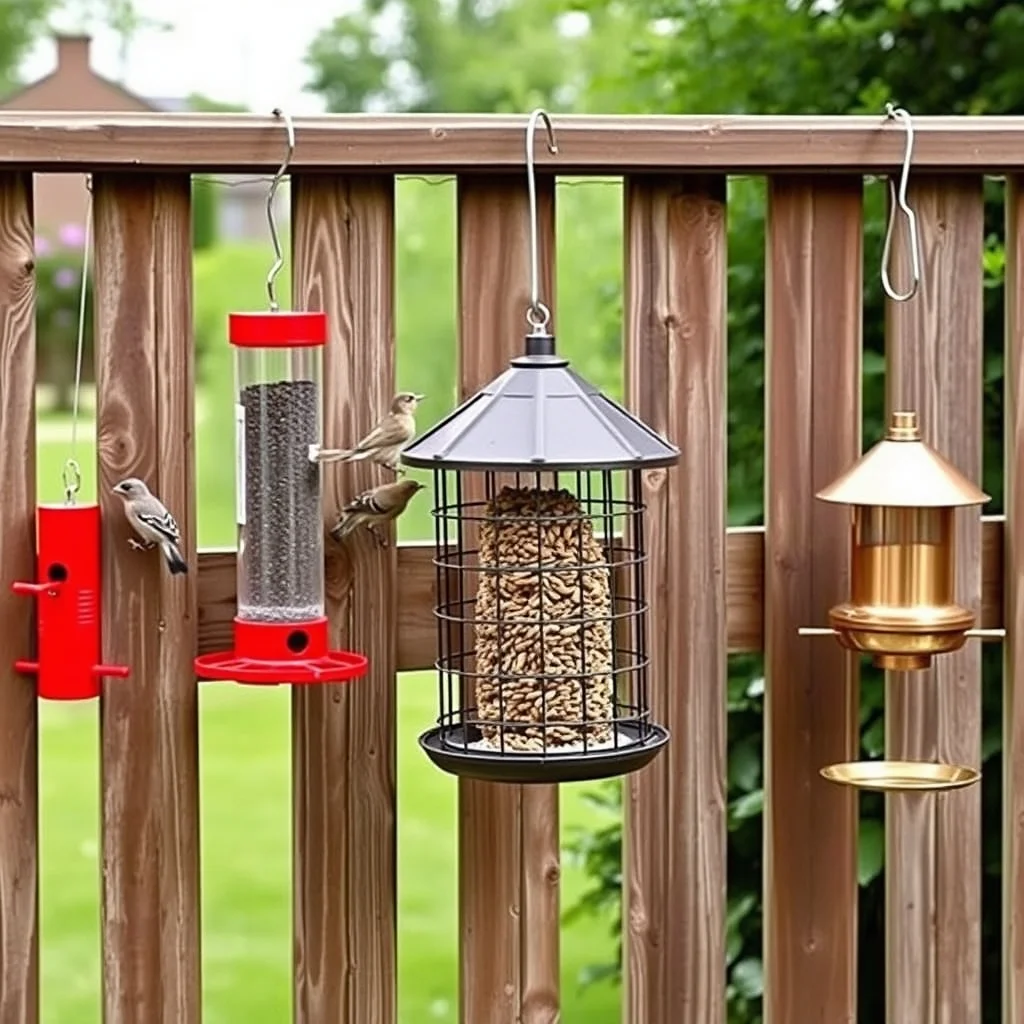
Feeder types: which birds use which style
The four main feeder categories each serve a different set of species based on how those birds naturally forage. Matching feeder to species — rather than buying a general-purpose feeder and hoping for variety — is the most effective thing you can do to attract the birds you want.
Tube feeders
Transparent acrylic or metal cylinders with multiple small perches and feeding ports. The perch-and-port design favors clinging feeders: finches (goldfinch, house finch, purple finch), chickadees, nuthatches, and titmice. Tube feeders are the best choice if you want to attract these smaller, acrobatic species while partially limiting larger birds like grackles that struggle with the small perches.
Tube feeders work best with black oil sunflower seed (high fat content, thin shell easy for small bills to crack) or nyjer/thistle seed (fine black seeds in a narrow-port tube called a thistle feeder or finch sock). Mixed seed tends to result in birds scattering the less-preferred seeds onto the ground.
Hopper feeders
Enclosed seed reservoirs with open trays or perch rails on one or more sides. The larger perch area accommodates bigger-bodied birds: Northern Cardinals (a heavily desired backyard species), Blue Jays, mourning doves, and dark-eyed juncos. Hoppers are the most species-diverse design and the format most commonly pictured in marketing photos for exactly that reason.
The downside is that hoppers are harder to keep dry — seed in the hopper can clump or mold if the feeder isn't well-ventilated. Look for hoppers with a sloped seed floor, drainage holes in the tray, and a roof overhang that keeps rain off the feeding tray. Quality hoppers with these features need less frequent emptying and cleaning than budget designs that pool water.
Platform and tray feeders
Open flat trays that attract the widest range of species, including ground-feeding birds that don't naturally visit hanging feeders: mourning doves, white-throated sparrows, fox sparrows, towhees, and even some thrushes. Platform feeders are the least squirrel-resistant design (no physical barrier whatsoever) but the most inclusive for species variety.
They work best mounted low to the ground on a post (for true ground feeders) or at a medium height on a pole. Because they're open, platform feeders need to be cleaned more frequently than enclosed hoppers — seed exposed to weather turns moldy faster, and bird droppings accumulate directly in the food.
Suet cage feeders
Wire or plastic cages that hold rendered suet cakes (and suet-seed mixtures). Suet is a high-energy winter food that specifically attracts insect-eating birds: woodpeckers (Downy, Hairy, Red-bellied, and sometimes Pileated), nuthatches, creepers, and in some regions Carolina Wrens. Suet feeders are the single most reliable way to attract woodpeckers.
Standard suet cages hold one or two commercially available suet cakes. "Tail-prop" models include a wooden panel below the cage where woodpeckers can brace their tails while feeding — this design attracts larger woodpecker species that prefer a more vertical feeding posture. Avoid suet in summer in warm climates; suet goes rancid quickly in heat and can harm birds. No-melt suet formulations extend the warm-weather window.
| Feeder type | Best species | Best seed/food |
|---|---|---|
| Tube feeder | Goldfinch, chickadee, nuthatch, titmouse | Black oil sunflower, nyjer |
| Hopper feeder | Cardinal, Blue Jay, junco, dove | Black oil sunflower, safflower |
| Platform/tray | Sparrows, towhees, doves, thrushes | Millet, sunflower, mixed |
| Suet cage | Woodpeckers, creepers, nuthatches | Rendered suet cakes |
| Nectar (hummingbird) | Ruby-throated hummingbird, others by region | 1:4 white sugar/water solution |
Seed selection: what drives species diversity
The single best all-purpose seed for most North American feeders is black oil sunflower seed. The thin shell is crackable by birds as small as chickadees; the high fat content makes it attractive to a wide range of species; and it creates less waste than mixed seed because virtually every bird that visits will eat it. Cardinals prefer it. Finches prefer it. Nuthatches prefer it. It's the closest thing to a universal seed for the hopper-and-tube feeder combination.
The seeds to be cautious about in mixed bird seed bags: milo (red/brown round seeds) is heavily filler, eaten mainly by ground-feeding birds in the Southwest and largely ignored in the East and Midwest; wheat and oats are similarly low-preference for most desired species. The cheaper the mixed bag, the higher the filler seed content, and the more seed ends up scattered on the ground where it rots.
Nyjer / thistle for finches
Nyjer seed (sold as thistle, though it's actually sterilized African yellow daisy seed imported under USDA permit) is the specific seed for goldfinches, house finches, and purple finches at tube feeders with narrow ports. It's expensive relative to other seeds but attractive to very few non-target species, which means less competition and less waste. Nyjer spoils faster than sunflower; buy in smaller quantities and refresh frequently.
Safflower to deter starlings and grackles
Safflower seed is accepted by cardinals, house finches, and some doves, but most starlings, grackles, and House Sparrows reject it. If aggressive common birds are dominating your feeders, switching a hopper to pure safflower is one of the more effective ways to reduce competition without eliminating other desired species.
Shopping for bird feeders? Browse current eBay listings → (we earn a small commission; your price is unchanged).
Squirrel-proofing: what actually works
Squirrel-proofing is one of the most heavily marketed categories in bird feeding and one of the most frequently disappointing. The reason: most products work in specific physical configurations and fail in others. A baffle that stops a squirrel in one yard is irrelevant if the feeder is installed differently in another. Understanding the mechanism of each approach is the only way to know whether it will work in your setup.
Weight-sensitive shutoff mechanisms
Several well-known feeder designs (Squirrel Buster, Brome models, and similar) close their seed ports when an animal above a set weight — typically around 1.5–3 oz, calibrated to exclude squirrels (~12–21 oz) while allowing small birds (chickadees ~0.4 oz, goldfinches ~0.5 oz) — sits on the perch ring. The mechanism is a spring-loaded outer sleeve: bird weight releases the ports; squirrel weight closes them.
These feeders genuinely work in the configuration they're designed for. They fail if: (1) the squirrel learns to hang from the top rather than sitting on the perch, (2) the squirrel is exceptionally small (juvenile squirrels approach the perch-weight threshold), or (3) raccoons trigger the closure by pulling the whole feeder. For most setups with adult gray squirrels, weight-sensitive feeders are effective and low-maintenance.
Baffles on poles
A physical dome or cylinder baffle mounted below a hanging feeder, or a cylindrical wrap around the pole, physically prevents squirrels from climbing to the feeder. This approach requires specific geometry to work: the baffle must be at least 4 feet off the ground (to prevent jump access from below) and the feeder must be at least 10 feet from any structure, fence, or tree limb squirrels can use as a launch point.
The 4/10 rule is widely cited in birding communities: 4 feet minimum height, 10 feet minimum distance from anything squirrels can jump from. Both conditions together are necessary; meeting only one is not sufficient. If your installation can satisfy both, a metal torpedo baffle is reliable and permanent. Most feeders hung from a shepherd's hook in the middle of a lawn can meet these requirements.
Caged feeders
A wire cage surrounding the feeder allows small birds to pass through to the seed while physically excluding squirrels and larger birds like starlings and grackles. The cage mesh size is the critical variable: standard 1.5" × 1.5" mesh excludes squirrels and most large birds while admitting chickadees, nuthatches, and finches. Smaller mesh (1" × 1") excludes more species including some medium-sized birds; larger mesh lets in more birds but may not reliably exclude juvenile squirrels.
Caged feeders are effective and don't depend on pole geometry, making them more versatile for difficult installation contexts like balconies or overhanging branches. They don't work for large-bodied desired species like cardinals or jays, which cannot fit through the cage.
Nectar feeders for hummingbirds
Hummingbird feeders are their own category with different maintenance requirements than seed feeders. The nectar solution (standard ratio: 1 part white cane sugar to 4 parts water, boiled to dissolve and then cooled) should be changed every 3–5 days in warm weather to prevent fermentation and mold growth, which can harm hummingbirds. In hot summer temperatures, change every 2 days.
Red dye is not necessary and should be avoided — plain clear sugar water with a red feeder is preferred. Look for feeders with wide-mouth reservoirs you can fully reach inside to scrub (test this before buying; narrow-mouth designs accumulate black mold in unreachable areas). Dish-style (saucer) feeders are generally easier to clean than bottle-style feeders because the entire feeding surface is accessible.
Placement: what actually brings birds in
Window strikes kill an estimated 600 million birds annually in the United States. Feeder placement relative to windows matters significantly: feeders placed within 3 feet of a window reduce strike fatalities because birds that startle off the feeder don't have room to reach a dangerous speed before encountering glass. Feeders placed more than 30 feet from a window also reduce strikes because birds aren't in the window reflection zone. The dangerous zone is 3–30 feet from a window — that's where most strikes happen.
Additional placement considerations: feeders near cover (dense shrubs, brush pile within 10–15 feet) give birds a place to watch from and retreat to, which increases feeder use. Open exposure with no nearby cover reduces bird activity as birds are reluctant to approach a completely exposed feeding station. Seed scattered under the feeder attracts ground feeders; a tray placed below a hopper catches dropped seed and reduces waste.


